







Question: Show all work for all problems Show your solution steps of each problems. Please do not just show the final answer 1. n class we
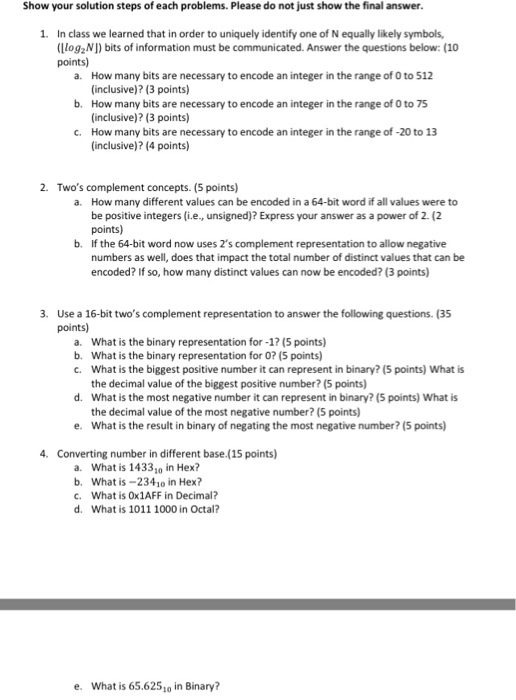
Show your solution steps of each problems. Please do not just show the final answer 1. n class we learned that in order to uniquely identify one of N equally likely symbols (llog2N]) bits of information must be communicated. Answer the questions below: (10 points) How many bits are necessary to encode an integer in the range of O to 512 (inclusive)? (3 points) How many bits are necessary to encode an integer in the range of O to 75 (inclusive)? (3 points) How many bits are necessary to encode an integer in the range of -20 to 13 (inclusive)? (4 points) a. b. c. 2. Two's complement concepts. (5 points) How many different values can be encoded in a 64-bit word if all values were to be positive integers (i.e., unsigned)? Express your answer as a power of 2-(2 points) If the 64-bit word now uses 2's complement representation to allow negative numbers as well, does that impact the total number of distinct values that can be encoded? If so, how many distinct values can now be encoded? (3 points) a. b. 3. Use a 16-bit two's complement representation to answer the following questions. (35 points) a. b. c. What is the binary representation for -1? (5 points) What is the binary representation for 0? (5 points) What is the biggest positive number it can represent in binary? (5 points) What is the decimal value of the biggest positive number? (5 points) d. What is the most negative number it can represent in binary? (5 points) What is the decimal value of the most negative number? (5 points) What is the result in binary of negating the most negative number? (5 points) e. 4. Converting number in different base.(15 points) a. What is 143310 in Hex? b. What is-23410 in Hex? c. What is 0x1AFF in Decimal? d. What is 1011 1000 in Octal? e. What is 65.62510 in Binary
Step by Step Solution
There are 3 Steps involved in it

Get step-by-step solutions from verified subject matter experts
 Study Help