





Question: Show all work In many services, the acquisition and allocation of capacity plays a significant role in determining the level of operational responsiveness. Our purpose

Show all work
Show all work In many services, the acquisition

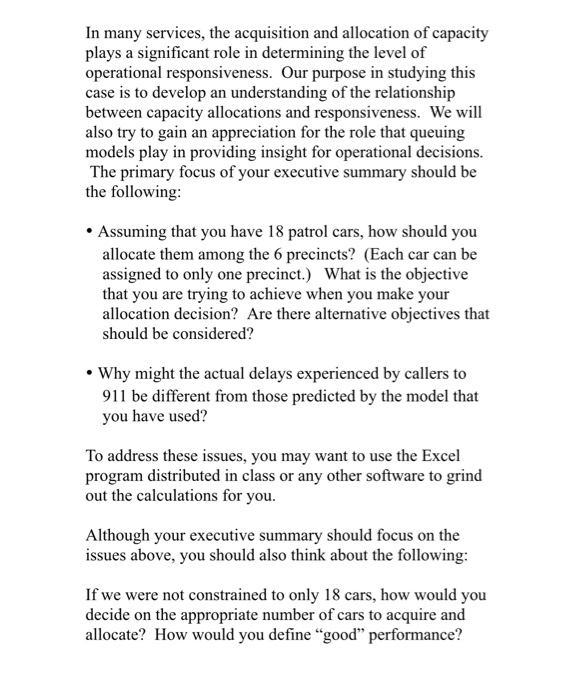
In many services, the acquisition and allocation of capacity plays a significant role in determining the level of operational responsiveness. Our purpose in studying this case is to develop an understanding of the relationship between capacity allocations and responsiveness. We will also try to gain an appreciation for the role that queuing models play in providing insight for operational decisions. The primary focus of your executive summary should be the following: Assuming that you have 18 patrol cars, how should you allocate them among the 6 precincts? (Each car can be assigned to only one precinct.) What is the objective that you are trying to achieve when you make your allocation decision? Are there alternative objectives that should be considered? Why might the actual delays experienced by callers to 911 be different from those predicted by the model that you have used? To address these issues, you may want to use the Excel program distributed in class or any other software to grind out the calculations for you. Although your executive summary should focus on the issues above, you should also think about the following: If we were not constrained to only 18 cars, how would you decide on the appropriate number of cars to acquire and allocate? How would you define "good" performance? In many services, the acquisition and allocation of capacity plays a significant role in determining the level of operational responsiveness. Our purpose in studying this case is to develop an understanding of the relationship between capacity allocations and responsiveness. We will also try to gain an appreciation for the role that queuing models play in providing insight for operational decisions. The primary focus of your executive summary should be the following: Assuming that you have 18 patrol cars, how should you allocate them among the 6 precincts? (Each car can be assigned to only one precinct.) What is the objective that you are trying to achieve when you make your allocation decision? Are there alternative objectives that should be considered? Why might the actual delays experienced by callers to 911 be different from those predicted by the model that you have used? To address these issues, you may want to use the Excel program distributed in class or any other software to grind out the calculations for you. Although your executive summary should focus on the issues above, you should also think about the following: If we were not constrained to only 18 cars, how would you decide on the appropriate number of cars to acquire and allocate? How would you define "good" performance

Step by Step Solution

There are 3 Steps involved in it

1 Expert Approved Answer
Step: 1 Unlock blur-text-image

Question Has Been Solved by an Expert!

Get step-by-step solutions from verified subject matter experts

Step: 2 Unlock
Step: 3 Unlock

Students Have Also Explored These Related General Management Questions!