







Question: Show all working please. Copied answer will be downvoted immediately. Original answer with effort applied = upvote. Let cR+. Consider the maximization problem maxx,yRxy4s.t.xey3e2,cy,x0,y0. (h)
Show all working please. Copied answer will be downvoted immediately. Original answer with effort applied = upvote.

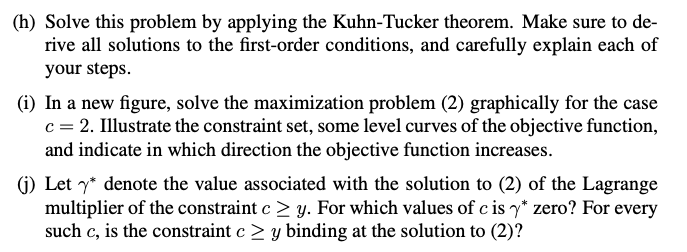
Let cR+. Consider the maximization problem maxx,yRxy4s.t.xey3e2,cy,x0,y0. (h) Solve this problem by applying the Kuhn-Tucker theorem. Make sure to derive all solutions to the first-order conditions, and carefully explain each of your steps. (i) In a new figure, solve the maximization problem (2) graphically for the case c=2. Illustrate the constraint set, some level curves of the objective function, and indicate in which direction the objective function increases. (j) Let denote the value associated with the solution to (2) of the Lagrange multiplier of the constraint cy. For which values of c is zero? For every such c, is the constraint cy binding at the solution to (2)? Let cR+. Consider the maximization problem maxx,yRxy4s.t.xey3e2,cy,x0,y0. (h) Solve this problem by applying the Kuhn-Tucker theorem. Make sure to derive all solutions to the first-order conditions, and carefully explain each of your steps. (i) In a new figure, solve the maximization problem (2) graphically for the case c=2. Illustrate the constraint set, some level curves of the objective function, and indicate in which direction the objective function increases. (j) Let denote the value associated with the solution to (2) of the Lagrange multiplier of the constraint cy. For which values of c is zero? For every such c, is the constraint cy binding at the solution to (2)
Step by Step Solution
There are 3 Steps involved in it

Get step-by-step solutions from verified subject matter experts
 Study Help