







Question: In a study of palatability of antibiotics for children, Doreen Matsui and her colleagues used a voluntary sample of healthy children to assess their
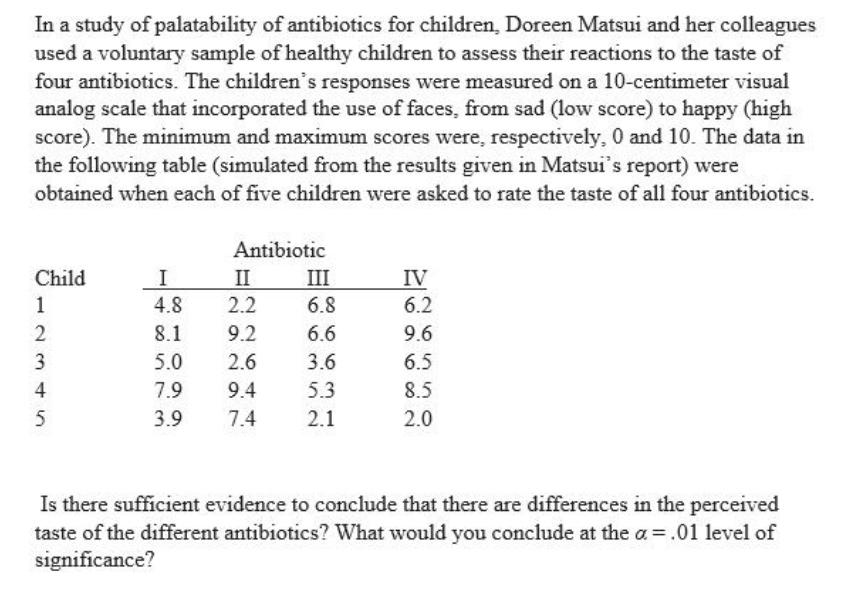
In a study of palatability of antibiotics for children, Doreen Matsui and her colleagues used a voluntary sample of healthy children to assess their reactions to the taste of four antibiotics. The children's responses were measured on a 10-centimeter visual analog scale that incorporated the use of faces, from sad (low score) to happy (high score). The minimum and maximum scores were, respectively, 0 and 10. The data in the following table (simulated from the results given in Matsui's report) were obtained when each of five children were asked to rate the taste of all four antibiotics. Antibiotic III 6.8 Child I II IV 6.2 1 4.8 2.2 2 8.1 9.2 6.6 9.6 3 5.0 2.6 3.6 6.5 4 7.9 9.4 5.3 8.5 3.9 7.4 2.1 2.0 Is there sufficient evidence to conclude that there are differences in the perceived taste of the different antibiotics? What would you conclude at the a =.01 level of significance?
Step by Step Solution
3.43 Rating (159 Votes )
There are 3 Steps involved in it
Critical valu... View full answer

Get step-by-step solutions from verified subject matter experts
 Study Help