







Question: Show me the steps to solve and do not use AI to answer, i will use AI detector to check it for my schoolwork. Thanks.
Show me the steps to solve and do not use AI to answer, i will use AI detector to check it for my schoolwork. Thanks.
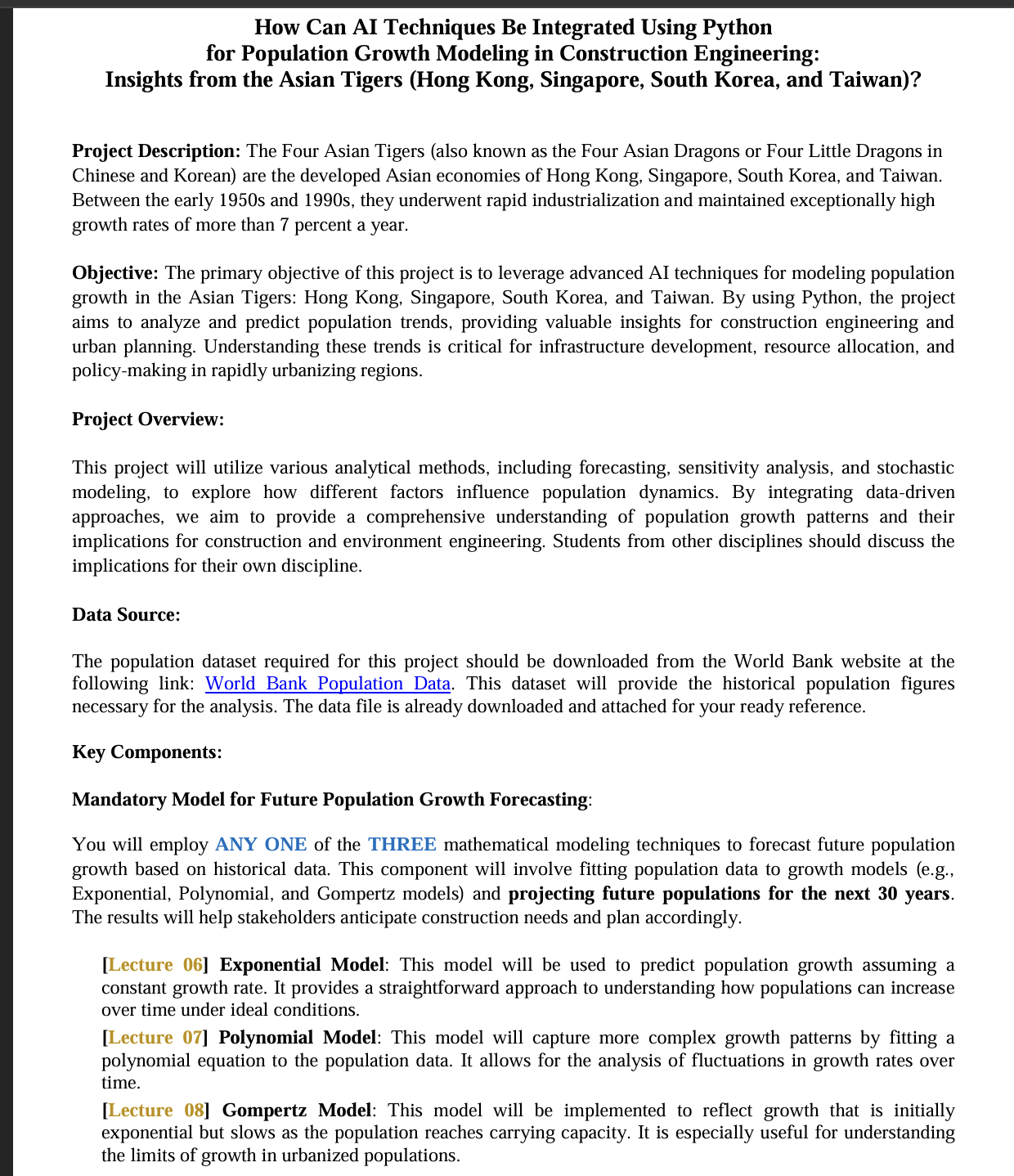
How Can AI Techniques Be Integrated Using Python for Population Growth Modeling in Construction Engineering: Insights from the Asian Tigers Hong Kong, Singapore, South Korea, and Taiwan
Project Description: The Four Asian Tigers also known as the Four Asian Dragons or Four Little Dragons in Chinese and Korean are the developed Asian economies of Hong Kong, Singapore, South Korea, and Taiwan. Between the early s and s they underwent rapid industrialization and maintained exceptionally high growth rates of more than percent a year.
Objective: The primary objective of this project is to leverage advanced AI techniques for modeling population growth in the Asian Tigers: Hong Kong, Singapore, South Korea, and Taiwan. By using Python, the project aims to analyze and predict population trends, providing valuable insights for construction engineering and urban planning. Understanding these trends is critical for infrastructure development, resource allocation, and policymaking in rapidly urbanizing regions.
Project Overview:
This project will utilize various analytical methods, including forecasting, sensitivity analysis, and stochastic modeling, to explore how different factors influence population dynamics. By integrating datadriven approaches, we aim to provide a comprehensive understanding of population growth patterns and their implications for construction and environment engineering. Students from other disciplines should discuss the implications for their own discipline.
Data Source:
The population dataset required for this project should be downloaded from the World Bank website at the following link: World Bank Population Data. This dataset will provide the historical population figures necessary for the analysis. The data file is already downloaded and attached for your ready reference.
Key Components:
Mandatory Model for Future Population Growth Forecasting:
You will employ ANY ONE of the THREE mathematical modeling techniques to forecast future population growth based on historical data. This component will involve fitting population data to growth models eg Exponential, Polynomial, and Gompertz models and projecting future populations for the next years. The results will help stakeholders anticipate construction needs and plan accordingly.
Lecture Exponential Model: This model will be used to predict population growth assuming a constant growth rate. It provides a straightforward approach to understanding how populations can increase over time under ideal conditions.
Lecture Polynomial Model: This model will capture more complex growth patterns by fitting a polynomial equation to the population data. It allows for the analysis of fluctuations in growth rates over time.
Lecture Gompertz Model: This model will be implemented to reflect growth that is initially exponential but slows as the population reaches carrying capacity. It is especially useful for understanding the limits of growth in urbanized populations.
Instructions:
Data Acquisition:
Obtain population data for the Asian Tigers from reputable demographic databases such as the
World Bank. The data should include annual population figures for each Asian Tiger.
Environment Setup:
Ensure Python is installed along with necessary libraries. If not installed, execute the following
command in your terminal: pip install pandas numpy matplotlib scipy scikitlearn
Loading the Data:
Load the CSV file containing the population data into a pandas DataFrame, ensuring that the first
row is treated as headers, which will include Asian Tigers and years.
Data Preprocessing:
Filter the DataFrame to include only the four Asian Tigers: Hong Kong, Singapore, South Korea,
and Taiwan.
Transpose the DataFrame so that years become the index and Asian Tigers names become
column headers, simplifying data manipulation for modeling.
Model Definition:
Define three mathematical models for population growth analysis:
Exponential Growth Model: This model assumes that the population grows at a rate
proportional to its current size, reflecting rapid urbanization.
Polynomial Model: A polynomial regression model that fits a quadratic curve to the
population data, capturing more complex growth patterns.
Gompertz Model: A sigmoidal model that represents growth processes, particularly
useful for populations that grow rapidly and then level off.
Model Fitting:
For each of the four Asian Tigers, fit all three models to the population data. Use the curvefit
function from the scipy.optimize library to determine the optimal parameters for each model.
Prediction:
Extend the predictions for the next years based on the fitted models. Create a range of future
years for visualization purposes.
Visualization:
Create a comprehensive subplot for each of the four Asian Tigers.
Step by Step Solution
There are 3 Steps involved in it
1 Expert Approved Answer
Step: 1 Unlock

Question Has Been Solved by an Expert!
Get step-by-step solutions from verified subject matter experts
Step: 2 Unlock
Step: 3 Unlock
 Study Help