







Question: Show solution on the solving part and explain your answer on the multiple choice each MULTIPLE CHOICE. Test IA. Read each item carefully. Determine what
Show solution on the solving part and explain your answer on the multiple choice each
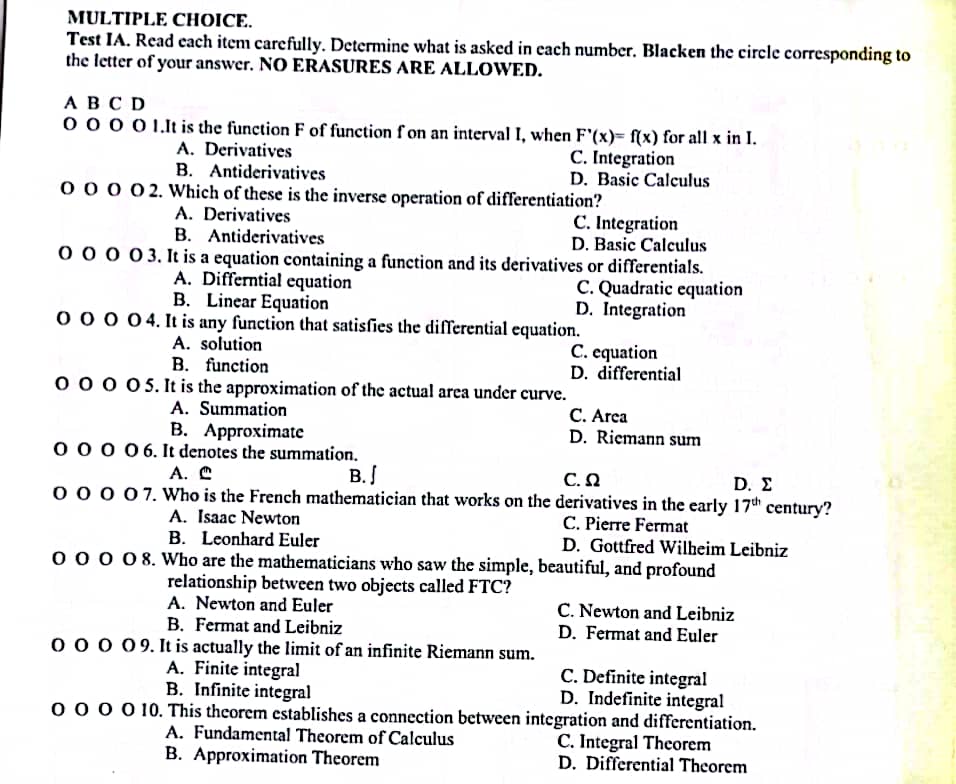
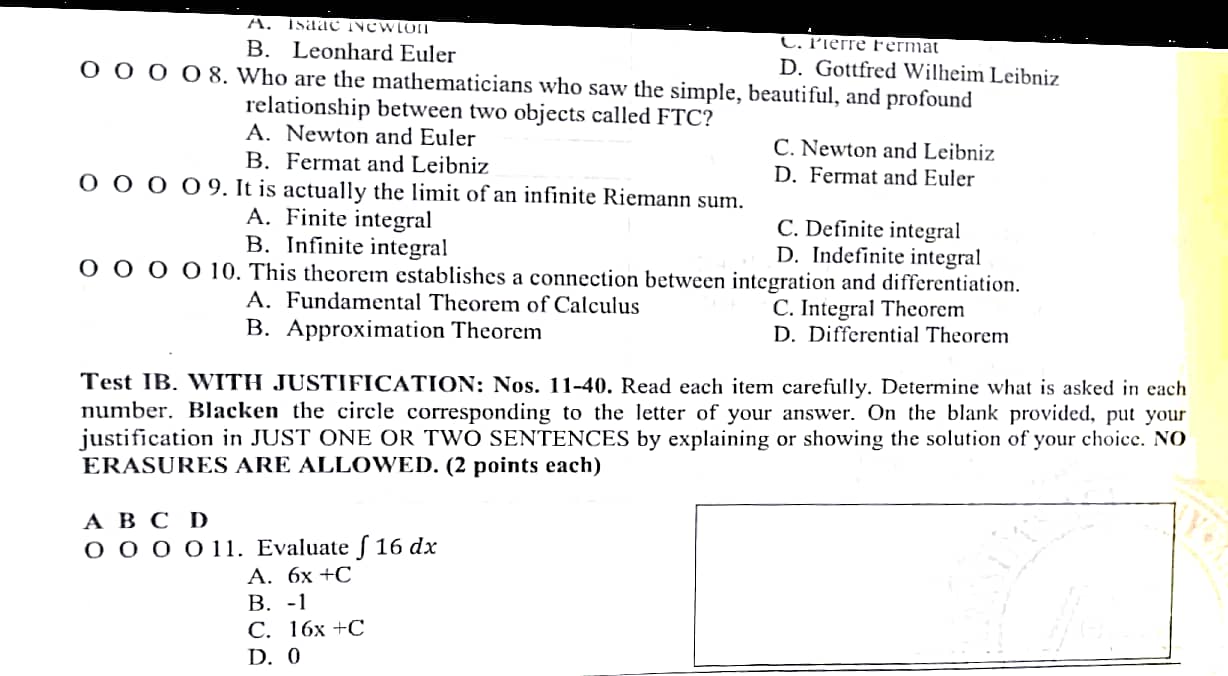
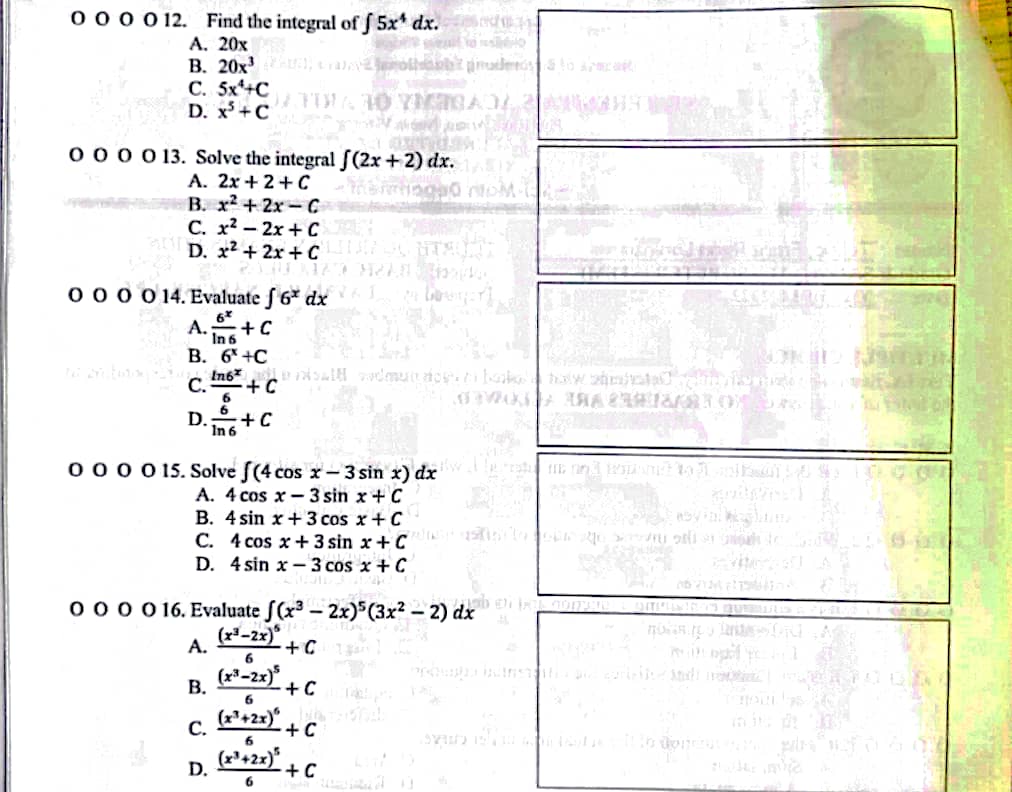
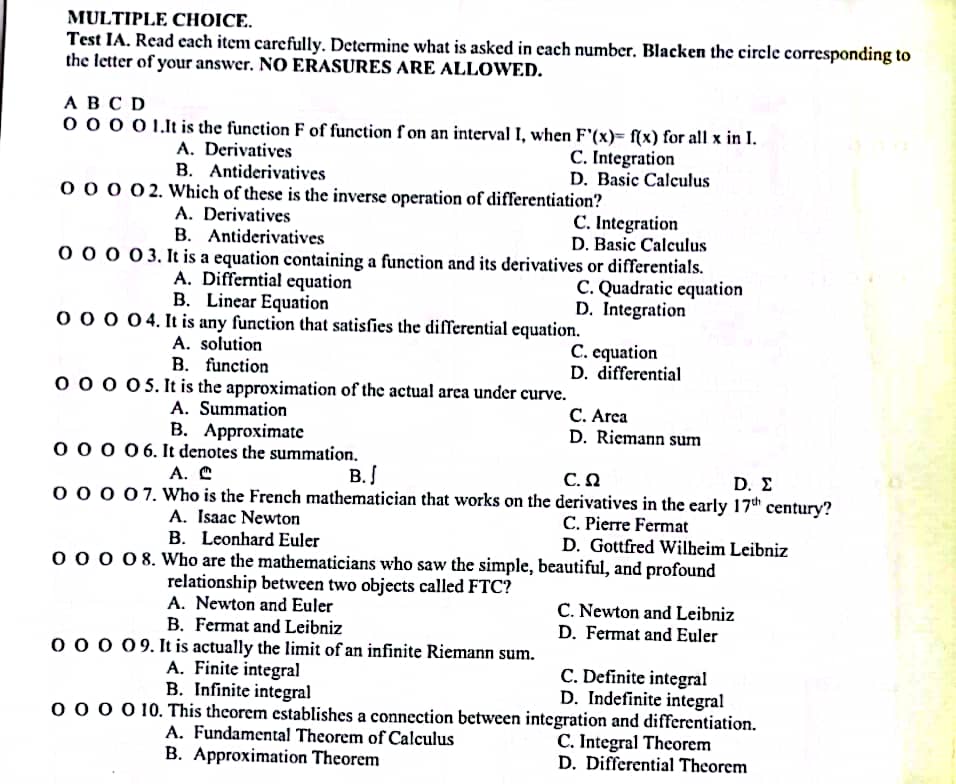
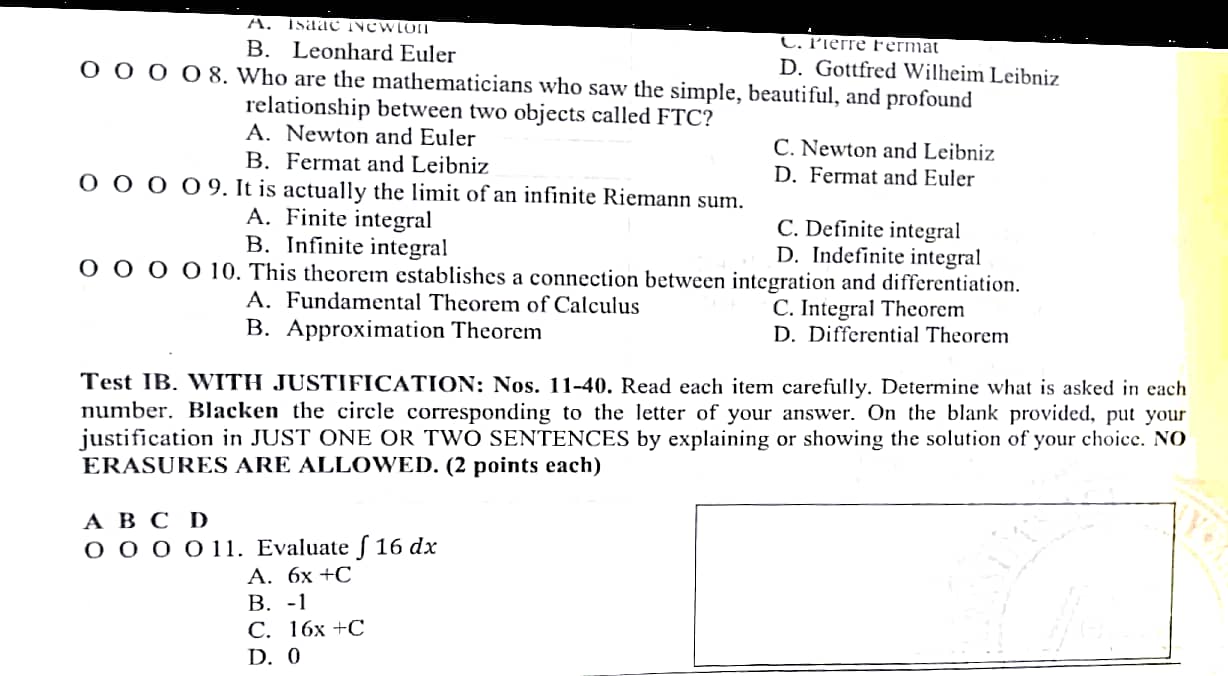
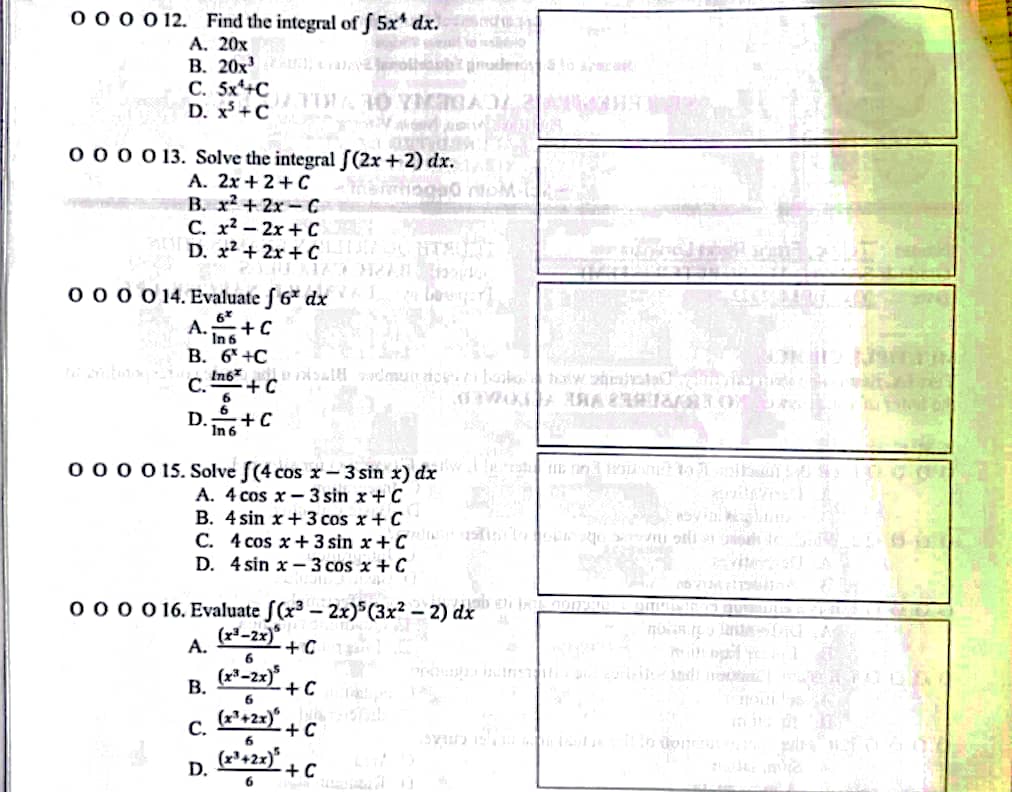
MULTIPLE CHOICE. Test IA. Read each item carefully. Determine what is asked in each number. Blacken the circle corresponding to the letter of your answer. NO ERASURES ARE ALLOWED. ABCD O O O O I. It is the function F of function fon an interval I, when F'(x)= f(x) for all x in I. A. Derivatives C. Integration B. Antiderivatives D. Basic Calculus O O O O 2. Which of these is the inverse operation of differentiation? A. Derivatives C. Integration B. Antiderivatives D. Basic Calculus O O O O 3. It is a equation containing a function and its derivatives or differentials. A. Differntial equation C. Quadratic equation B. Linear Equation D. Integration O O O O 4. It is any function that satisfies the differential equation. A. solution C. equation B. function D. differential O O O O 5. It is the approximation of the actual area under curve. A. Summation C. Area B. Approximate D. Riemann sum O O O O 6. It denotes the summation. A. C B. J C. Q D. E O O O 0 7. Who is the French mathematician that works on the derivatives in the early 17" century? A. Isaac Newton C. Pierre Fermat B. Leonhard Euler D. Gottfred Wilheim Leibniz 0 0 0 0 8. Who are the mathematicians who saw the simple, beautiful, and profound relationship between two objects called FTC? A. Newton and Euler C. Newton and Leibniz B. Fermat and Leibniz D. Fermat and Euler O O O O 9. It is actually the limit of an infinite Riemann sum. A. Finite integral C. Definite integral B. Infinite integral D. Indefinite integral O O O O 10. This theorem establishes a connection between integration and differentiation. A. Fundamental Theorem of Calculus C. Integral Theorem B. Approximation Theorem D. Differential TheoremA. isaac Newton L. Pierre Fermat B. Leonhard Euler D. Gottfred Wilheim Leibniz O O O O 8. Who are the mathematicians who saw the simple, beautiful, and profound relationship between two objects called FTC? A. Newton and Euler C. Newton and Leibniz B. Fermat and Leibniz D. Fermat and Euler O O O 0 9. It is actually the limit of an infinite Riemann sum. A. Finite integral C. Definite integral B. Infinite integral D. Indefinite integral O O O O 10. This theorem establishes a connection between integration and differentiation. A. Fundamental Theorem of Calculus C. Integral Theorem B. Approximation Theorem D. Differential Theorem Test IB. WITH JUSTIFICATION: Nos. 11-40. Read each item carefully. Determine what is asked in each number. Blacken the circle corresponding to the letter of your answer. On the blank provided, put your justification in JUST ONE OR TWO SENTENCES by explaining or showing the solution of your choice. NO ERASURES ARE ALLOWED. (2 points each) ABCD O O O Ol1. Evaluate f 16 dx A. 6x +C B. -1 C. 16x +C D. 00 0 0 0 12. Find the integral of f 5x* dx. A. 20x C. 5x +C D. X + C 0 0 0 0 13. Solve the integral f (2x + 2) dx. 1/817 A. 2x + 2+C B. x2 + 2x - C C. x2 - 2x + C an D. x2 + 2x + C 0 0 0 0 14. Evaluate * dx A. +C B. 6* +C C. + C 6 D. =+c In 6 0 0 0 0 15. Solve S(4cos x - 3sin x)dxa A. 4 cos x - 3 sin x + C B. 4 sin x + 3 cos x + C C. 4 cos x + 3 sin x + C D. 4 sin x - 3 cos x + C O O 0 0 16. Evaluate S (x3 - 2x)5(3x2 -2) dx ab Of A. (x]-2x) + C 6 B. (x*-2x) + c C. (x*+2x) + C D. (x'+2x)+ C 6
Step by Step Solution
There are 3 Steps involved in it

Get step-by-step solutions from verified subject matter experts
 Study Help