







Question: Show that the grammars S - > aSb | bSa | SS | a and S - > aSb | bSa | a are not
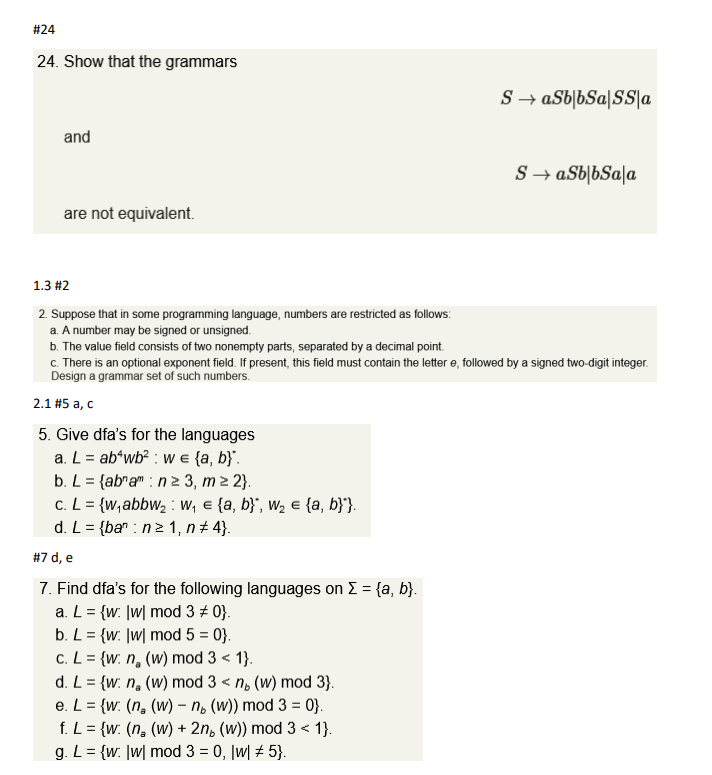
Show that the grammars
SaSbbSaSSa
and
SaSbbSaa
are not equivalent.
#
Suppose that in some programming language, numbers are restricted as follows:
a A number may be signed or unsigned.
b The value field consists of two nonempty parts, separated by a decimal point.
c There is an optional exponent field. If present, this field must contain the letter theta followed by a signed twodigit integer.
Design a grammar set of such numbers.
# a c
Give dfa's for the languages
a Labwb:winab
b Labnam:nm
c Lwabbw:winabwinab
d Lban:nn
# de
Find dfa's for the following languages on Sigma ab
a Lwwmod
b Lw:wmod
c Lwnawmod
d LwnawnbwmodLw:nawnbwmodLwwmodw
Step by Step Solution
There are 3 Steps involved in it
1 Expert Approved Answer
Step: 1 Unlock

Question Has Been Solved by an Expert!
Get step-by-step solutions from verified subject matter experts
Step: 2 Unlock
Step: 3 Unlock
 Study Help