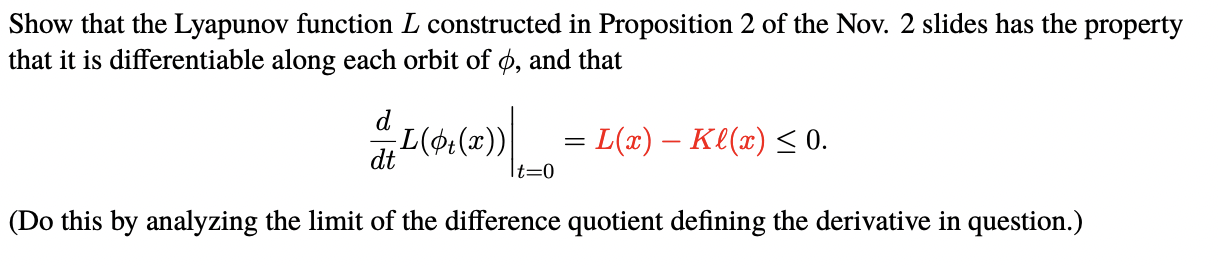
Question: Show that the Lyapunov function L constructed in Proposition 2 of the Nov. 2 slides has the property that it is differentiable along each orbit
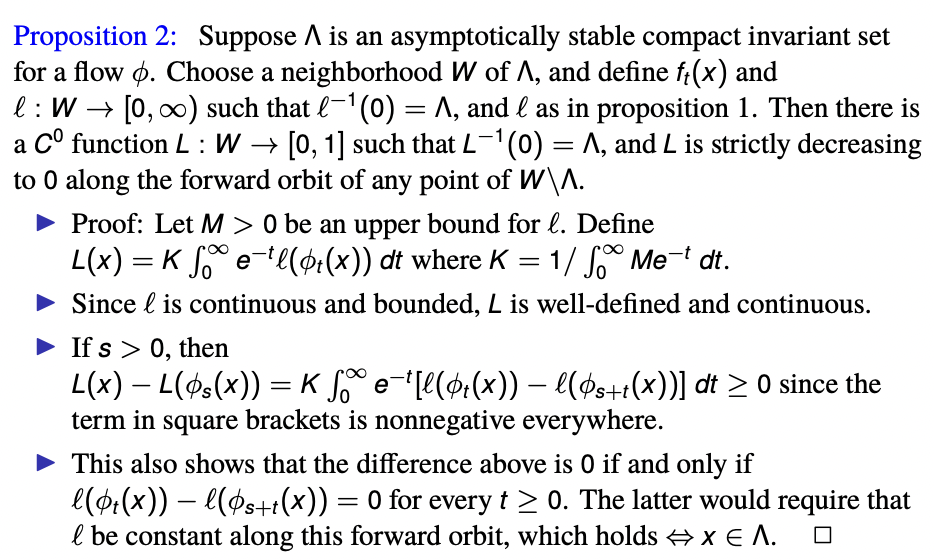
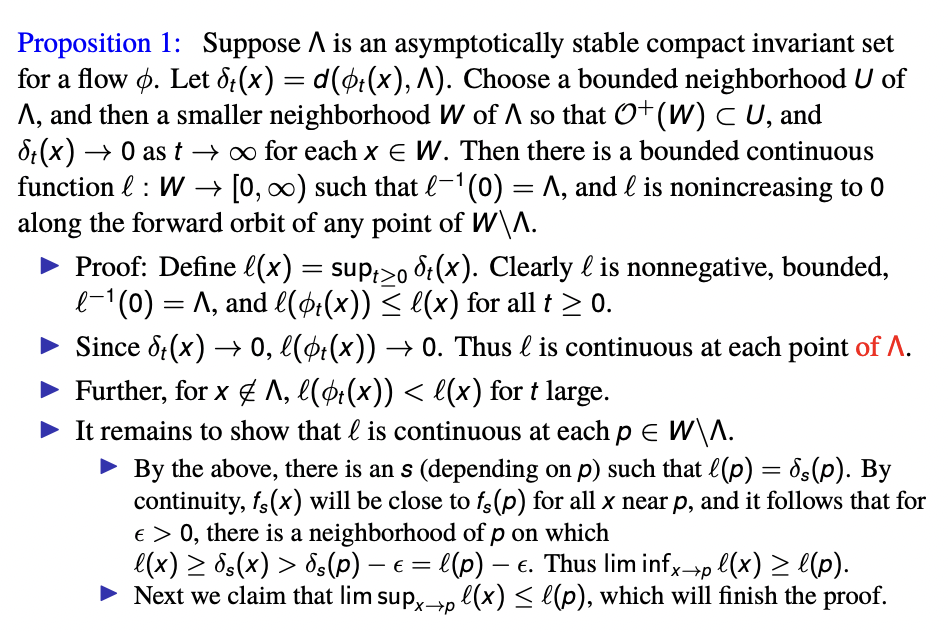
Show that the Lyapunov function L constructed in Proposition 2 of the Nov. 2 slides has the property that it is differentiable along each orbit of g6, and that imam) = Mm) Kw) [0, 00) such that E\" (0) = A, and E as in proposition 1. Then there is a 0 function L : W > [0, 1] such that L_1(0) = A, and L is strictly decreasing to 0 along the forward orbit of any point of W\\/\\. b Proof: Let M > 0 be an upper bound for 6. Dene L(x) = K [00 e_'(q5;(x)) dt where K = 1/ jam Me'r dt. > Since 6 is continuous and bounded, L is well-dened and continuous. b Ifs > 0,then L(x) Low = K15\" e_t[(r(X)) whom dr 2 0 since the term in square brackets is nonnegative everywhere. b This also shows that the difference above is 0 if and only if (q5r(x)) (S+,(x)) = 0 for every t 2 0. The latter would require that E be constant along this forward orbit, which holds 4:} x e A. I] Proposition 1: Suppose A is an asymptotically stable compact invariant set for a ow qb. Let r(x) = d(qr(x), A). Choose a bounded neighborhood U of A, and then a smaller neighborhood W of A so that 0+(W) C U, and Mx) > 0 as t > oo for eachx e W. Then there is a bounded continuous function E : W > [0, 00) such that 131 (0) = A, and if is nonincreasing to 0 along the forward orbit of any point of W\\A. b Proof: Dene f(x) = suprzo (SAX). Clearly I? is nonnegative, bounded, 64(0) = A, and (q5;(x)) 5 f(x) for all t Z 0. > Since o}(x) > 0, (q5r(x)) > 0. Thus 6 is continuous at each point of A. I Further, forx 92' A, (q,(x)) 0, there is a neighborhood of p on which (X) Z 65(X) > 55(p) e = (p) 6. Thus Iim infxnp (x) Z (p). > Next we claim that lim su p,(_Hp (x) 5 (p), which will nish the proof
Step by Step Solution
There are 3 Steps involved in it
1 Expert Approved Answer
Step: 1 Unlock
Question Has Been Solved by an Expert!
Get step-by-step solutions from verified subject matter experts
Step: 2 Unlock
Step: 3 Unlock
Students Have Also Explored These Related Mathematics Questions!









 Study Help