







Question: SHOW WORK After installing a new bottling line you determine the time to perform the first setup (Replication 1) as 164 minutes. As you move
SHOW WORK
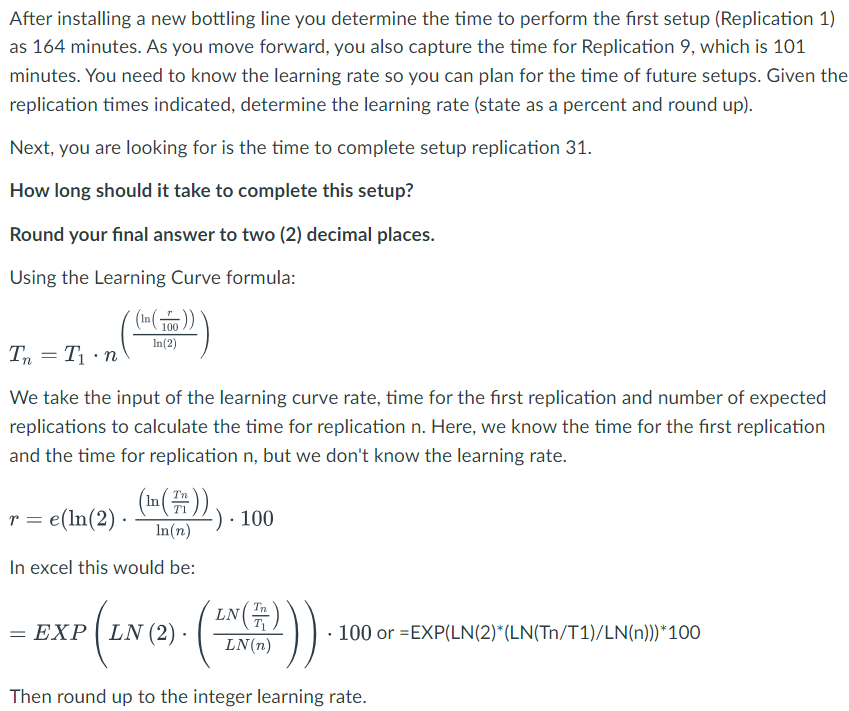
After installing a new bottling line you determine the time to perform the first setup (Replication 1) as 164 minutes. As you move forward, you also capture the time for Replication 9, which is 101 minutes. You need to know the learning rate so you can plan for the time of future setups. Given the replication times indicated, determine the learning rate (state as a percent and round up). Next, you are looking for is the time to complete setup replication 31 . How long should it take to complete this setup? Round your final answer to two (2) decimal places. Using the Learning Curve formula: Tn=T1n(ln(2)(ln(100r))) We take the input of the learning curve rate, time for the first replication and number of expected replications to calculate the time for replication n. Here, we know the time for the first replication and the time for replication n, but we don't know the learning rate. r=e(ln(2)ln(n)(ln(T1Tn)))100 In excel this would be: =EXP(LN(2)(LN(n)LN(T1Tn)))100or=EXP(LN(2)(LN(Tn/T1)/LN(n)))100 Then round up to the integer learning rate. After installing a new bottling line you determine the time to perform the first setup (Replication 1) as 164 minutes. As you move forward, you also capture the time for Replication 9, which is 101 minutes. You need to know the learning rate so you can plan for the time of future setups. Given the replication times indicated, determine the learning rate (state as a percent and round up). Next, you are looking for is the time to complete setup replication 31 . How long should it take to complete this setup? Round your final answer to two (2) decimal places. Using the Learning Curve formula: Tn=T1n(ln(2)(ln(100r))) We take the input of the learning curve rate, time for the first replication and number of expected replications to calculate the time for replication n. Here, we know the time for the first replication and the time for replication n, but we don't know the learning rate. r=e(ln(2)ln(n)(ln(T1Tn)))100 In excel this would be: =EXP(LN(2)(LN(n)LN(T1Tn)))100or=EXP(LN(2)(LN(Tn/T1)/LN(n)))100 Then round up to the integer learning rate
Step by Step Solution
There are 3 Steps involved in it

Get step-by-step solutions from verified subject matter experts
 Study Help