







Question: SHOW WORK FOR ALL PROBLEMS. EVEN IF YOU HAVE THE CORRECT ANSWER, YOU WILL GET ZERO FOR NO WORK SHOWN. 1. Let B(x) represent the
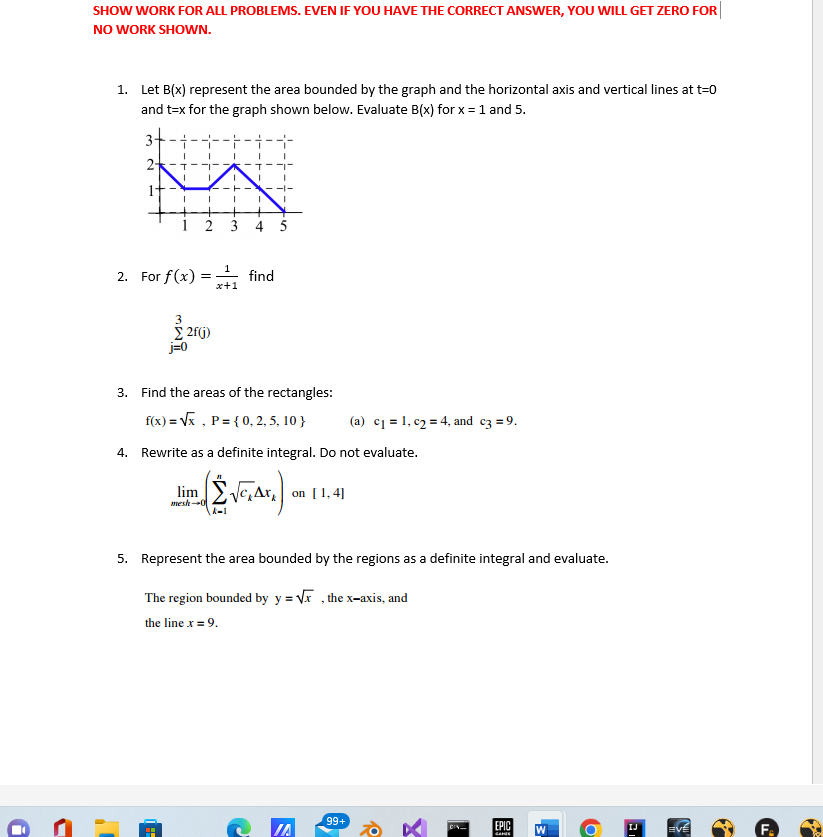
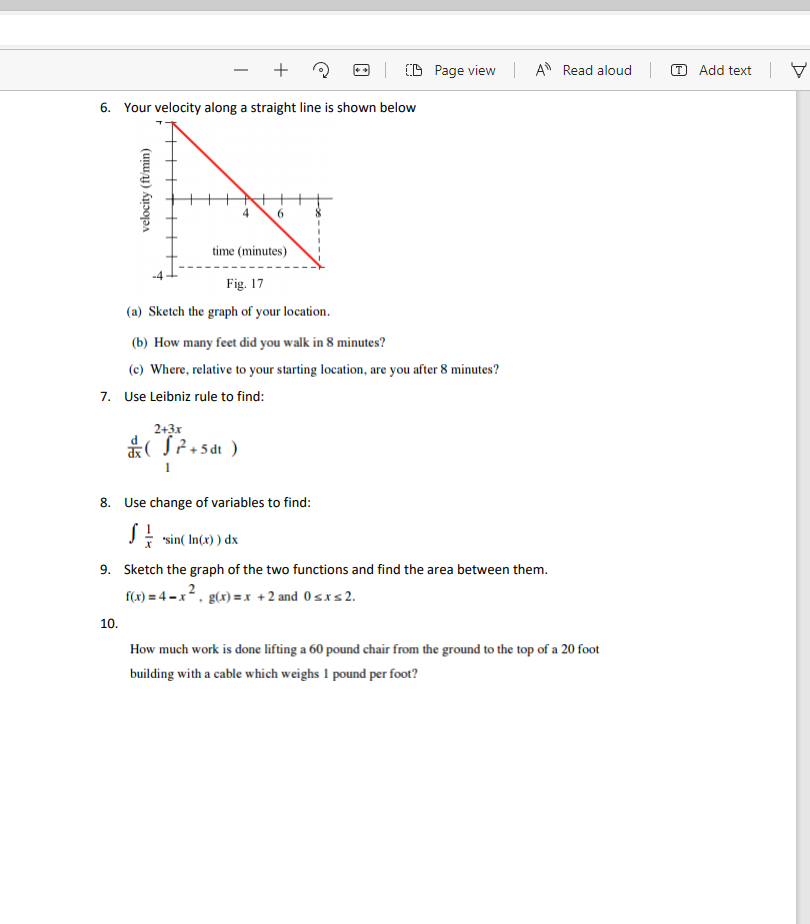
SHOW WORK FOR ALL PROBLEMS. EVEN IF YOU HAVE THE CORRECT ANSWER, YOU WILL GET ZERO FOR NO WORK SHOWN. 1. Let B(x) represent the area bounded by the graph and the horizontal axis and vertical lines at t=0 and t=x for the graph shown below. Evaluate B(x) for x = 1 and 5. W 2. For f (x) = = find $ 2f(j) 1=0 3. Find the areas of the rectangles: f(x) = vx , P = { 0, 2, 5, 10 } (a) c1 = 1, c2 = 4, and c3 =9. Rewrite as a definite integral. Do not evaluate. lim mesh- EVGAXK on [1,41 5. Represent the area bounded by the regions as a definite integral and evaluate. The region bounded by y = Vx , the x-axis, and the line x = 9. 99+ EPIC W EVE+ Q [ Page view | A Read aloud | ) Add text A 6. Your velocity along a straight line is shown below velocity (ft/min) time (minutes) Fig. 17 (a) Sketch the graph of your location. (b) How many feet did you walk in 8 minutes? (c) Where, relative to your starting location, are you after 8 minutes? 7. Use Leibniz rule to find: 2+3x ax ( J 2 +5 dt ) 8. Use change of variables to find: J 'sin( In(x) ) dx 9. Sketch the graph of the two functions and find the area between them. f(x) =4-x ", g(x) =x + 2 and 0sxs2. 10. How much work is done lifting a 60 pound chair from the ground to the top of a 20 foot building with a cable which weighs 1 pound per foot
Step by Step Solution
There are 3 Steps involved in it

Get step-by-step solutions from verified subject matter experts
 Study Help