



Question: Show work Question 5 1 pts Suppose we take a disk with initial radius R, initial mass M, and initial moment of inertia I; =
Show work
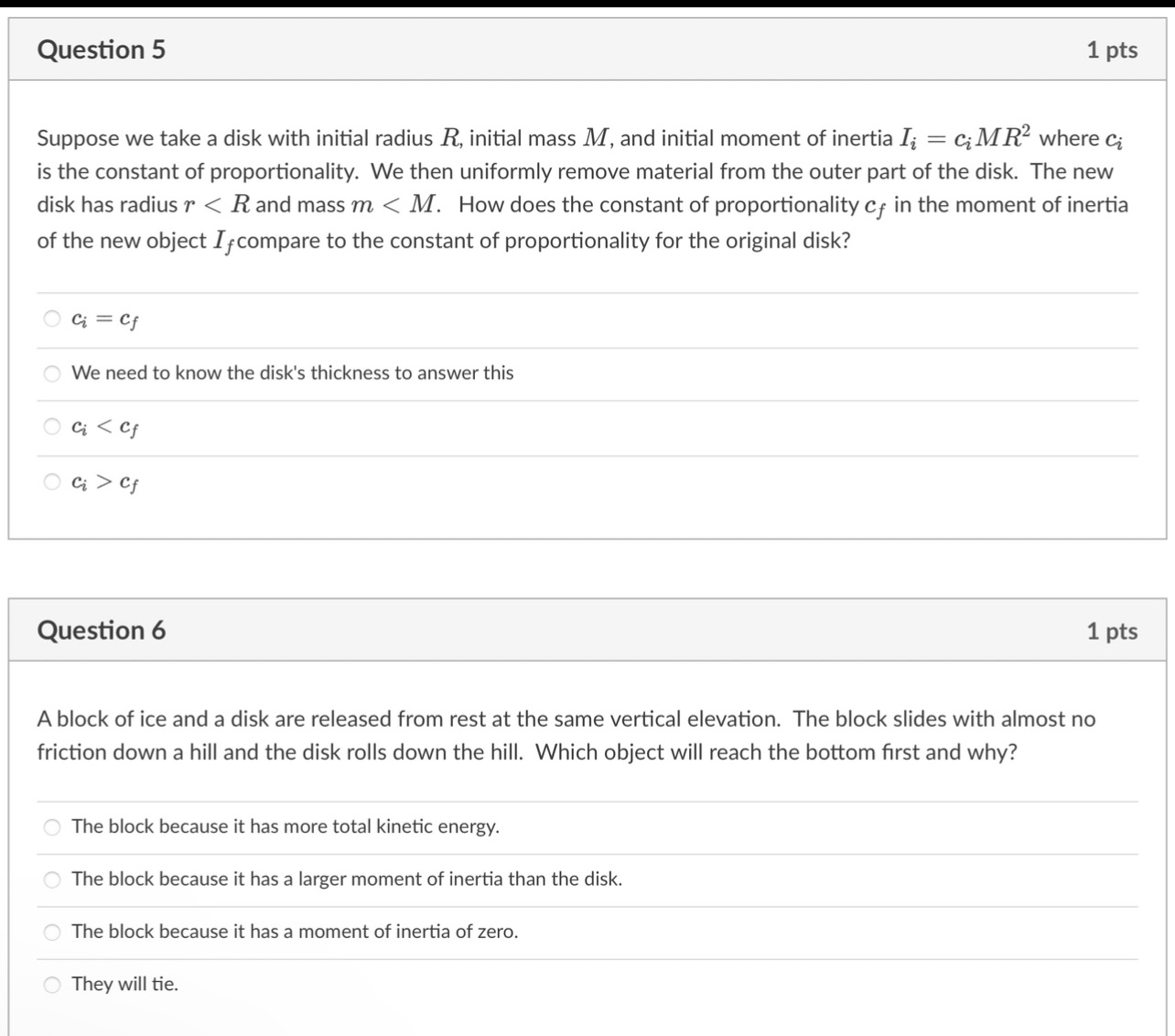
Question 5 1 pts Suppose we take a disk with initial radius R, initial mass M, and initial moment of inertia I; = qMR2 where (L; is the constant of proportionality. We then uniformly remove material from the outer part of the disk. The new disk has radius 'r' Cf Question 6 1 pts A block of ice and a disk are released from rest at the same vertical elevation. The block slides with almost no friction down a hill and the disk rolls down the hill. Which object will reach the bottom rst and why? The block because it has more total kinetic energy. The block because it has a larger moment of inertia than the disk. The block because it has a moment of inertia of zero. They will tie
Step by Step Solution
There are 3 Steps involved in it

Get step-by-step solutions from verified subject matter experts