







Question: Showing that a problem is NP complete requires Polynomial-time Reduction. Now, a set of nodes V is a vertex cover. The removal of V
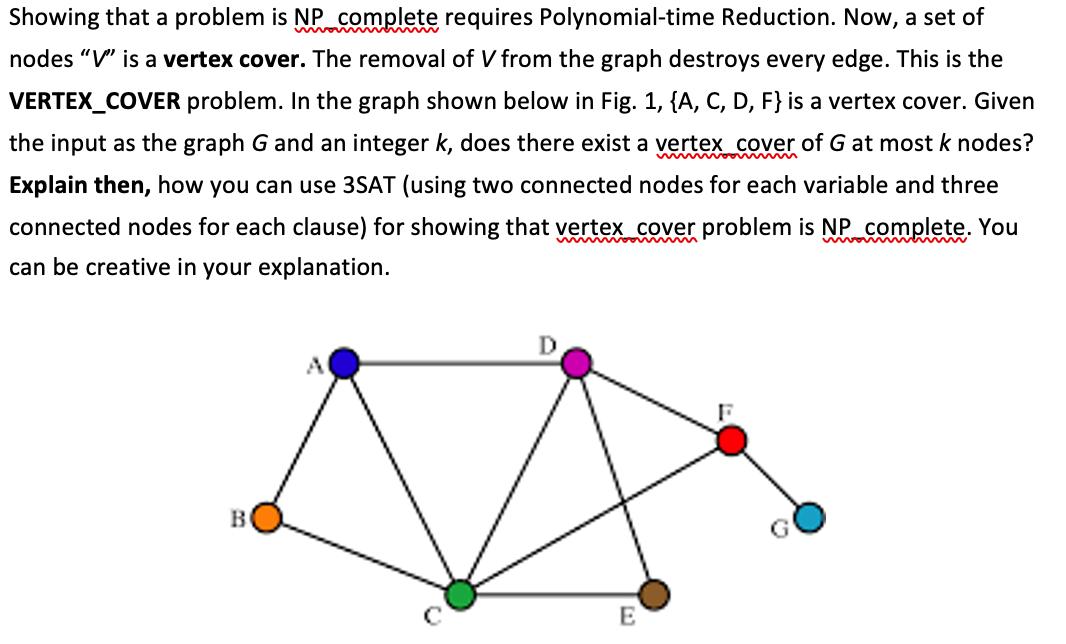
Showing that a problem is NP complete requires Polynomial-time Reduction. Now, a set of nodes "V" is a vertex cover. The removal of V from the graph destroys every edge. This is the VERTEX_COVER problem. In the graph shown below in Fig. 1, {A, C, D, F} is a vertex cover. Given the input as the graph G and an integer k, does there exist a vertex cover of G at most k nodes? Explain then, how you can use 3SAT (using two connected nodes for each variable and three connected nodes for each clause) for showing that vertex cover problem is NP complete. You can be creative in your explanation. B A D E
Step by Step Solution
3.60 Rating (150 Votes )
There are 3 Steps involved in it
To show that the vertex cover problem is NPcomplete we need to demonstrate two things 1 The vertex cover problem is in NP 2 Any problem in NP is reduc... View full answer

Get step-by-step solutions from verified subject matter experts
 Study Help