







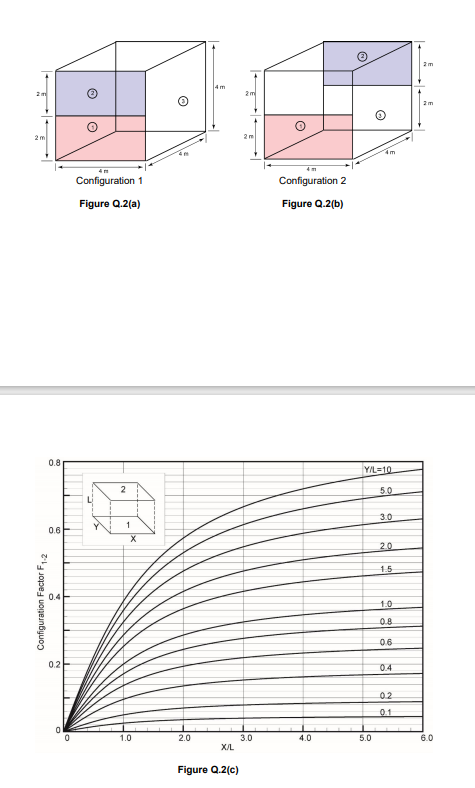
Question: Shown in Figure Q . 2 ( a ) and Figure Q . 2 ( b ) are configurations of a room where surface 1
Shown in Figure Qa and Figure Qb are configurations of a room
where surface is a radiator and surface is a window. In each case the
radiator is at a temperature of K emissivity and the window is a
temperature of K emissivity All other surfaces in each
configuration could be treated as one black surface at temperature
K It is required to calculate heat loss through the window for both
cases to determine the most energy efficient location for the radiator.
Assume the radiative heat transfer is the dominant heat transfer
mechanism.
Confiquration
a Noting that, in configuration surface and surface are on the
same wall, draw an electrical network that could be used to
calculate radiative heat transfer at each surface.
marks
b Calculate necessary configuration factors and resistances required
for the circuit drawn in a
marks
c Use the network drawn in a to write nodal equations and solve
them to calculate heat transfer at surfaces and
marks
d Provide a heat balance to verify your answers obtained in c
mark
Confiquration
e Draw an electrical network to calculate radiative heat transfer at
surfaces of Configuration
marks
f Calculate necessary configuration factors required for the circuit
drawn in e
marks
g Use the network drawn in e to write nodal equations and solve
them to calculate heat transfer at surfaces and
marks
h Provide a heat balance to verify your answers in g
mark
i Based on your answers obtained in c and g what is the best
configuration to minimise heat transfer to the window. What is the
energy provided to the radiator in each case?
mark
Figure Qc is to be used for configuration factor calculations.
Some useful configuration factor properties:Figure Qc
Step by Step Solution
There are 3 Steps involved in it
1 Expert Approved Answer
Step: 1 Unlock

Question Has Been Solved by an Expert!
Get step-by-step solutions from verified subject matter experts
Step: 2 Unlock
Step: 3 Unlock
 Study Help