







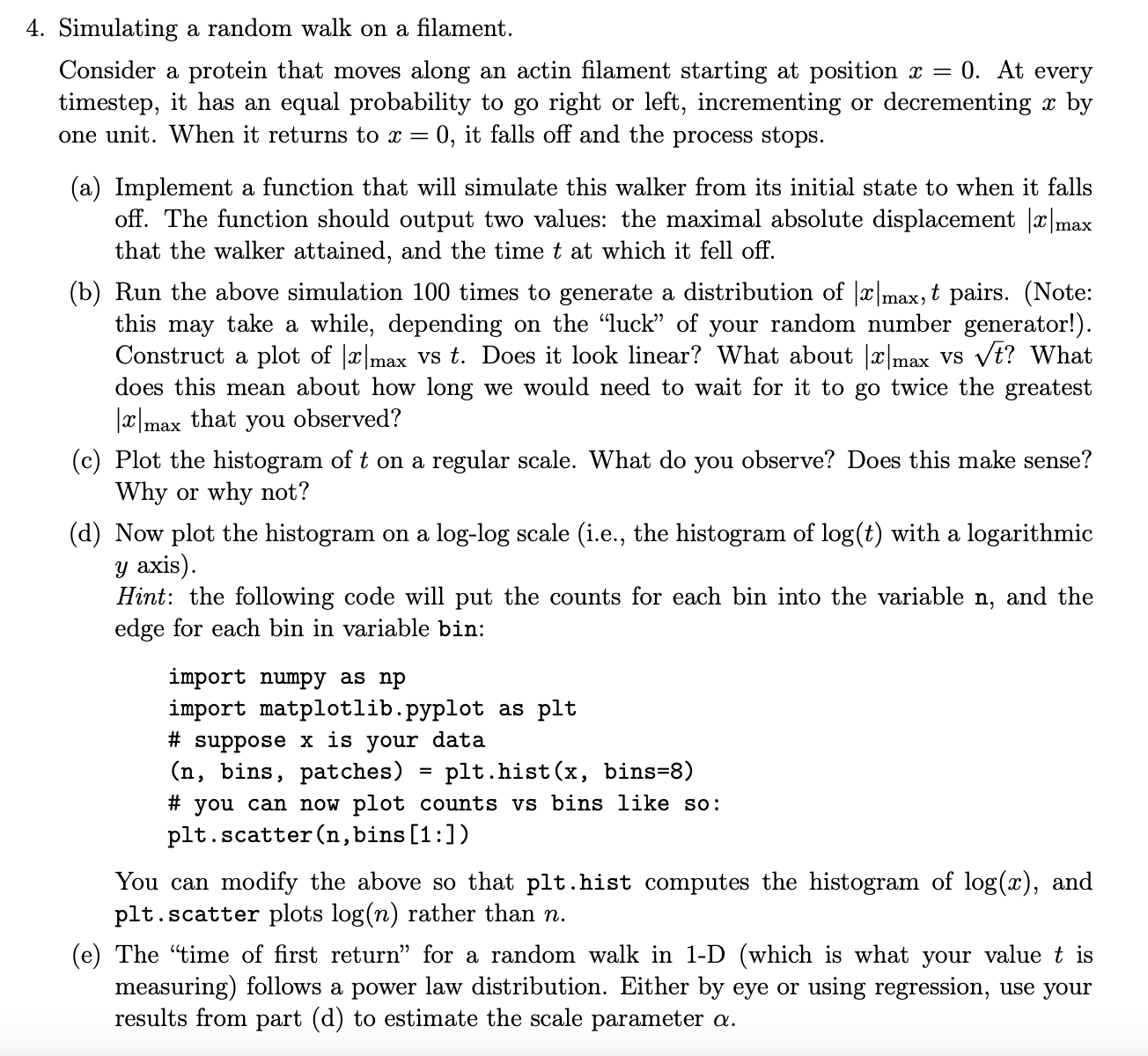
Question: Simulating a random walk on a filament. Consider a protein that moves along an actin filament starting at position x = 0 . At every
Simulating a random walk on a filament.
Consider a protein that moves along an actin filament starting at position At every
timestep, it has an equal probability to go right or left, incrementing or decrementing by
one unit. When it returns to it falls off and the process stops.
a Implement a function that will simulate this walker from its initial state to when it falls
off. The function should output two values: the maximal absolute displacement
that the walker attained, and the time at which it fell off.
b Run the above simulation times to generate a distribution of pairs. Note:
this may take a while, depending on the "luck" of your random number generator!
Construct a plot of vs Does it look linear? What about vs What
does this mean about how long we would need to wait for it to go twice the greatest
that you observed?
c Plot the histogram of on a regular scale. What do you observe? Does this make sense?
Why or why not?
d Now plot the histogram on a loglog scale ie the histogram of with a logarithmic
axis
Hint: the following code will put the counts for each bin into the variable and the
edge for each bin in variable bin:
You can modify the above so that plthist computes the histogram of and
pltscatter plots rather than
e The "time of first return" for a random walk in D which is what your value is
measuring follows a power law distribution. Either by eye or using regression, use your
results from part d to estimate the scale parameter
Step by Step Solution
There are 3 Steps involved in it
1 Expert Approved Answer
Step: 1 Unlock

Question Has Been Solved by an Expert!
Get step-by-step solutions from verified subject matter experts
Step: 2 Unlock
Step: 3 Unlock
 Study Help