







Question: simulation also required on matlab. The desired reference signal for a system is given as r(t) = 3 sin(t) +2. Use the disturbance-observer based approach
simulation also required on matlab.
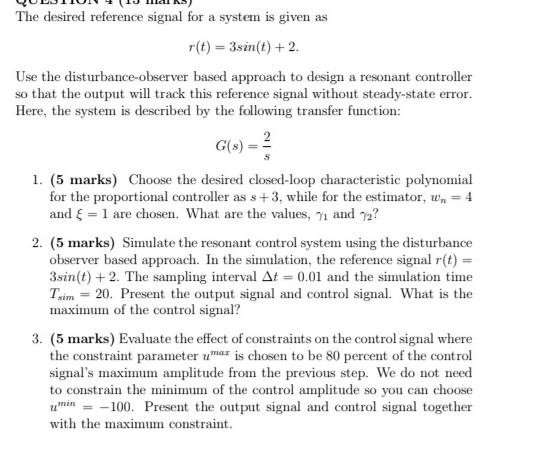
The desired reference signal for a system is given as r(t) = 3 sin(t) +2. Use the disturbance-observer based approach to design a resonant controller so that the output will track this reference signal without steady-state error. Here, the system is described by the following transfer function: 2 G(s) 1. (5 marks) Choose the desired closed-loop characteristic polynomial for the proportional controller as s +3, while for the estimator, n = 4 and & = 1 are chosen. What are the values, 71 and 12? 2. (5 marks) Simulate the resonant control system using the disturbance observer based approach. In the simulation, the reference signal r(t) = 3sin(t) +2. The sampling interval At = 0.01 and the simulation time Tsim = 20. Present the output signal and control signal. What is the maximum of the control signal? 3. (5 marks) Evaluate the effect of constraints on the control signal where the constraint parameter umat is chosen to be 80 percent of the control signal's maximum amplitude from the previous step. We do not need to constrain the minimum of the control amplitude so you can choose w min = -100. Present the output signal and control signal together with the maximum constraint. The desired reference signal for a system is given as r(t) = 3 sin(t) +2. Use the disturbance-observer based approach to design a resonant controller so that the output will track this reference signal without steady-state error. Here, the system is described by the following transfer function: 2 G(s) 1. (5 marks) Choose the desired closed-loop characteristic polynomial for the proportional controller as s +3, while for the estimator, n = 4 and & = 1 are chosen. What are the values, 71 and 12? 2. (5 marks) Simulate the resonant control system using the disturbance observer based approach. In the simulation, the reference signal r(t) = 3sin(t) +2. The sampling interval At = 0.01 and the simulation time Tsim = 20. Present the output signal and control signal. What is the maximum of the control signal? 3. (5 marks) Evaluate the effect of constraints on the control signal where the constraint parameter umat is chosen to be 80 percent of the control signal's maximum amplitude from the previous step. We do not need to constrain the minimum of the control amplitude so you can choose w min = -100. Present the output signal and control signal together with the maximum constraint
Step by Step Solution
There are 3 Steps involved in it

Get step-by-step solutions from verified subject matter experts
 Study Help