







Question: SIMULATION USE WOLFRAM MATHEMATICA ---------------------------------------------------------------------------------------------------------------------------------------------------------------------------------------------- Question 1 Tshepiso owns a Muffler shop. His mechanic, Samkelo is able to install new mufflers at an average of
SIMULATION
USE WOLFRAM MATHEMATICA
----------------------------------------------------------------------------------------------------------------------------------------------------------------------------------------------
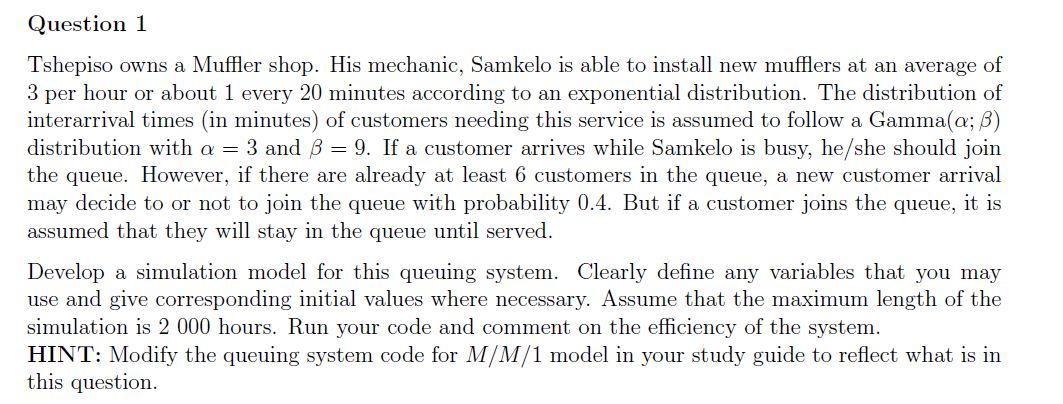
Question 1 Tshepiso owns a Muffler shop. His mechanic, Samkelo is able to install new mufflers at an average of 3 per hour or about 1 every 20 minutes according to an exponential distribution. The distribution of interarrival times (in minutes) of customers needing this service is assumed to follow a Gamma(a; 8) distribution with a = 3 and B = 9. If a customer arrives while Samkelo is busy, he/she should join the queue. However, if there are already at least 6 customers in the queue, a new customer arrival may decide to or not to join the queue with probability 0.4. But if a customer joins the queue, it is assumed that they will stay in the queue until served. Develop a simulation model for this queuing system. Clearly define any variables that you may use and give corresponding initial values where necessary. Assume that the maximum length of the simulation is 2 000 hours. Run your code and comment on the efficiency of the system. HINT: Modify the queuing system code for M/M/1 model in your study guide to reflect what is in this question. Question 1 Tshepiso owns a Muffler shop. His mechanic, Samkelo is able to install new mufflers at an average of 3 per hour or about 1 every 20 minutes according to an exponential distribution. The distribution of interarrival times (in minutes) of customers needing this service is assumed to follow a Gamma(a; 8) distribution with a = 3 and B = 9. If a customer arrives while Samkelo is busy, he/she should join the queue. However, if there are already at least 6 customers in the queue, a new customer arrival may decide to or not to join the queue with probability 0.4. But if a customer joins the queue, it is assumed that they will stay in the queue until served. Develop a simulation model for this queuing system. Clearly define any variables that you may use and give corresponding initial values where necessary. Assume that the maximum length of the simulation is 2 000 hours. Run your code and comment on the efficiency of the system. HINT: Modify the queuing system code for M/M/1 model in your study guide to reflect what is in this
Step by Step Solution
There are 3 Steps involved in it

Get step-by-step solutions from verified subject matter experts
 Study Help