



Question: Since policy development and compliance do not happen in a vacuum, health administrators need to consider their various stakeholders as they think about the pros
Since policy development and compliance do not happen in a vacuum, health administrators need to consider their various stakeholders as they think about the pros and cons of any health policy and of how to implement it strategically.
Demonstrate or apply the stakeholder theory and the power/interest matrix that was learned about in the initial course in the MHA program.
Emily has already studying the new HAC Medicare policy mandated by the ACA to determine how Allen Care System can better comply with current HAC regulations and avoid penalties.As health care administrators, Emily's Policy Task Force has taken time to identify the major stakeholders in the HAC policy issue, realizing that an organization must communicate with its stakeholders in a particular way. Some stakeholders may be instrumental in the success of her organization's compliance with the policy or can be valuable in future advocacy for rule and policy modifications.
Ms. Dewitt, the CEO of the health system on whose policy task force Emily is serving, has asked each Health Policy Task Force member to suggest, individually, a plan for keeping stakeholders in the loop regarding the HAC issues Emily has been studying. As a start, Ms. Dewitt has identified four stakeholders based on their lying within certain quadrants of the stakeholder power matrix the Health Policy Task Force developed:
- High power/high interest: nurses
- High power/low interest: board members
- Low power/high interest: patients
- Low power/low interest: system business departments (non-clinical)
Emily may wish to retrieve from her records or recall the stakeholder power matrix from the first course in the MHA program to refresh her memory of how the matrix is constructed and used.
Given the power and interest of each group in regard to the HAC policy (both implementation andrulemaking), identify the issues that will guide later development of an organizational communication planfor each group. Emily's explanation and plan can be in combined bulleted and sentence format as long as there is sufficient explanation.
References
- Mayer, D.O. (n.d.)Stakeholder theory. Retrieved fromhttp://www.referenceforbusiness.com/encyclopedia/Sel-Str/Stakeholder-Theory.html
- Barrett, M. (2001).A stakeholder approach to responsiveness and accountability in non-profitorganisations.Social Policy Journal of New Zealand. Retrieved fromhttp://www.thefreelibrary.com/A+stakeholder+approach+to+responsiveness+and+accountability+in...-a081762104
- Longest,B.B.(2016).HealthpolicymakingintheUnitedStates(6thEd.).Chicago,IL:HealthAdministrationPress.
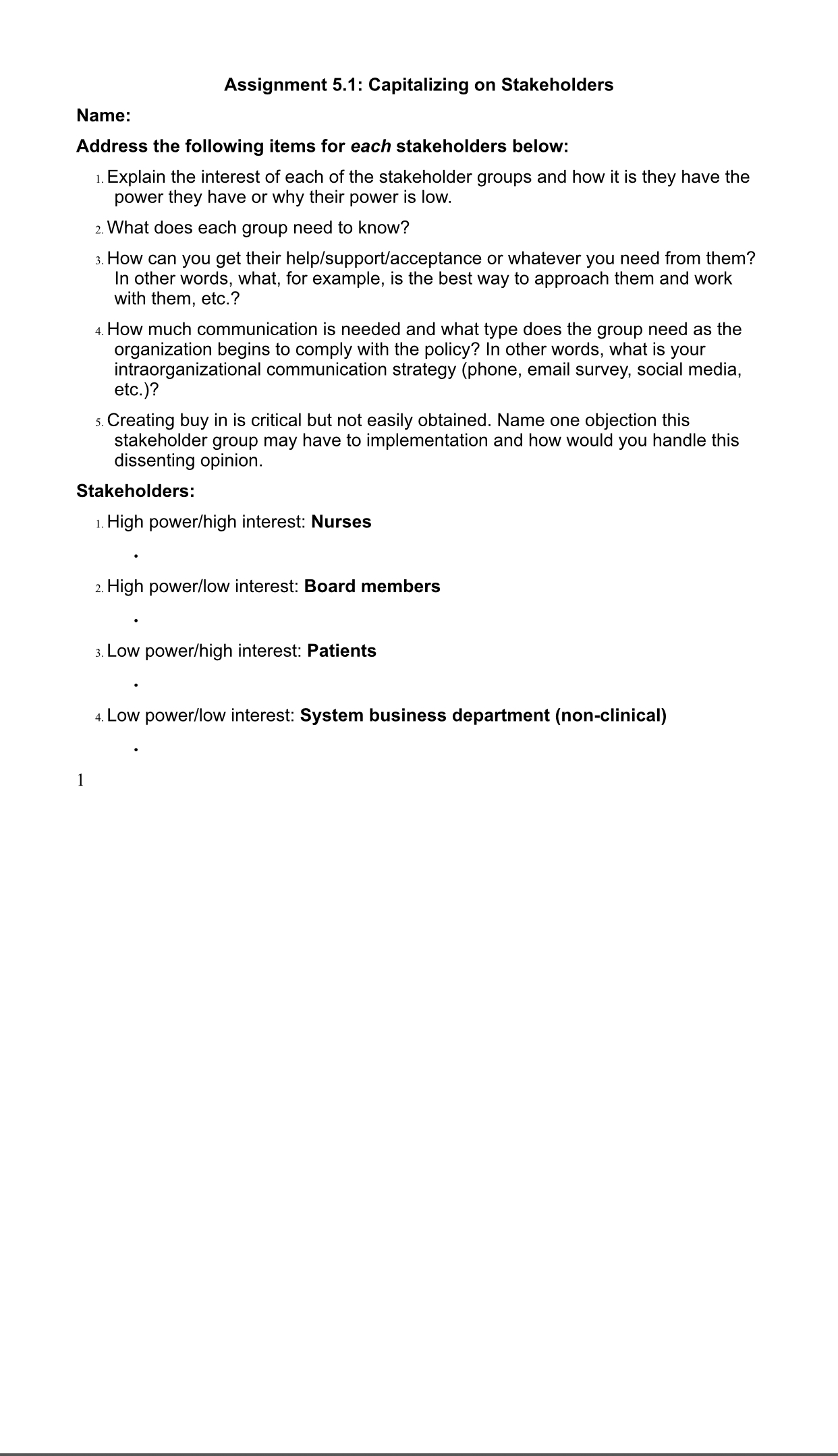
Assignment 5.1: Capitalizing on Stakeholders Name: Address the following items for each stakeholders below: 1. Explain the interest of each of the stakeholder groups and how it is they have the power they have or why their power is low. 2. What does each group need to know? 3. How can you get their helplsupportlacceptance or whatever you need from them? In other words, what, for example, is the best way to approach them and work with them, etc? 4. How much communication is needed and what type does the group need as the organization begins to comply with the policy? In other words, what is your intraorganizational communication strategy (phone, email survey, social media, etc)? 5. Creating buy in is critical but not easily obtained. Name one objection this stakeholder group may have to implementation and how would you handle this dissenting opinion. Stakeholders: 1. High power/high interest: Nurses 2. High power/low interest: Board members 3. Low power/high interest: Patients o 4. Low power/low interest: System business department (non-clinical)
Step by Step Solution
There are 3 Steps involved in it

Get step-by-step solutions from verified subject matter experts