







Question: Six mutually exclusive projects A, B, C, D, E , and F , are being considered by XYZ . They have been ordered by first
Six mutually exclusive projects A, B, C, D, E, and F, are being considered by XYZ. They have been ordered by first costs so that project A has the lowest first cost, project F the largest. Specifically, detailed cash flows for Projects A and B are given below.
Project A: Initial Cost of $323,120. annual benefit of $50,000 for 15 years
Project B: Initial Cost of $494,310. annual benefit of $70,000 for 15 years
Also, the table below apply to all projects (A through F). The data can be interpreted as follows: the IRR on the incremental investment from project C to D is 13%.
First, calculate both the IRR for Project A and the Increment IRR from Project A to Project B.
Next, Use the table to decide which project should be selected. MARR for XYZ is set at 10%
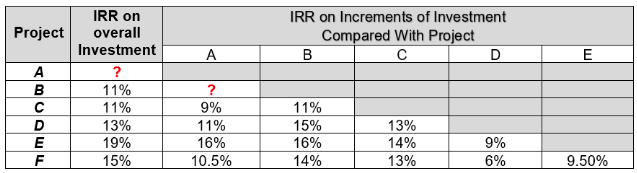
\begin{tabular}{|c|c|c|c|c|c|c|} \hline \multirow{2}{*}{ Project } & \multirow{2}{*}{ IRR on overall Investment } & \multicolumn{5}{|c|}{ IRR on Increments of Investment Compared With Project } \\ \cline { 3 - 7 } & A & A & C & D & E \\ \hline A & ? & & & & \\ \hline B & 11% & ? & & & & \\ \hline C & 11% & 9% & 11% & & & \\ \hline D & 13% & 11% & 15% & 13% & & \\ \hline E & 19% & 16% & 16% & 14% & 9% & \\ \hline F & 15% & 10.5% & 14% & 13% & 6% & 9.50% \\ \hline \end{tabular}
Step by Step Solution
There are 3 Steps involved in it

Get step-by-step solutions from verified subject matter experts
 Study Help