



Question: Six ways in which project estimates go wrong: False analogies - Project estimates based on historical data are generally considered to be more reliable than
Six ways in which project estimates go wrong:
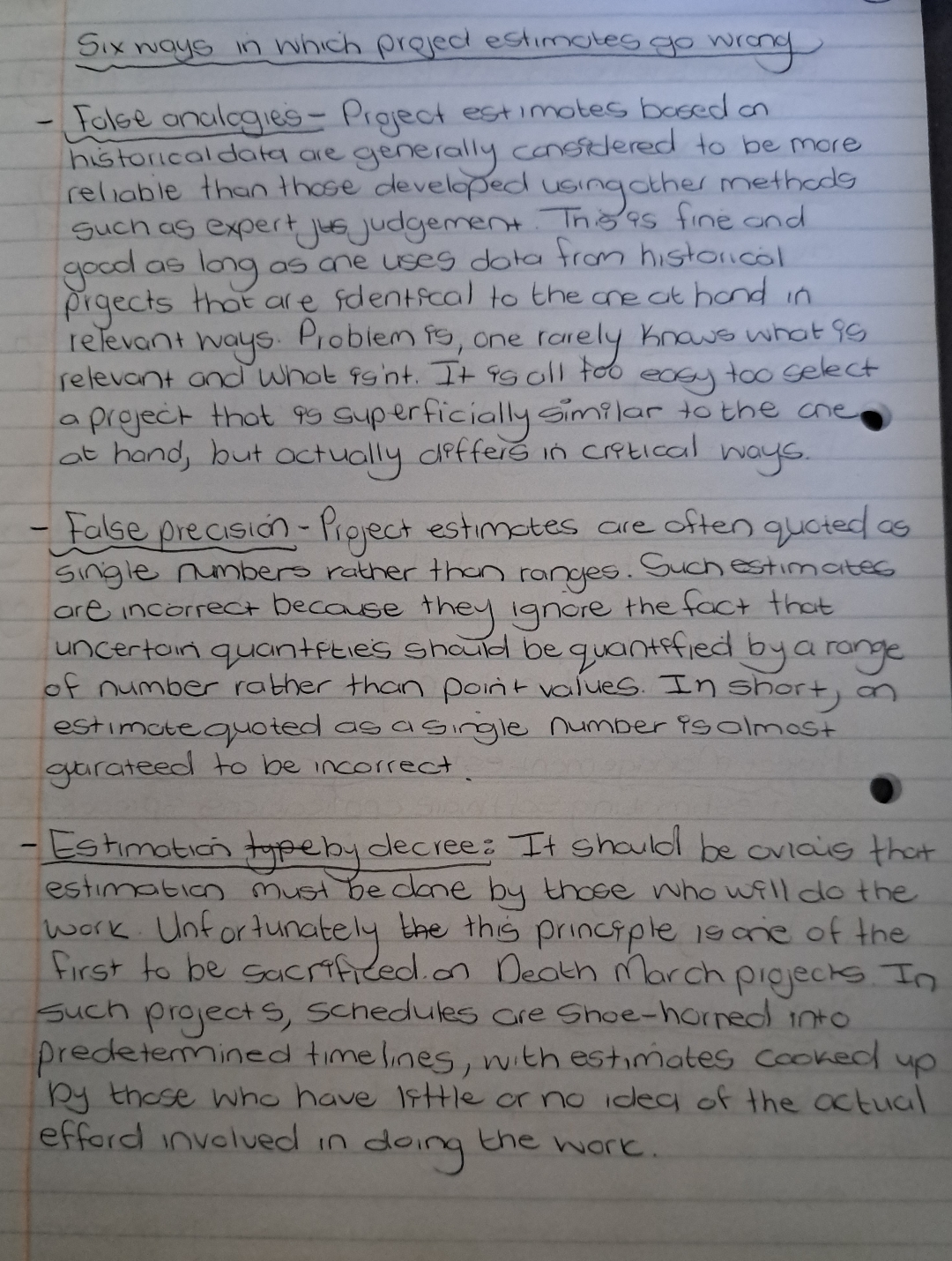
False analogies Project estimates based on historical data are generally considered to be more reliable than those developed using other methods such as expert judgement. This is fine and good as long as one uses data from historical projects that are identical to the one at hand in relevant ways. Problem is one rarely knows what is relevant and what is'nt. It is all too easy too select a project that is superficially similar to the one at hand, but actually differs in critical ways.
False precision Project estimates are often quoted as single numbers rather than ranges. Such estimates are incorrect because they ignore the fact that uncertain quantities should be quantified by a range of number rather than point values. In short, an estimote quoted as a single number is almost guarateed to be incorrect.
Estimation by decree: It should be ovious that estimation must be done by those who will do the work Unfortunately this principle is one of the first to be sacrificed on Death March projects. In such projects, schedules are shoehorned into predetermined timelines, with estimates cooked up by those who have little or no idea of the actual efford involved in doing the work.
Subjectivity This is where estimates are plucked out of thin air and a range of other cognitive biased.
Coordination neglect projects consist of diverse carefully. Unfortunately, the time and effort needed for coordination and intergration is often underestimated by project decision makers. This is referred to as coordination neglect. coordination neglect is a problem projects of all suzes, but is generally more significant for projecta that consist of a large number of dependent tasks or have a large number of external depenencies.
Too course grainedLarge tasks are made up for smaller tasks strung together in specific ways. Consequently, estimates for larger tasks should be built up from estimates for the smaller subtasks. Teams often shortcircuit the process by attempting to estimates the larger tasks directly. such estimates usually turn out to be incorrect becaise subtasks are overlooked.
Step by Step Solution
There are 3 Steps involved in it
1 Expert Approved Answer
Step: 1 Unlock

Question Has Been Solved by an Expert!
Get step-by-step solutions from verified subject matter experts
Step: 2 Unlock
Step: 3 Unlock