







Question: Skeleton for Assignment 2 // dynalloc parms: array size, pointer to array which is defined in main but modified by function when it executes the
Skeleton for Assignment 2
// dynalloc parms: array size, pointer to array which is defined in main but modified by function when it executes the // definition with new. Return value: none.
void dynAlloc(int, int*&);
// insertionSort parms (or bubbleSort parms): pointer to array to sort, array size, pointer to sorted array. // Return value: number of iterations.
int insertionSort(int *, int, int *);
// linearSearch parms: pointer to array to search, array size, target value, number of iterations. Number of // iterations defined in main but modified by search. Return value: element # of found element, or -1 if not found.
int linearSearch(int *, int, int, int &); // binarySearch parms: same as with linearSearch int binarySearch(int *, int, int, int &); main
numElements=100; int * unsortedArrayPtr, * sortedArrayPtr;
dynAlloc(numElements, unsortedArrayPtr) for(i=0;i
unsortedArrayPtr[i]=rand() % 100+1 cout ... unsorted array
dynAlloc(numelements, sortedArrayPtr) numIter=insertionSort(unsortedArrayPtr, numElements, sortedArrayPtr) cout ... sorted array cin ... a target value while (!= -1)
return
// dont forget to clean up
// new not xeqd until execution time
wasFound=linearSearch(sortedArrayPtr, numElements, targetValue, numIter) cout ... results wasFound=binarySearch(sortedArrayPtr, numElements, targetValue, numIter) cout ... results
cin ... a target value
dynAlloc(int numelements, int * &ptrtothearray) ...
ptrtothearray=new int[numelements]
int insertionSort(int *toSort, numElements, int*sortedResult) ...
sortedResult[i]=toSort[i]; ...
// or use a global // a ptr can function as an array name it can be subscripted // refer to the rules // get space for array to sort // populate array to sort
// get array to hold sorted result
if (sortedResult[i]
int linearSearch(int *toSearch, numElements, targetValue, numIterations) ...
if(toSearch[i] = targetValue) ...
int binarySearch(int *toSearch, numElements, targetValue, numIterations) ...
if(toSearch[i] = targetValue) ...
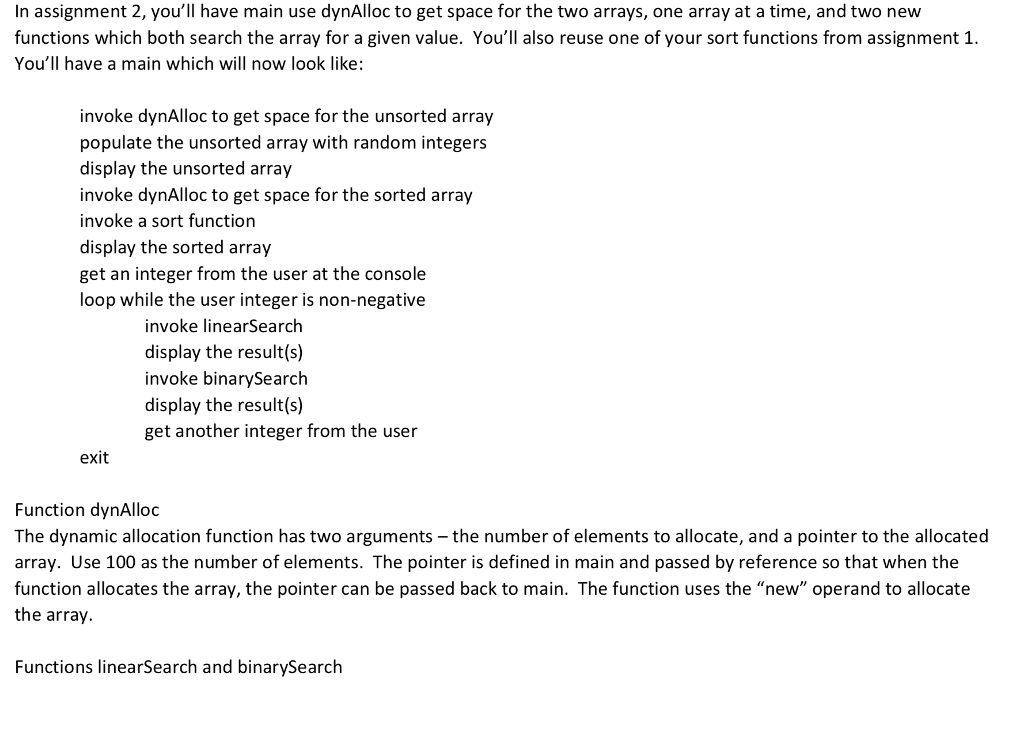
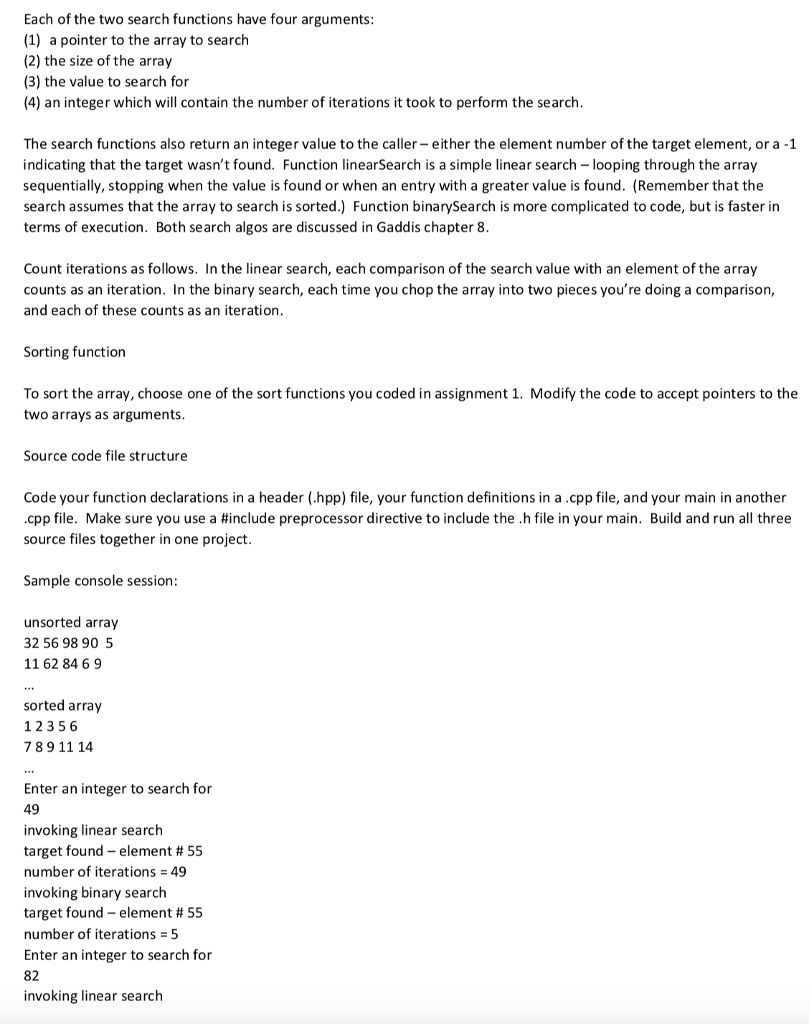
In assignment 2, you'll have main use dynAlloc to get space for the two arrays, one array at a time, and two new functions which both search the array for a given value. You'll also reuse one of your sort functions from assignment 1. You'll have a main which will now look like: invoke dynAlloc to get space for the unsorted array populate the unsorted array with random integers display the unsorted array invoke dynAlloc to get space for the sorted array invoke a sort function display the sorted array get an integer from the user at the console loop while the user integer is non-negative invoke linearSearch display the result(s) invoke binarySearch display the result(s) get another integer from the user exit Function dynAlloc The dynamic allocation function has two arguments - the number of elements to allocate, and a pointer to the allocated array. Use 100 as the number of elements. The pointer is defined in main and passed by reference so that when the function allocates the array, the pointer can be passed back to main. The function uses the "new" operand to allocate the array. Functions linearSearch and binarySearch
Step by Step Solution
There are 3 Steps involved in it

Get step-by-step solutions from verified subject matter experts
 Study Help