







Question: Skill Builder 4-1 exercise Making a Decision Using the Decision-Making Model . Upon thorough review of the skill builder exercise, you will then answer the
Skill Builder 4-1 exercise "Making a Decision Using the Decision-Making Model". Upon thorough review of the skill builder exercise, you will then answer the (Step 1-Step 6) questions and the 'Apply it' questions. It is not sufficient to state your opinions alone; you must be able to backup yourresponses by applying management concepts. Expected response length is 3 sentences per question .At least 80-150 words per question. Please list the question you are answering in your Skill Builder 4-1 exercise.
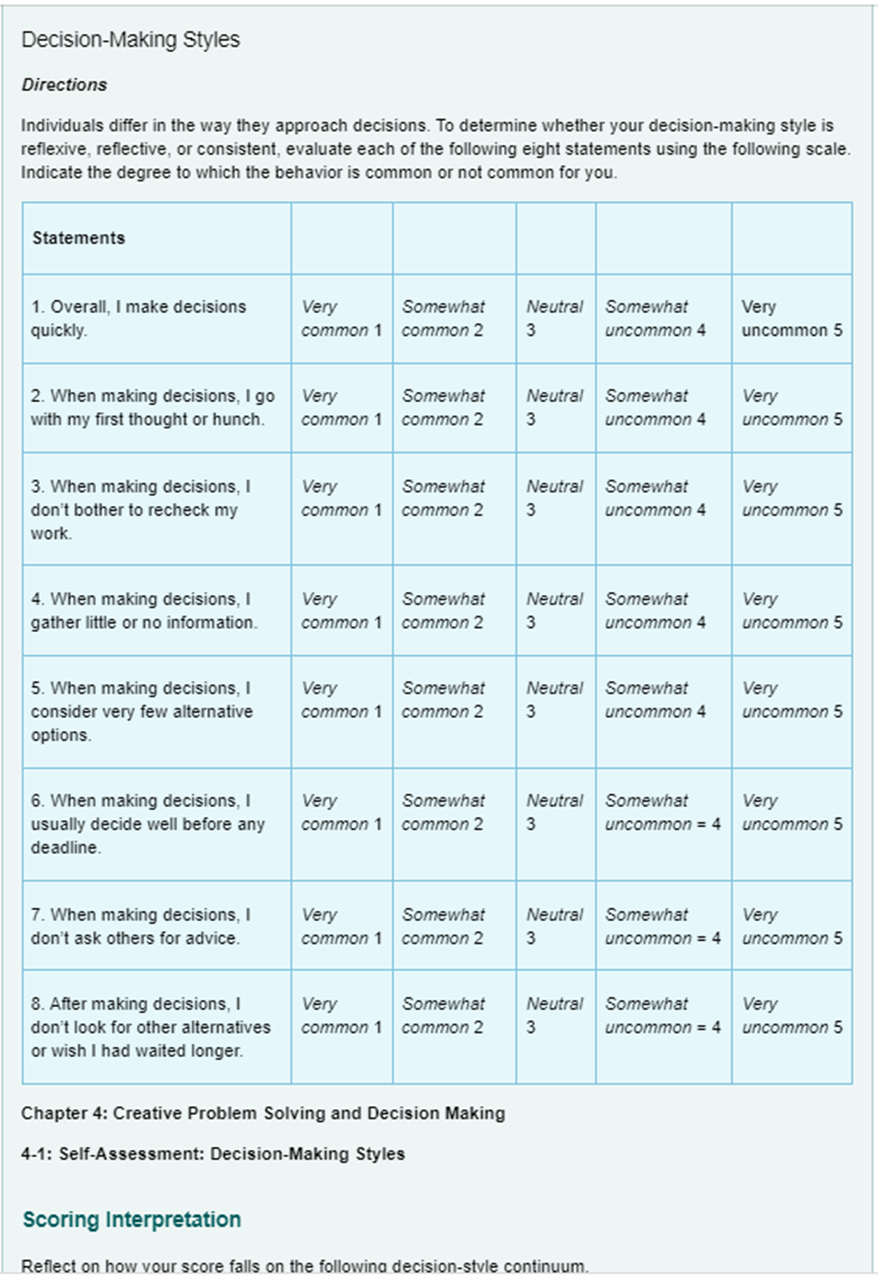
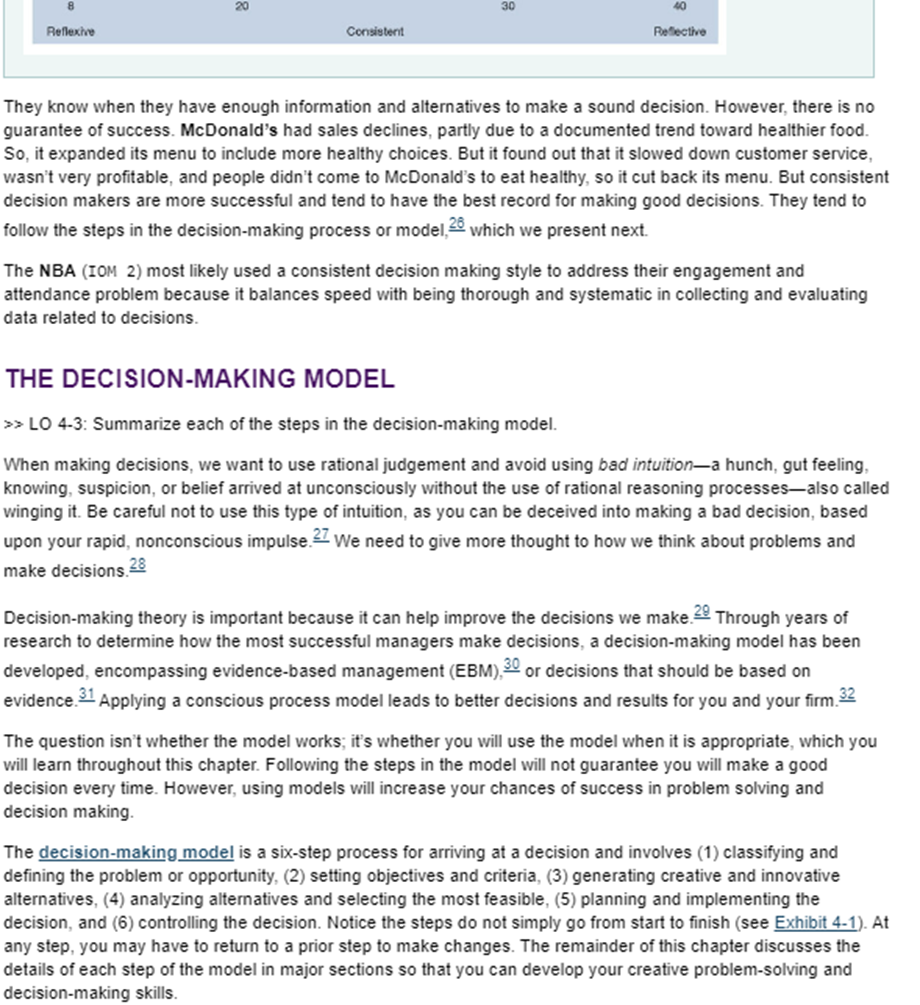
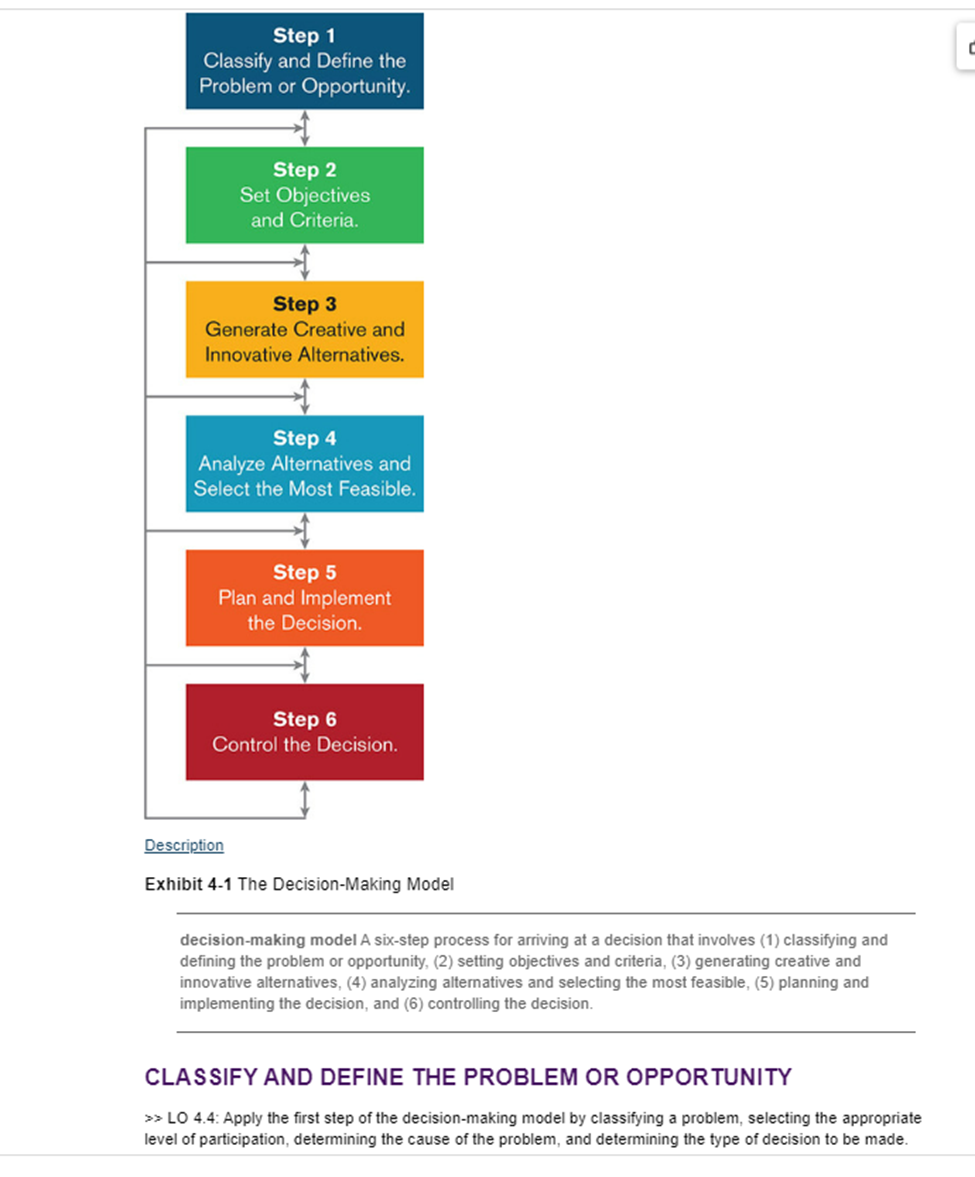
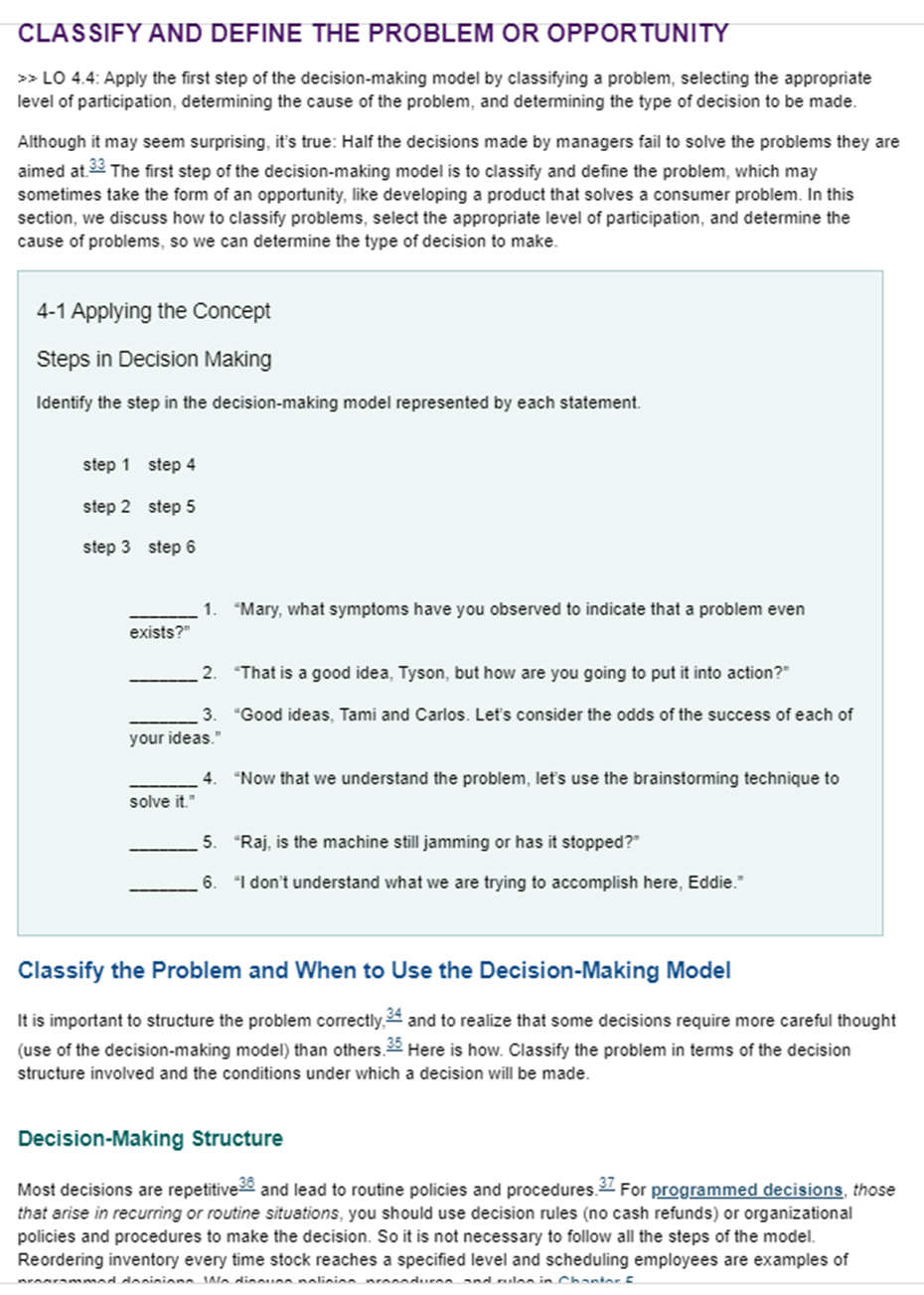
Decision-Making Styles Directions Individuals differ in the way they approach decisions. To determine whether your decision-making style is reflexive, reflective, or consistent, evaluate each of the following eight statements using the following scale. Indicate the degree to which the behavior is common or not common for you. Statements 1. Overall, I make decisions Very Somewhat Neutral Somewhat Very quickly. common 1 common 2 3 uncommon 4 uncommon 5 2. When making decisions, I go Very Somewhat Neutral Somewhat Very with my first thought or hunch. common 1 common 2 3 uncommon 4 uncommon 5 3. When making decisions, I Very Somewhat Neutral Somewhat Very don't bother to recheck my common 1 common 2 3 uncommon 4 uncommon 5 work. 4. When making decisions, I Very Somewhat Neutral Somewhat Very gather little or no information. common 1 common 2 3 uncommon 4 uncommon 5 5. When making decisions, I Very Somewhat Neutral Somewhat Very consider very few alternative common 1 common 2 3 uncommon 4 uncommon 5 options. 6. When making decisions, I Very Somewhat Neutral Somewhat Very usually decide well before any common 1 common 2 3 uncommon = 4 uncommon 5 deadline. 7. When making decisions, I Very Somewhat Neutral Somewhat Very don't ask others for advice. common 1 common 2 3 uncommon = 4 uncommon 5 8. After making decisions, I Very Somewhat Neutral Somewhat Very don't look for other alternatives common 1 common 2 3 uncommon = 4 uncommon 5 or wish I had waited longer. Chapter 4: Creative Problem Solving and Decision Making 4-1: Self-Assessment: Decision-Making Styles Scoring Interpretation Reflect on how your score falls on the following decision-style continuum.They know when they have enough information and alternatives to make a sound decision. However. there is no guarantee of success. McDonald's had sales declines. partly due to a documented trend toward healthier food. So. it expanded its menu to include more healthy choices. But it found out that it slowed down customer service. wasn't very protable. and people didn't come to McDonald's to eat healthy, so it cut back its menu. But consistent decision makers are more successful and tend to have the best record for making good decisions. They tend to follow the steps in the decision-making process or model-23 which we present next. The NBA {ION 2) most likely used a consistent decision making style to address their engagement and attendance problem because it balances speed with being thorough and systematic in collecting and evaluating data related to decisions. THE DECISION-MAKING MODEL s> LO 4-3: Summarize each of the steps in the decision-making model. When making decisions. we want to use rational judgement and avoid using bad intuitiona hunch. gut feeling. knowing. suspicion. or belief arrived at unconsciously without the use of rational reasoning processesalso called winging it. Be careful not to use this hr'li'e of intuition. as you can be deceived into making a bad decision. based upon your rapid. nonconscious impulseg-T- We need to give more thought to how we think about problems and make decisions.E Decision-making theory is important because it can help improve the decisions we make.a Through years at research to determine new the most successful managers make decisions. a decision-making model has been developed. encompassing evidence-based management (EBM).E or decisions that should be based on 32 evidence.3T Applying a conscious process model leads to better decisions and results for you and your rm . The question isn't whether the model works: its whether you will use the model when it is appropriate. which you will learn throughout this chapter. Following the steps in the model will not guarantee you will make a good decision every time. However. using models will increase your chances of success in problem sohring and decision making The decision-making model is a six-step process for arriving at a decision and involves (1) classifying and dening the problem or opportunity. (2) setting objectives and criteria. {3} generating creative and innovative alternatives. (4) analyzing alternatives and selecting the most feasible. {5} planning and implementing the decision. and (6] controlling the decision. Notice the steps do not simply go from start to nish (see Exhibit 4-1}. At any step, you may have to return to a prior step to make changes. The remainder of this chapter discusses the details of each step of the model in major sections so that you can develop your creative problem-solving and decision-making skills. Step 1 Classify and Define the Problem or Opportunity. Step 2 Set Objectives and Criteria. Step 3 Generate Creative and Innovative Alternatives. Step 4 Analyze Alternatives and Select the Most Feasible Step 5 Plan and Implement the Decision. Step 6 Control the Decision. Description Exhibit 4-1 The Decision-Making Model decision-making model A six-step process for arriving at a decision that involves (1) classifying and defining the problem or opportunity, (2) setting objectives and criteria, (3) generating creative and innovative alternatives, (4) analyzing alternatives and selecting the most feasible, (5) planning and implementing the decision, and (6) controlling the decision. CLASSIFY AND DEFINE THE PROBLEM OR OPPORTUNITY > > LO 4.4: Apply the first step of the decision-making model by classifying a problem, selecting the appropriate level of participation, determining the cause of the problem, and determining the type of decision to be made.CLASSIFY AND DEFINE THE PROBLEM OR OPPORTUNITY >> LO 4.4: Apply the first step of the decision-making model by classifying a problem, selecting the appropriate level of participation, determining the cause of the problem, and determining the type of decision to be made. Although it may seem surprising, it's true: Half the decisions made by managers fail to solve the problems they are aimed at. The first step of the decision-making model is to classify and define the problem, which may sometimes take the form of an opportunity, like developing a product that solves a consumer problem. In this section, we discuss how to classify problems, select the appropriate level of participation, and determine the cause of problems, so we can determine the type of decision to make. 4-1 Applying the Concept Steps in Decision Making Identify the step in the decision-making model represented by each statement. step 1 step 4 step 2 step 5 step 3 step 6 1 . "Mary, what symptoms have you observed to indicate that a problem even exists?" 2. "That is a good idea, Tyson, but how are you going to put it into action?" 3. "Good ideas, Tami and Carlos. Let's consider the odds of the success of each of your ideas." 4. "Now that we understand the problem, let's use the brainstorming technique to solve it." 5. "Raj, is the machine still jamming or has it stopped?" 6. "I don't understand what we are trying to accomplish here, Eddie." Classify the Problem and When to Use the Decision-Making Model It is important to structure the problem correctly, and to realize that some decisions require more careful thought (use of the decision-making model) than others. Here is how. Classify the problem in terms of the decision structure involved and the conditions under which a decision will be made. Decision-Making Structure Most decisions are repetitive and lead to routine policies and procedures. For programmed decisions, those that arise in recurring or routine situations, you should use decision rules (no cash refunds) or organizational policies and procedures to make the decision. So it is not necessary to follow all the steps of the model. Reordering inventory every time stock reaches a specified level and scheduling employees are examples of ad decisions WA dissuss Balisiss and rules in Chantae E
Step by Step Solution
There are 3 Steps involved in it

Get step-by-step solutions from verified subject matter experts
 Study Help