







Question: SLT 3 1 2 DRY LAB 2 The standard methods that apply to analytical chemistry still applies with radiochemical analytes. When the behavior of a
SLT DRY LAB
The standard methods that apply to analytical chemistry still applies with radiochemical analytes. When the behavior of a radionuclide has to be taken into consideration such details are taken care of: The common methods available for separation are: i Complexation ii solvent iii Tracer adsorption.
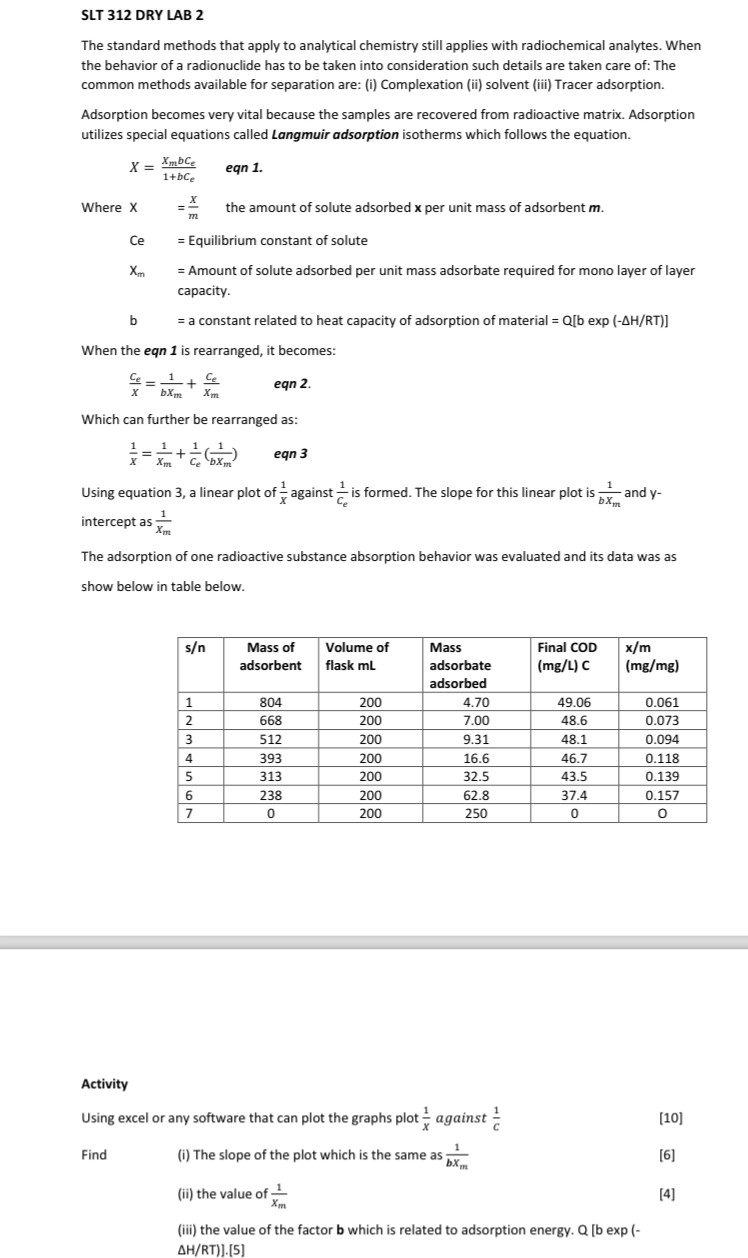
Adsorption becomes very vital because the samples are recovered from radioactive matrix. Adsorption utilizes special equations called Langmuir adsorption isotherms which follows the equation.
eqn
Where the amount of solute adsorbed per unit mass of adsorbent
Equilibrium constant solute
Amount solute adsorbed per unit mass adsorbate required for mono layer layer
capacity.
a constant related heat capacity adsorption material
When the eqn is rearranged, it becomes:
eqn
Which can further be rearranged as:
eqn
Using equation a linear plot of against is formed. The slope for this linear plot is and intercept as
The adsorption of one radioactive substance absorption behavior was evaluated and its data was as show below in table below.
tabletableMass ofadsorbenttableVolume offlask mLtableMassadsorbateadsorbedtableFinal CODmgL Ctable
Step by Step Solution
There are 3 Steps involved in it
1 Expert Approved Answer
Step: 1 Unlock

Question Has Been Solved by an Expert!
Get step-by-step solutions from verified subject matter experts
Step: 2 Unlock
Step: 3 Unlock
 Study Help