







Question: SM 3. Differentiate w.r.t x the following functions: (a) ( b ) x 1 ( x2 + 1 ) Vx (c) (d) *+1 x -
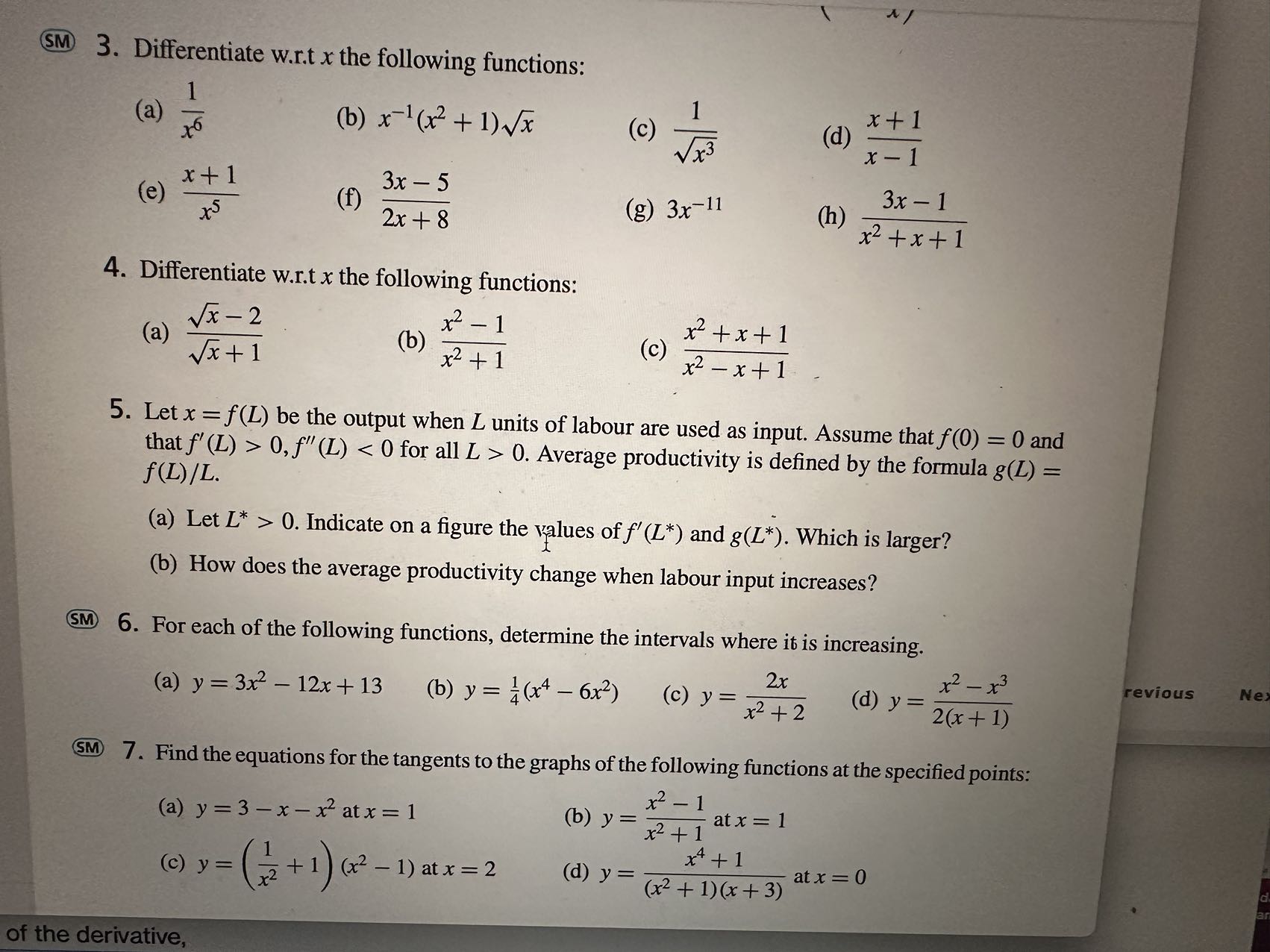
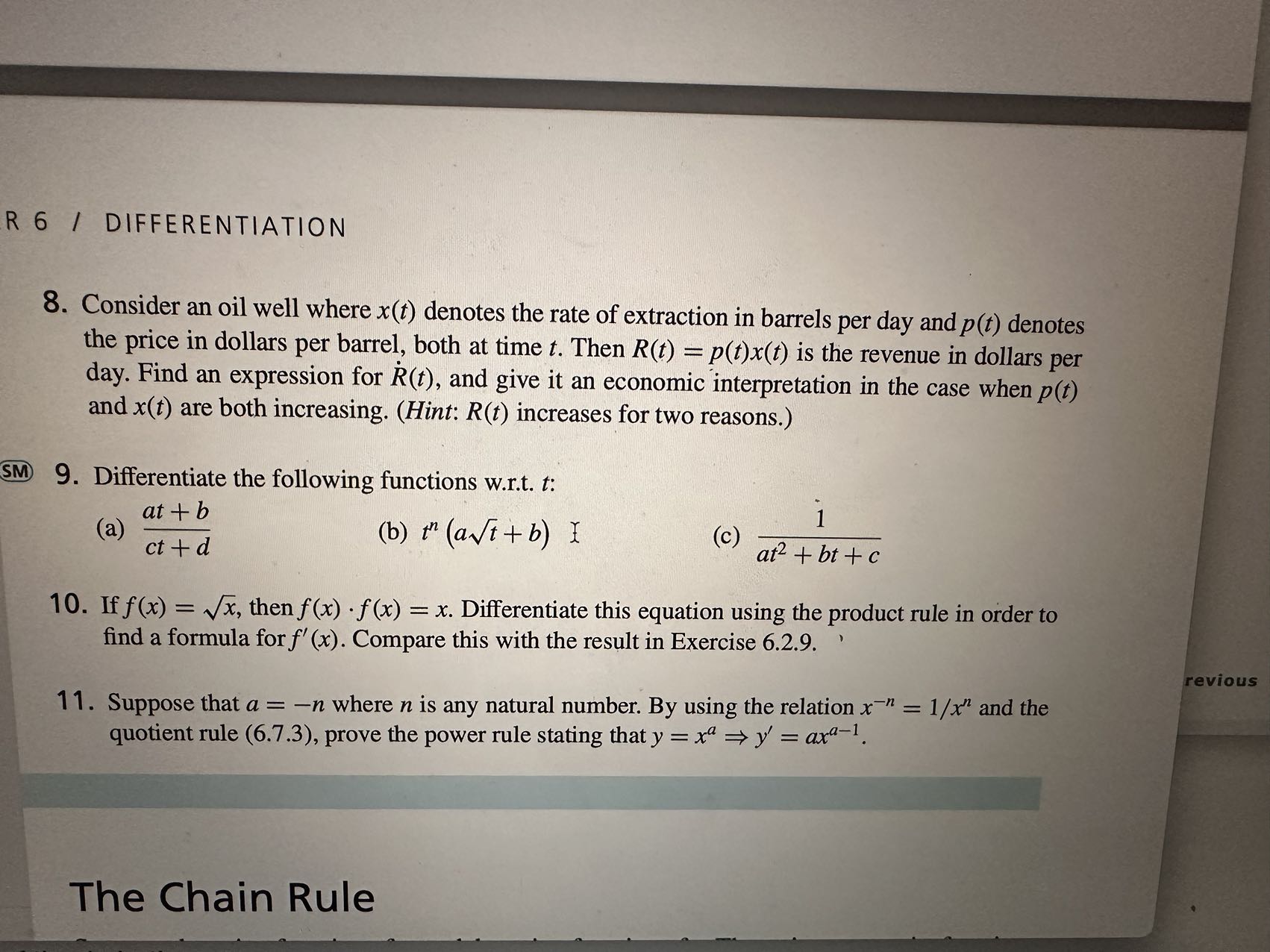
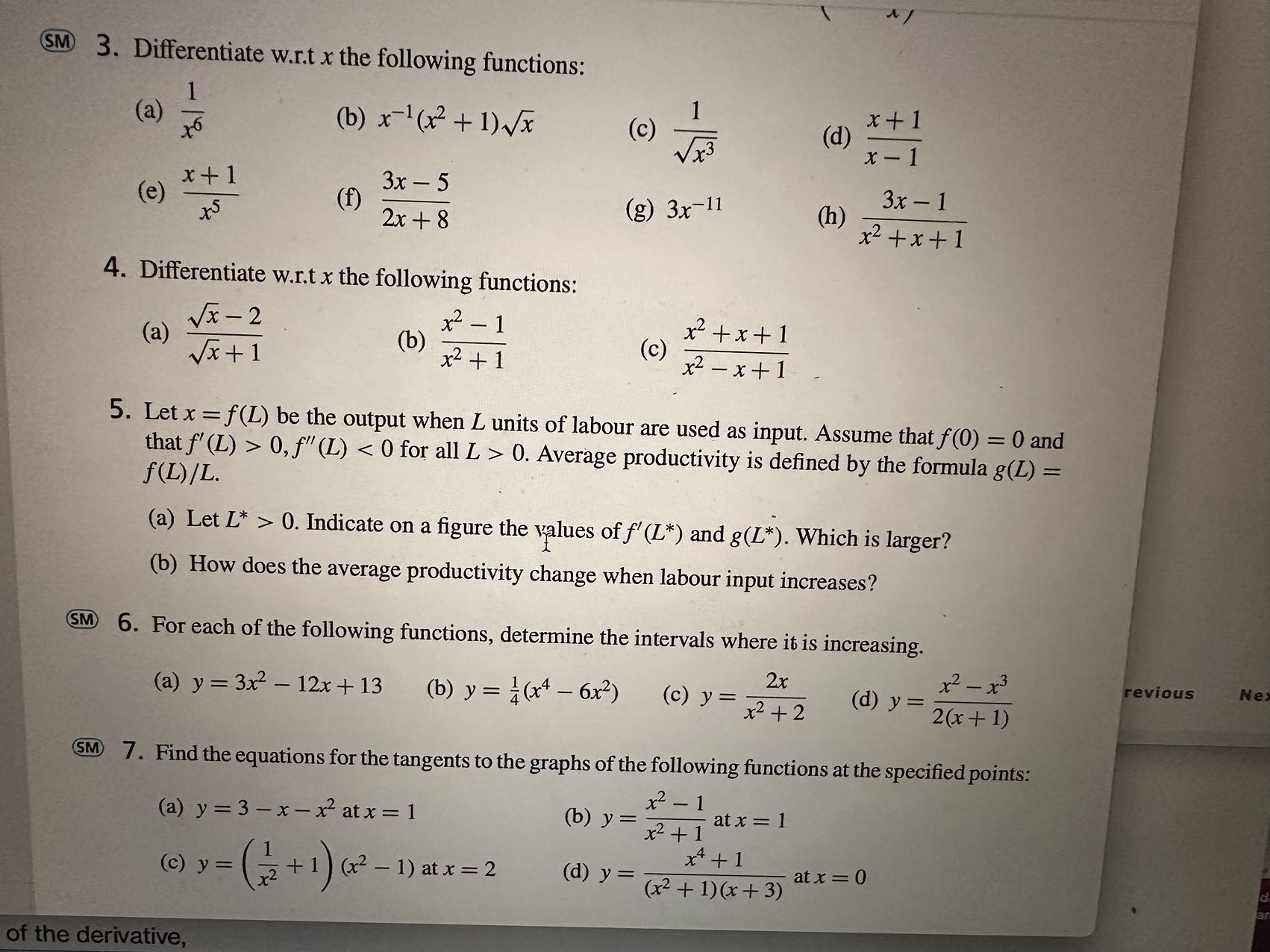
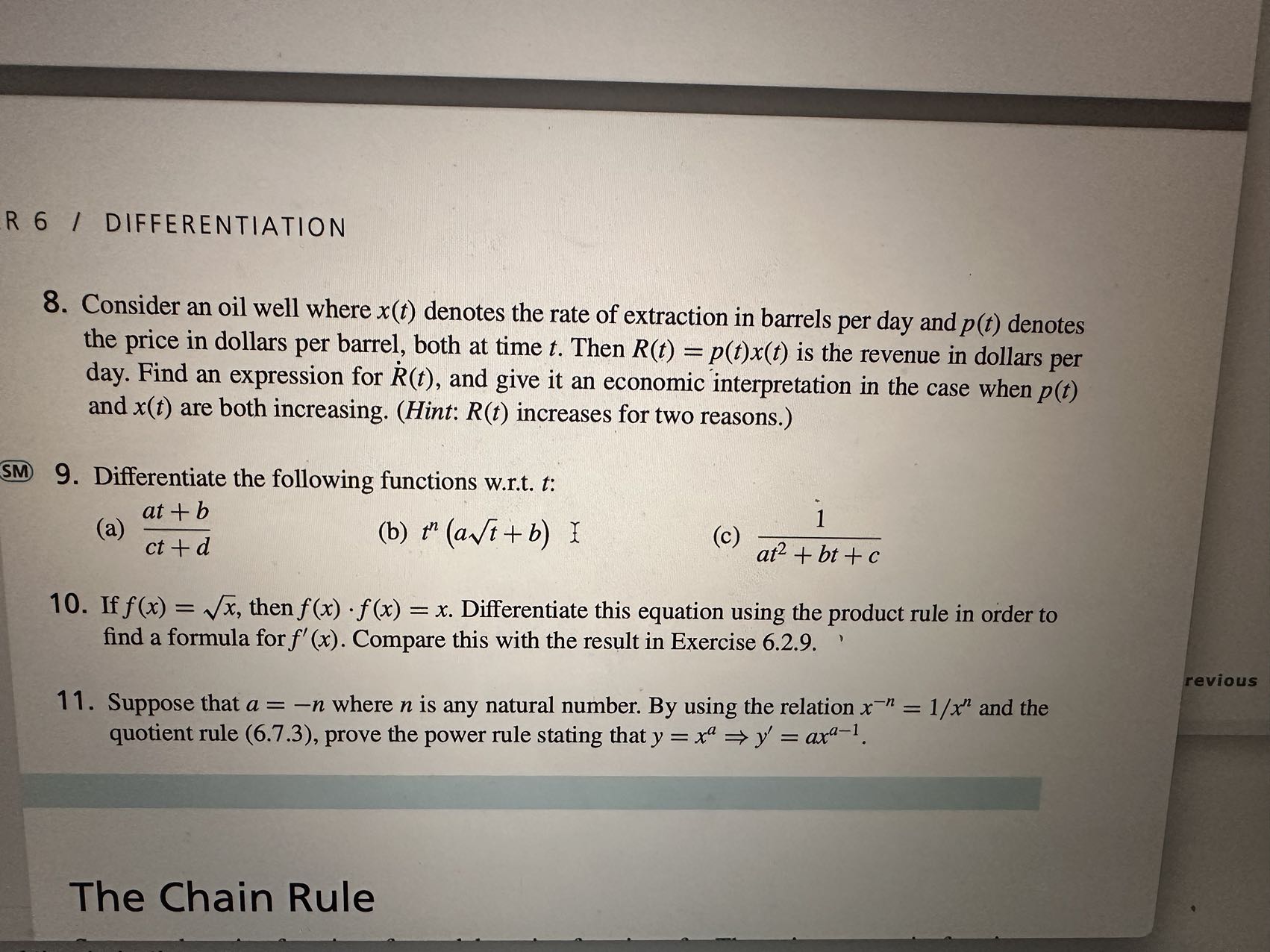
SM 3. Differentiate w.r.t x the following functions: (a) ( b ) x 1 ( x2 + 1 ) Vx (c) (d) *+1 x - 1 (e) *+1 3x - 5 3x - 1 x5 ( f ) 2x + 8 (g) 3x-11 (h) x 2 + x + 1 4. Differentiate w.r.t x the following functions: (a) Vx - 2 Vx+ 1 ( b ) 1 x2 + 1 (c) *+x+1 x2 - x+1 5. Let x = f(L) be the output when L units of labour are used as input. Assume that f(0) = 0 and that f' (L) > 0, f"(L) 0. Average productivity is defined by the formula g(L) = f(L) / L. (a) Let L* > 0. Indicate on a figure the values of f' (L*) and g(L*). Which is larger? (b) How does the average productivity change when labour input increases? SM 6. For each of the following functions, determine the intervals where it is increasing. (a) y = 3x2 - 12x + 13 (b) y = 4(x4- 6x2) (0) y = x2+ 2 2x x2-x3 revious Nex (d) y = 2 (x + 1) SM 7. Find the equations for the tangents to the graphs of the following functions at the specified points: x 2 - (a) y = 3- x-x atx = 1 ( b ) y = ; at x = 1 x2 + 1 (c) y = * 2 + 1 ) ( x 2 - 1 ) at x = 2 * *+ 1 (d) y = (x2 + 1) (x + 3) at x = 0 of the derivative,R 6 / DIFFERENTIATION 8. Consider an oil well where x(t) denotes the rate of extraction in barrels per day and p(t) denotes the price in dollars per barrel, both at time t. Then R(t) = p(t)x(t) is the revenue in dollars per day. Find an expression for R(t), and give it an economic interpretation in the case when p(t) and x(t) are both increasing. (Hint: R(t) increases for two reasons.) SM 9. Differentiate the following functions w.r.t. t: at + b (a) ( b ) th ( avt + b) I ct + d (c) at2 + bt + c 10. If f(x) = x, then f(x) . f(x) = x. Differentiate this equation using the product rule in order to find a formula for f' (x). Compare this with the result in Exercise 6.2.9. revious 11. Suppose that a = -n where n is any natural number. By using the relation x-" = 1/x" and the quotient rule (6.7.3), prove the power rule stating that y = x" = y' = axa-1. The Chain Rule
Step by Step Solution
There are 3 Steps involved in it

Get step-by-step solutions from verified subject matter experts
 Study Help