



Question: Snap Inc.'s IPO (A) and (B) This case examines the proposed IPO pricing and valuation of Snap Inc., a young an unprofitable technology company. It
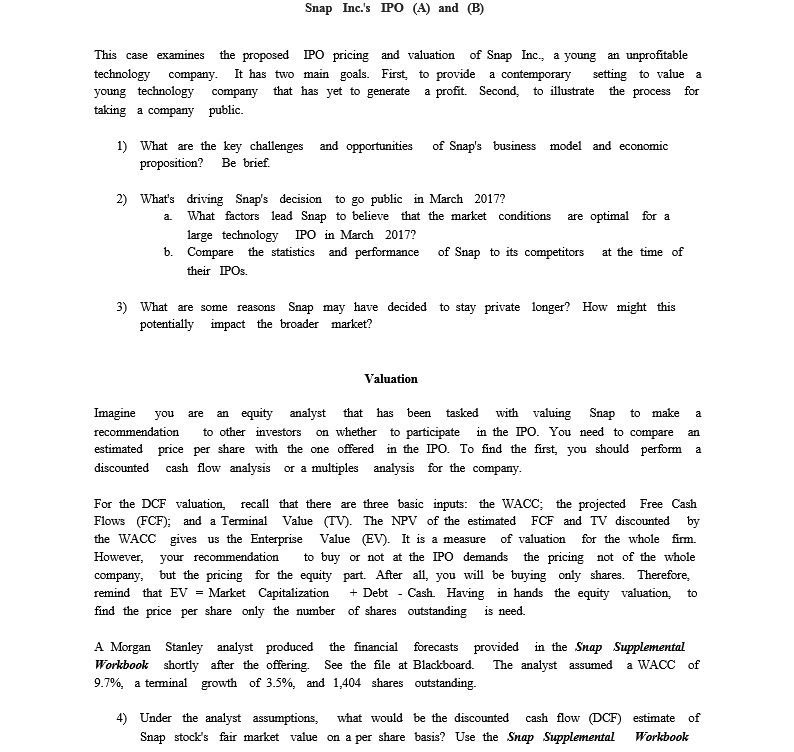
Snap Inc.'s IPO (A) and (B) This case examines the proposed IPO pricing and valuation of Snap Inc., a young an unprofitable technology company. It has two main goals. First, to provide a contemporary setting to value a young technology company that has yet to generate a profit. Second, to illustrate the process for taking a company public. What are the key challenges and opportunities of Snap's business model and economic proposition? Be brief. What's driving Snap's decision to go public in March 2017? a. What factors lead Snap to believe that the market conditions are optimal for a large technology IPO in March 2017? b. Compare the statistics and performance of Snap to its competitors at the time of their IPOs. 3) What are some reasons Snap may have decided to stay private longer? How might this potentially impact the broader market? Valuation Imagine you are an equity analyst that has been tasked with valuing Snap to make a recommendation to other investors on whether to participate in the IPO. You need to compare an estimated price per share with the one offered in the IPO. To find the first, you should perform a discounted cash flow analysis or a multiples a analysis for the company. For the DCF valuation, recall that there are three basic inputs: the WACC; the projected Free Cash Flows (FCF); and a Terminal Value (TV). The NPV of the estimated FCF and TV discounted by the WACC gives us the Enterprise Value (EV). It is a measure of valuation for the whole firm. However, your recommendation to buy or not at the IPO demands the pricing not of the whole company, but the pricing for the equity part. After all, you will be buying only shares. Therefore, remind that EV = Market Capitalization + Debt - Cash. Having in hands the equity valuation, to find the price per share only the number of shares outstanding is need A Morgan Stanley analyst produced the financial forecasts provided in the Snap Supplemental Workbook shortly after the offering. See the file at Blackboard. The analyst assumed a WACC of 9.7%, a terminal growth of 3.5%, and 1,404 shares outstanding. Under the analyst assumptions, what would be the discounted cash flow (DCF) e estimate of Snap stock's fair market value on a per share basis? Use the Snap Supplemental Workbook
Step by Step Solution
There are 3 Steps involved in it

Get step-by-step solutions from verified subject matter experts