







Question: So now we need to determine our direct labor needs. Direct labor includes all of the employees who are required to actually manufacture the shoes.
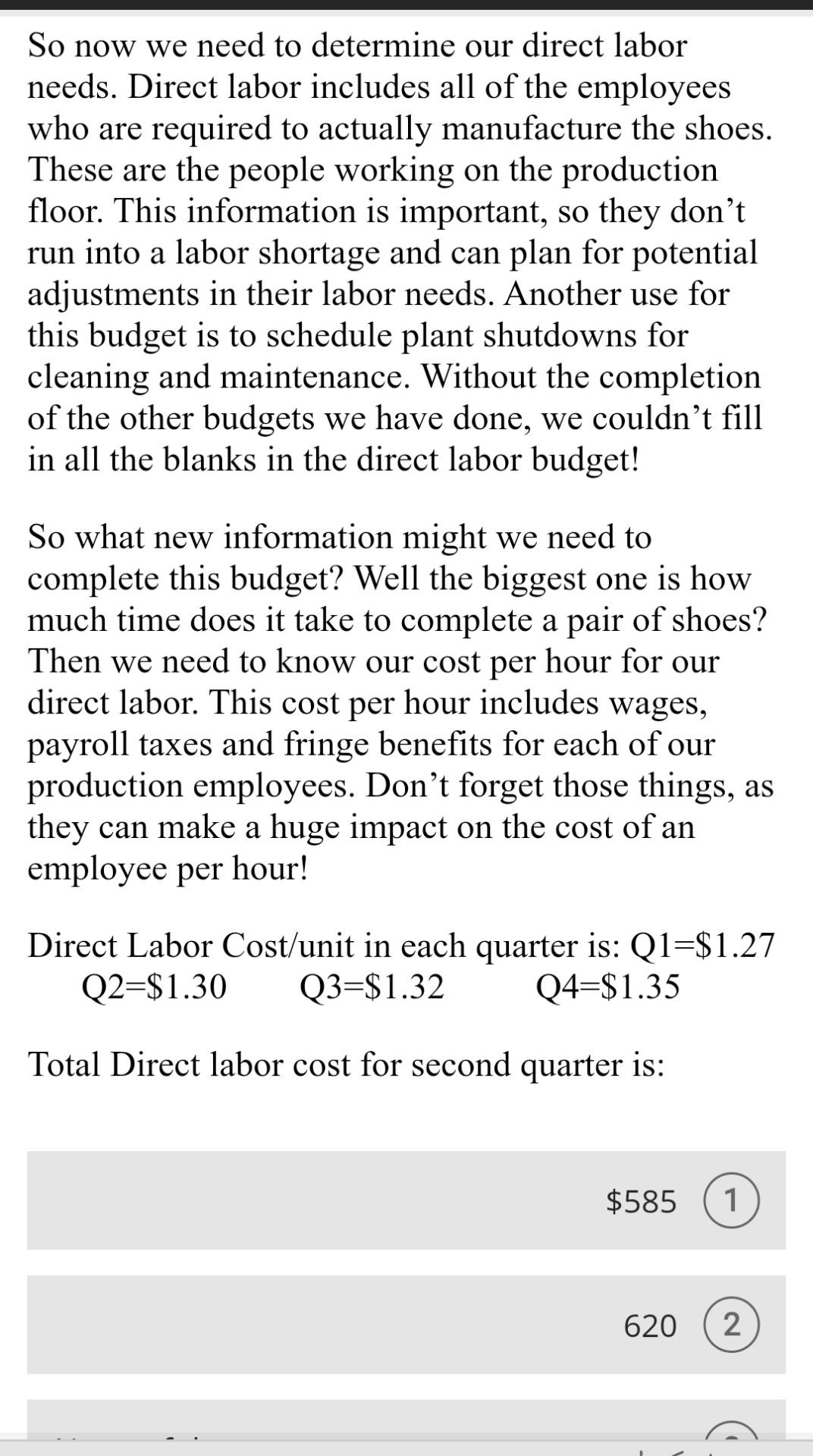
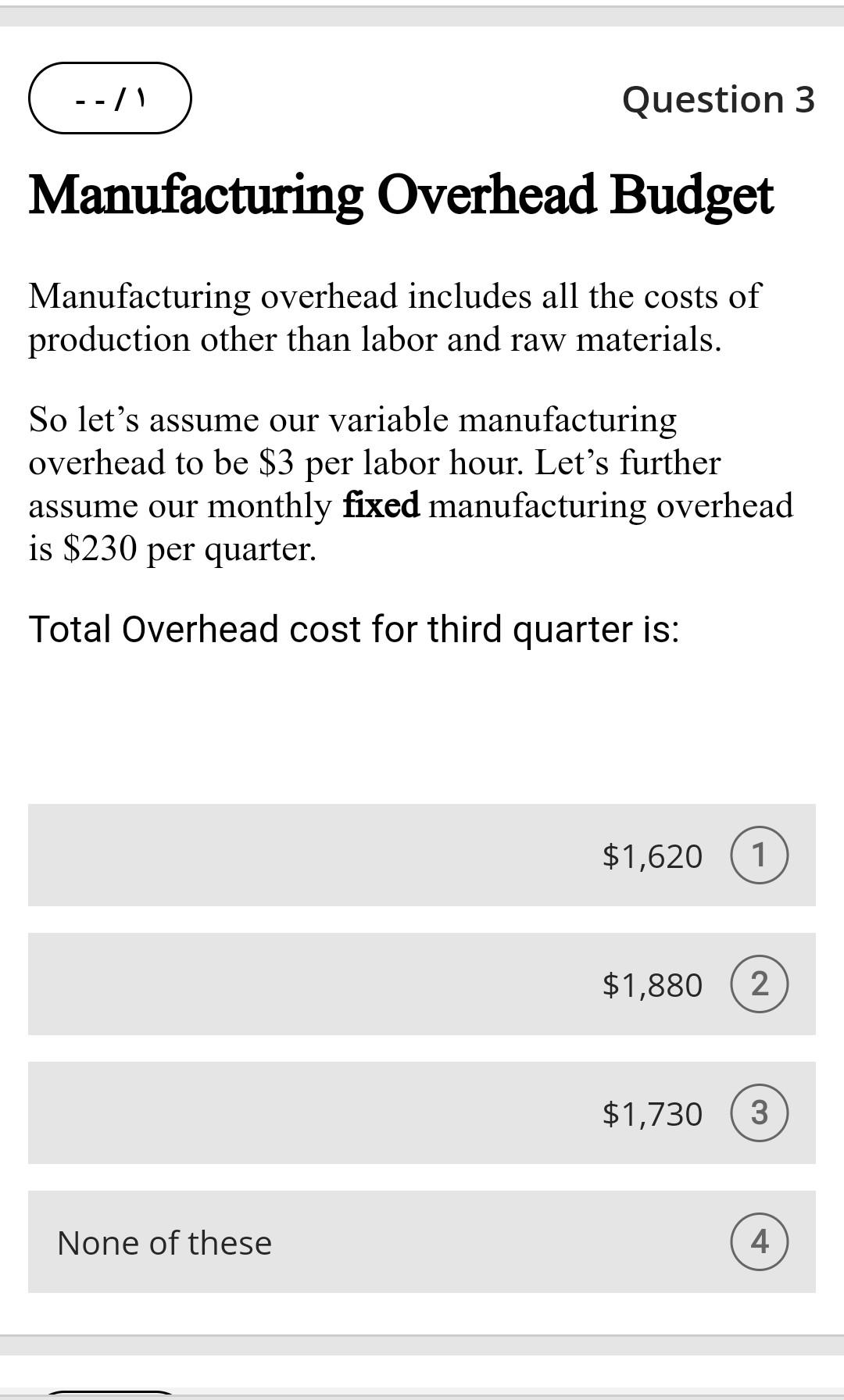
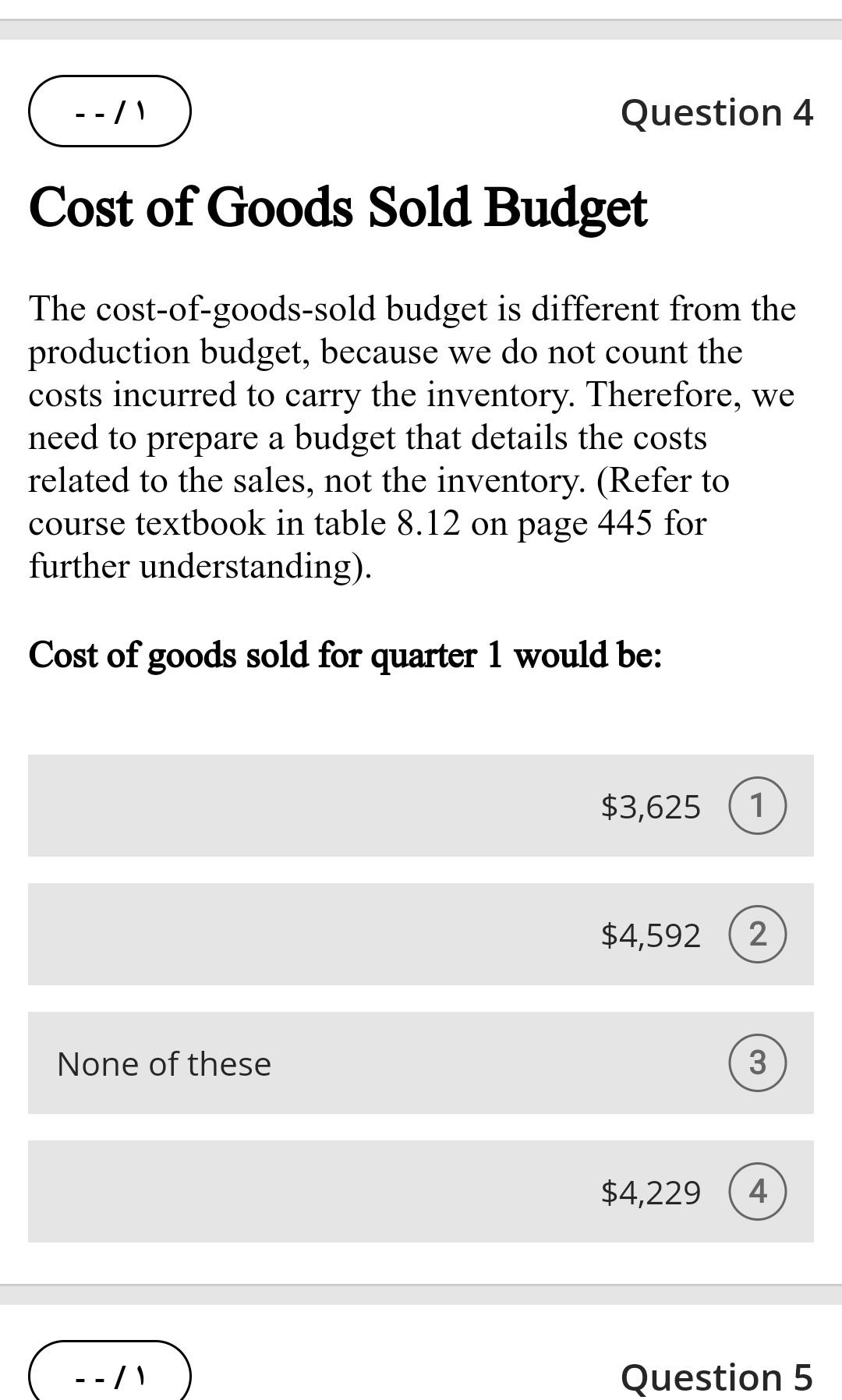
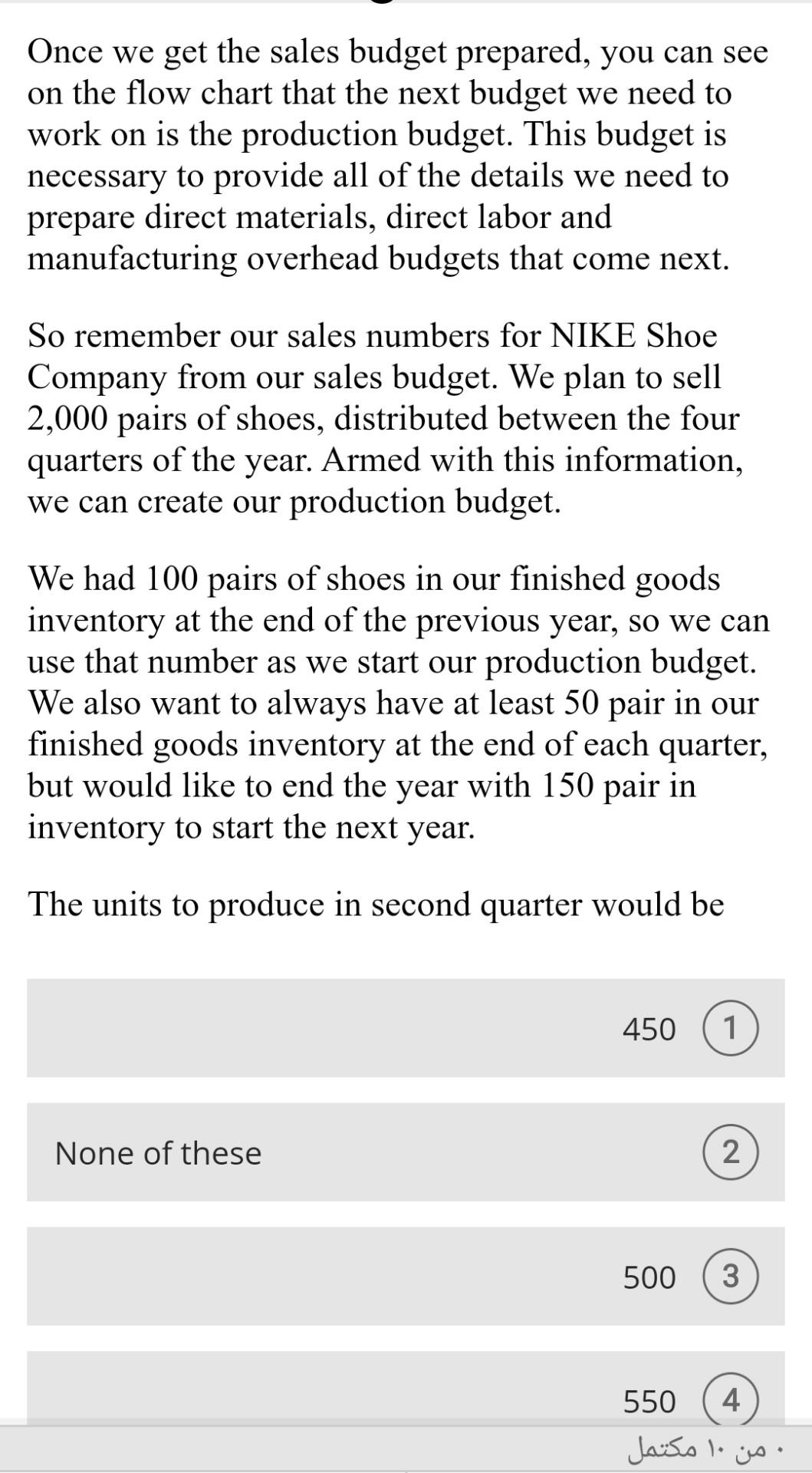
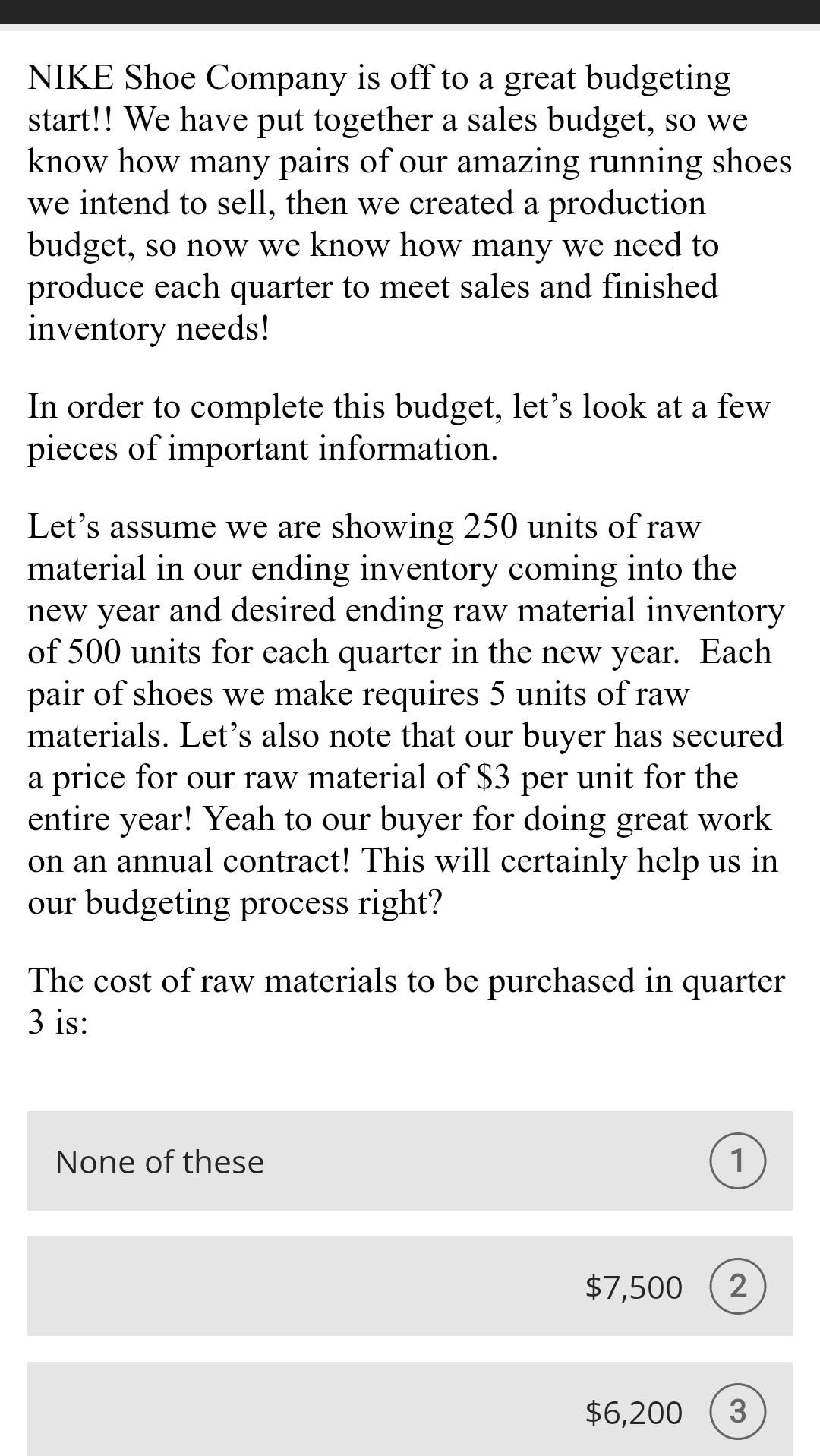
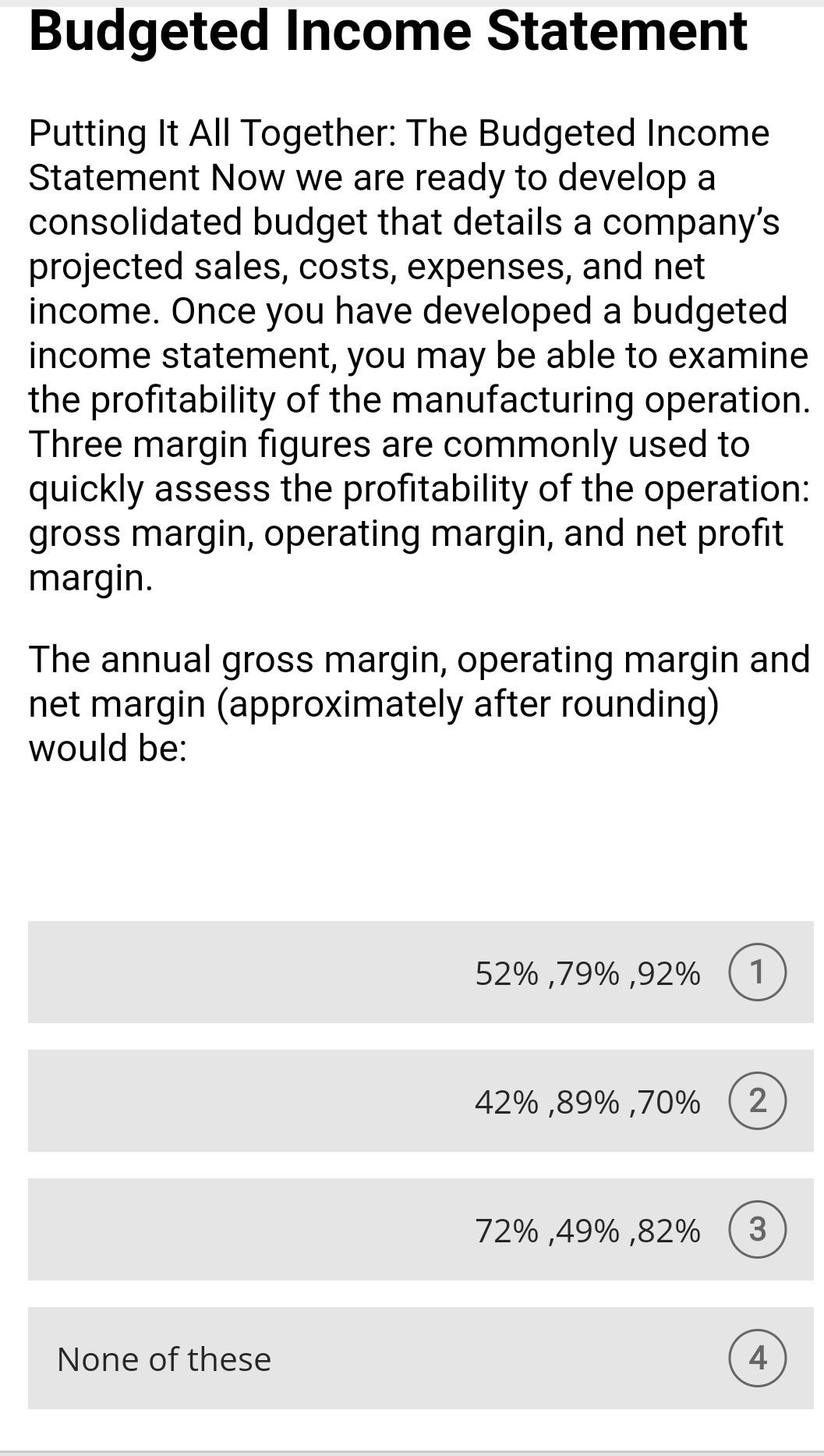
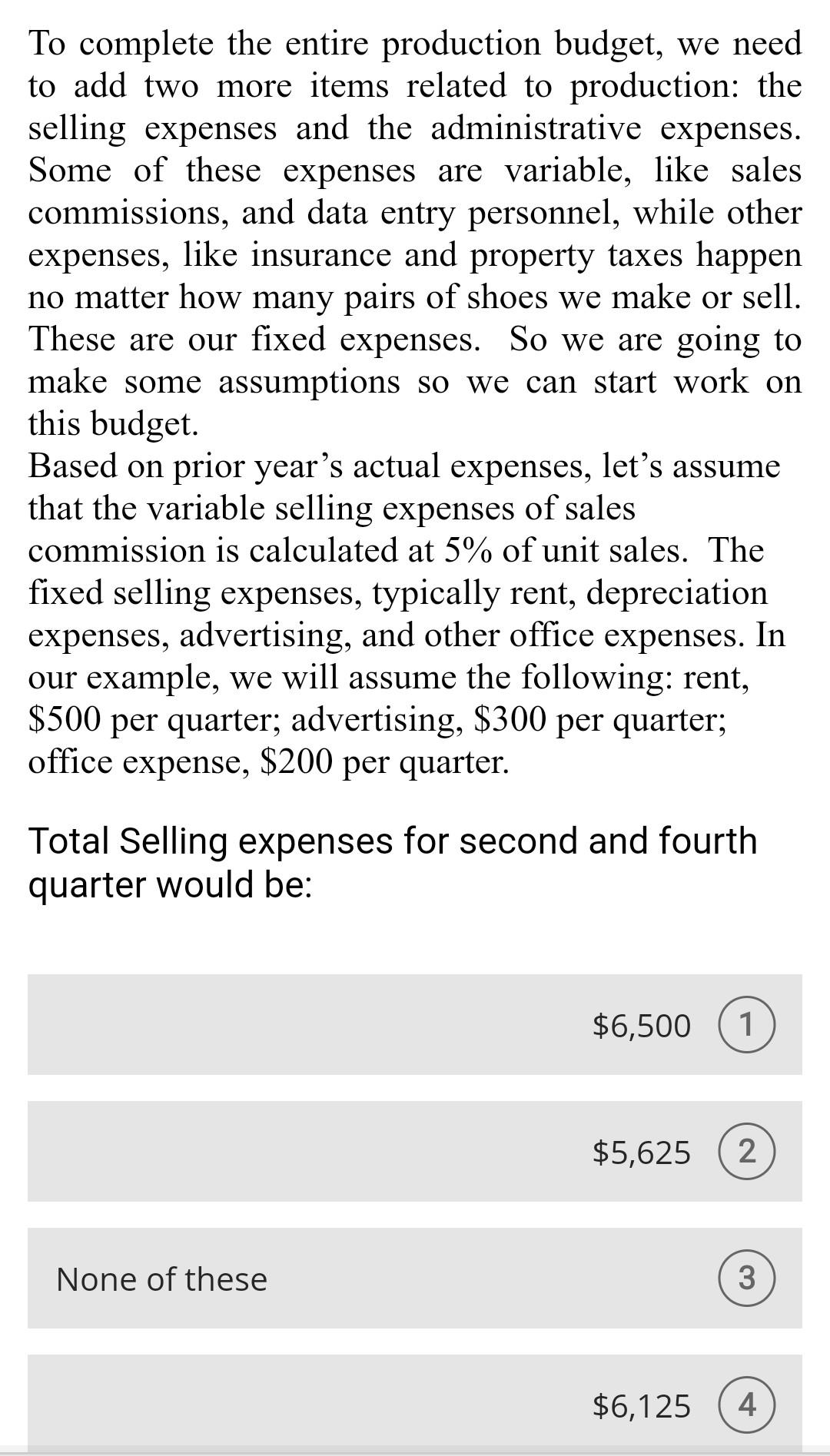
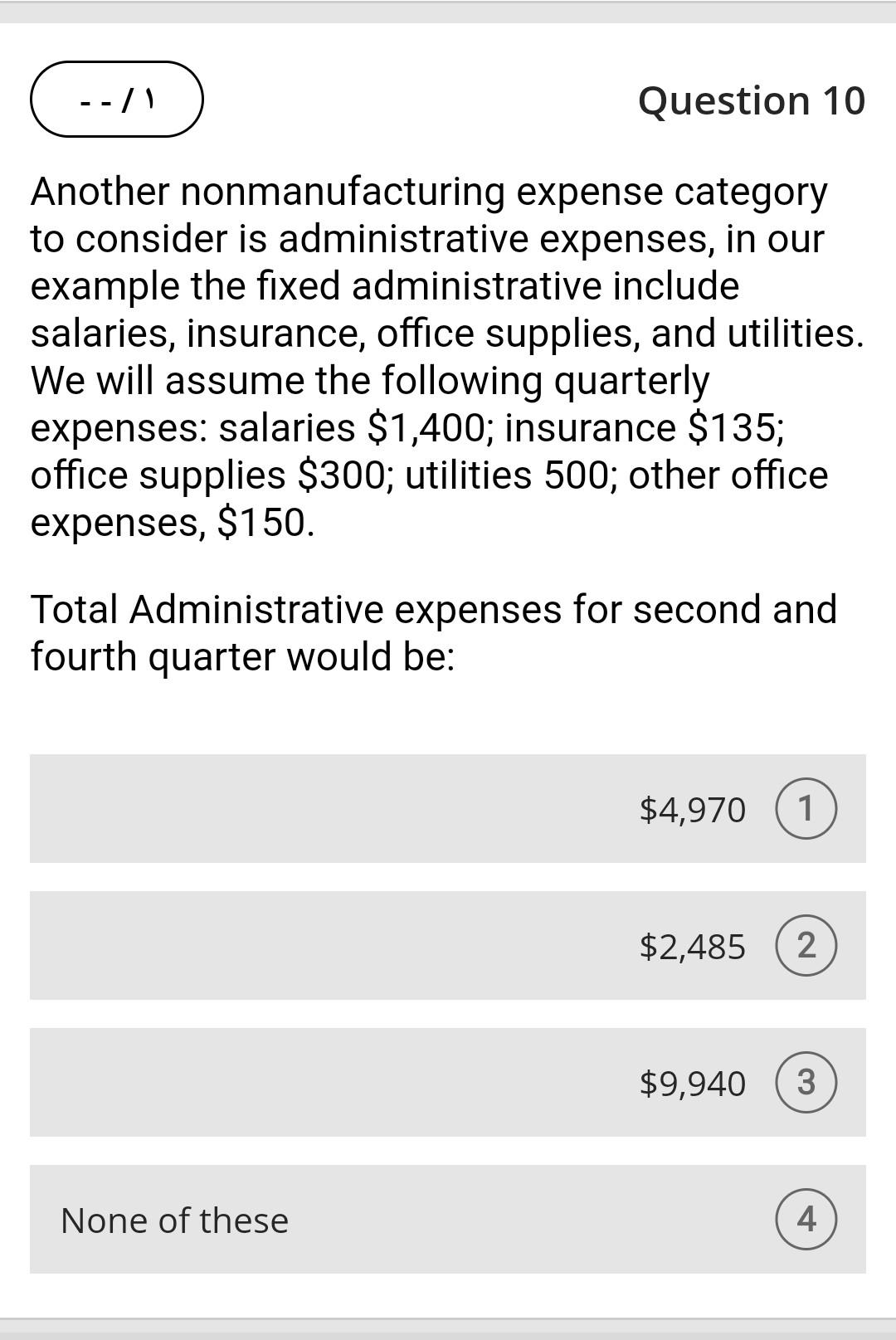
So now we need to determine our direct labor needs. Direct labor includes all of the employees who are required to actually manufacture the shoes. These are the people working on the production floor. This information is important, so they don't run into a labor shortage and can plan for potential adjustments in their labor needs. Another use for this budget is to schedule plant shutdowns for cleaning and maintenance. Without the completion of the other budgets we have done, we couldn't fill in all the blanks in the direct labor budget! So what new information might we need to complete this budget? Well the biggest one is how much time does it take to complete a pair of shoes? Then we need to know our cost per hour for our direct labor. This cost per hour includes wages, payroll taxes and fringe benefits for each of our production employees. Don't forget those things, as they can make a huge impact on the cost of an employee per hour! ! Direct Labor Cost/unit in each quarter is: Q1=$1.27 Q2=$1.30 Q3=$1.32 Q4=$1.35 Total Direct labor cost for second quarter is: $585 1 620 2 - 71 Question 4 Cost of Goods Sold Budget The cost-of-goods-sold budget is different from the production budget, because we do not count the costs incurred to carry the inventory. Therefore, we need to prepare a budget that details the costs related to the sales, not the inventory. (Refer to course textbook in table 8.12 on page 445 for further understanding). Cost of goods sold for quarter 1 would be: $3,625 1 $4,592 2. None of these 3 $4,229 4 --/1 Question 5 Once we get the sales budget prepared, you can see on the flow chart that the next budget we need to work on is the production budget. This budget is necessary to provide all of the details we need to prepare direct materials, direct labor and manufacturing overhead budgets that come next. So remember our sales numbers for NIKE Shoe Company from our sales budget. We plan to sell 2,000 pairs of shoes, distributed between the four quarters of the year. Armed with this information, we can create our production budget. We had 100 pairs of shoes in our finished goods inventory at the end of the previous year, so we can use that number as we start our production budget. We also want to always have at least 50 pair in our finished goods inventory at the end of each quarter, but would like to end the year with 150 pair in inventory to start the next year. The units to produce in second quarter would be 450 1 None of these 2 500 3 550 4 : NIKE Shoe Company is off to a great budgeting start!! We have put together a sales budget, so we know how many pairs of our amazing running shoes we intend to sell, then we created a production budget, so now we know how many we need to produce each quarter to meet sales and finished inventory needs! In order to complete this budget, let's look at a few pieces of important information. Let's assume we are showing 250 units of raw material in our ending inventory coming into the new year and desired ending raw material inventory of 500 units for each quarter in the new year. Each pair of shoes we make requires 5 units of raw materials. Let's also note that our buyer has secured a price for our raw material of $3 per unit for the entire year! Yeah to our buyer for doing great work on an annual contract! This will certainly help us in our budgeting process right? The cost of raw materials to be purchased in quarter 3 is: None of these 1 $7,500 2 $6,200 3 Budgeted Income Statement Putting It All Together: The Budgeted Income Statement Now we are ready to develop a consolidated budget that details a company's projected sales, costs, expenses, and net income. Once you have developed a budgeted income statement, you may be able to examine the profitability of the manufacturing operation. Three margin figures are commonly used to quickly assess the profitability of the operation: gross margin, operating margin, and net profit margin. The annual gross margin, operating margin and net margin (approximately after rounding) would be: 52% ,79% ,92% 1 42% ,89% ,70% 2 72% ,49% ,82% 3 None of these 4 To complete the entire production budget, we need to add two more items related to production: the selling expenses and the administrative expenses. Some of these expenses are variable, like sales commissions, and data entry personnel, while other expenses, like insurance and property taxes happen no matter how many pairs of shoes we make or sell. These are our fixed expenses. So we are going to make some assumptions so we can start work on this budget. Based on prior year's actual expenses, let's assume that the variable selling expenses of sales commission is calculated at 5% of unit sales. The fixed selling expenses, typically rent, depreciation expenses, advertising, and other office expenses. In our example, we will assume the following: rent, $500 per quarter; advertising, $300 per quarter; office expense, $200 per quarter. Total Selling expenses for second and fourth quarter would be: $6,500 1 $5,625 2 None of these 3 $6,125 4. Question 10 Another nonmanufacturing expense category to consider is administrative expenses, in our example the fixed administrative include salaries, insurance, office supplies, and utilities. We will assume the following quarterly expenses: salaries $1,400; insurance $135; office supplies $300; utilities 500; other office expenses, $150. Total Administrative expenses for second and fourth quarter would be: $4,970 1 $2,485 2 $9,940 3 None of these 4 So now we need to determine our direct labor needs. Direct labor includes all of the employees who are required to actually manufacture the shoes. These are the people working on the production floor. This information is important, so they don't run into a labor shortage and can plan for potential adjustments in their labor needs. Another use for this budget is to schedule plant shutdowns for cleaning and maintenance. Without the completion of the other budgets we have done, we couldn't fill in all the blanks in the direct labor budget! So what new information might we need to complete this budget? Well the biggest one is how much time does it take to complete a pair of shoes? Then we need to know our cost per hour for our direct labor. This cost per hour includes wages, payroll taxes and fringe benefits for each of our production employees. Don't forget those things, as they can make a huge impact on the cost of an employee per hour! ! Direct Labor Cost/unit in each quarter is: Q1=$1.27 Q2=$1.30 Q3=$1.32 Q4=$1.35 Total Direct labor cost for second quarter is: $585 1 620 2 - 71 Question 4 Cost of Goods Sold Budget The cost-of-goods-sold budget is different from the production budget, because we do not count the costs incurred to carry the inventory. Therefore, we need to prepare a budget that details the costs related to the sales, not the inventory. (Refer to course textbook in table 8.12 on page 445 for further understanding). Cost of goods sold for quarter 1 would be: $3,625 1 $4,592 2. None of these 3 $4,229 4 --/1 Question 5 Once we get the sales budget prepared, you can see on the flow chart that the next budget we need to work on is the production budget. This budget is necessary to provide all of the details we need to prepare direct materials, direct labor and manufacturing overhead budgets that come next. So remember our sales numbers for NIKE Shoe Company from our sales budget. We plan to sell 2,000 pairs of shoes, distributed between the four quarters of the year. Armed with this information, we can create our production budget. We had 100 pairs of shoes in our finished goods inventory at the end of the previous year, so we can use that number as we start our production budget. We also want to always have at least 50 pair in our finished goods inventory at the end of each quarter, but would like to end the year with 150 pair in inventory to start the next year. The units to produce in second quarter would be 450 1 None of these 2 500 3 550 4 : NIKE Shoe Company is off to a great budgeting start!! We have put together a sales budget, so we know how many pairs of our amazing running shoes we intend to sell, then we created a production budget, so now we know how many we need to produce each quarter to meet sales and finished inventory needs! In order to complete this budget, let's look at a few pieces of important information. Let's assume we are showing 250 units of raw material in our ending inventory coming into the new year and desired ending raw material inventory of 500 units for each quarter in the new year. Each pair of shoes we make requires 5 units of raw materials. Let's also note that our buyer has secured a price for our raw material of $3 per unit for the entire year! Yeah to our buyer for doing great work on an annual contract! This will certainly help us in our budgeting process right? The cost of raw materials to be purchased in quarter 3 is: None of these 1 $7,500 2 $6,200 3 Budgeted Income Statement Putting It All Together: The Budgeted Income Statement Now we are ready to develop a consolidated budget that details a company's projected sales, costs, expenses, and net income. Once you have developed a budgeted income statement, you may be able to examine the profitability of the manufacturing operation. Three margin figures are commonly used to quickly assess the profitability of the operation: gross margin, operating margin, and net profit margin. The annual gross margin, operating margin and net margin (approximately after rounding) would be: 52% ,79% ,92% 1 42% ,89% ,70% 2 72% ,49% ,82% 3 None of these 4 To complete the entire production budget, we need to add two more items related to production: the selling expenses and the administrative expenses. Some of these expenses are variable, like sales commissions, and data entry personnel, while other expenses, like insurance and property taxes happen no matter how many pairs of shoes we make or sell. These are our fixed expenses. So we are going to make some assumptions so we can start work on this budget. Based on prior year's actual expenses, let's assume that the variable selling expenses of sales commission is calculated at 5% of unit sales. The fixed selling expenses, typically rent, depreciation expenses, advertising, and other office expenses. In our example, we will assume the following: rent, $500 per quarter; advertising, $300 per quarter; office expense, $200 per quarter. Total Selling expenses for second and fourth quarter would be: $6,500 1 $5,625 2 None of these 3 $6,125 4. Question 10 Another nonmanufacturing expense category to consider is administrative expenses, in our example the fixed administrative include salaries, insurance, office supplies, and utilities. We will assume the following quarterly expenses: salaries $1,400; insurance $135; office supplies $300; utilities 500; other office expenses, $150. Total Administrative expenses for second and fourth quarter would be: $4,970 1 $2,485 2 $9,940 3 None of these 4
Step by Step Solution
There are 3 Steps involved in it

Get step-by-step solutions from verified subject matter experts
 Study Help