







Question: Current technology uses highresolution X-rays and lasers for inspection of solder-joint defects on printed circuit boards (PCBS) (Global SMT & Packaging, April 2008). A
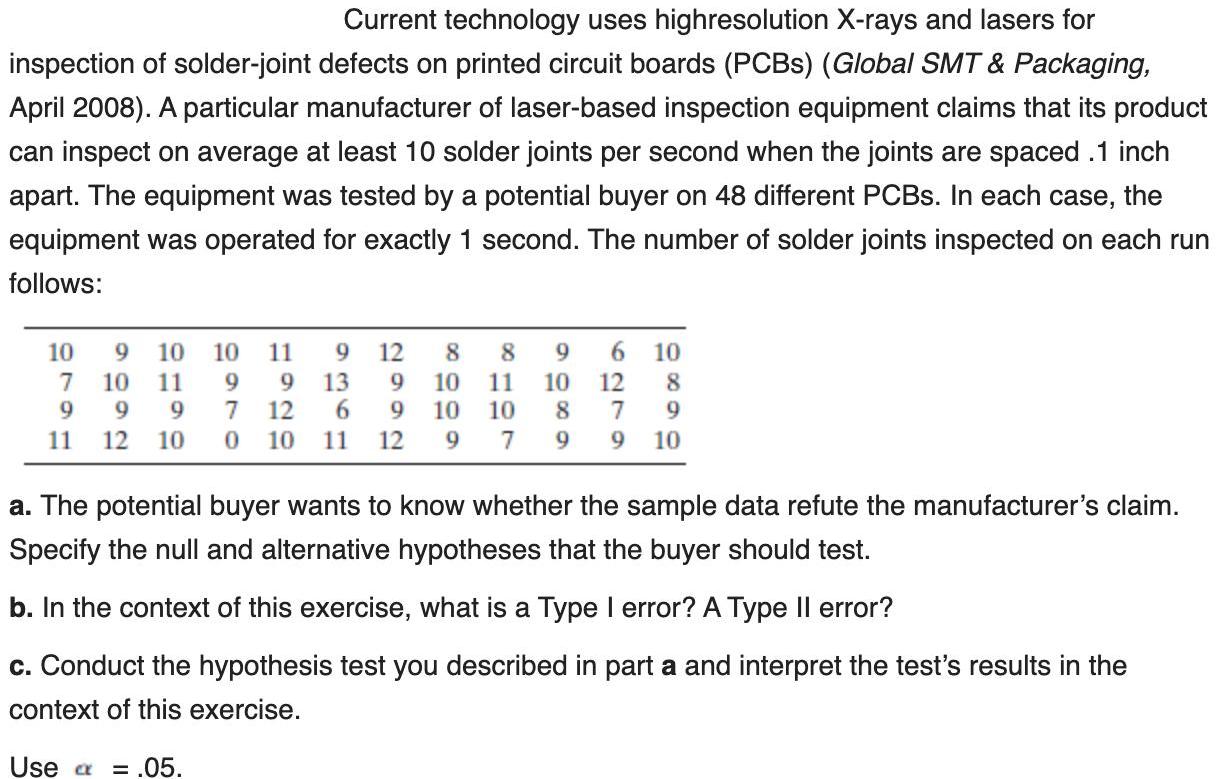
Current technology uses highresolution X-rays and lasers for inspection of solder-joint defects on printed circuit boards (PCBS) (Global SMT & Packaging, April 2008). A particular manufacturer of laser-based inspection equipment claims that its product can inspect on average at least 10 solder joints per second when the joints are spaced .1 inch apart. The equipment was tested by a potential buyer on 48 different PCBS. In each case, the equipment was operated for exactly 1 second. The number of solder joints inspected on each run follows: 10 10 10 11 9. 12 8. 8 9. 6. 10 7 10 11 9. 9. 13 9. 10 11 10 10 12 8. 9. 9. 9. 7 12 6. 9. 10 8. 9. 11 12 10 10 11 12 7 9. 9. 10 a. The potential buyer wants to know whether the sample data refute the manufacturer's claim. Specify the null and alternative hypotheses that the buyer should test. b. In the context of this exercise, what is a Type I error? A Type Il error? c. Conduct the hypothesis test you described in part a and interpret the test's results in the context of this exercise. Use a = .05.
Step by Step Solution
3.48 Rating (155 Votes )
There are 3 Steps involved in it

Get step-by-step solutions from verified subject matter experts
Document Format (2 attachments)

6361fcb854d40_235848.pdf
180 KBs PDF File

6361fcb854d40_235848.docx
120 KBs Word File
 Study Help