







Question: Solid samples often must be crushed or ground to create particles of smaller average size prior to analysis. However, during this sample preparation, contamination or
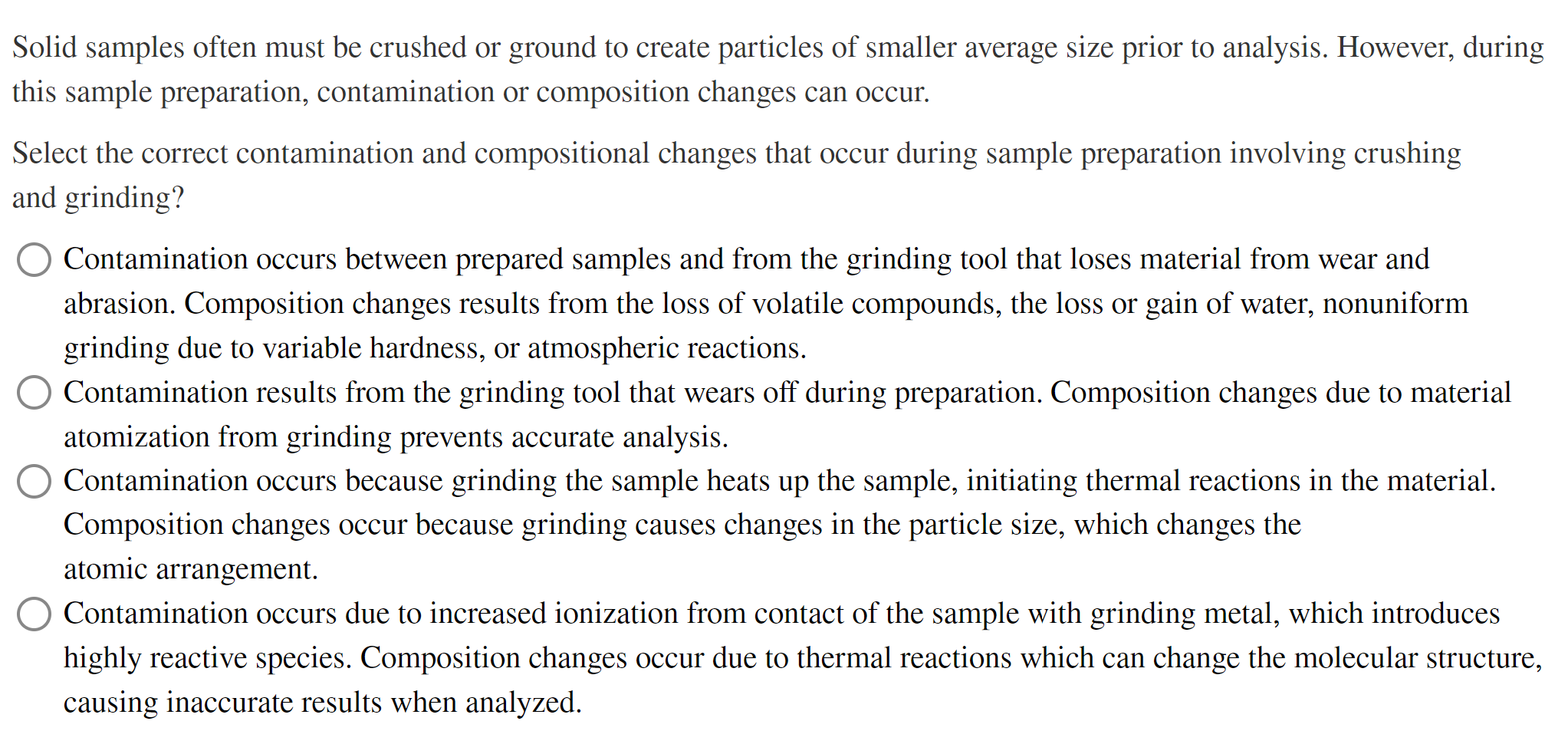
Solid samples often must be crushed or ground to create particles of smaller average size prior to analysis. However, during
this sample preparation, contamination or composition changes can occur.
Select the correct contamination and compositional changes that occur during sample preparation involving crushing
and grinding?
Contamination occurs between prepared samples and from the grinding tool that loses material from wear and
abrasion. Composition changes results from the loss of volatile compounds, the loss or gain of water, nonuniform
grinding due to variable hardness, or atmospheric reactions.
Contamination results from the grinding tool that wears off during preparation. Composition changes due to material
atomization from grinding prevents accurate analysis.
Contamination occurs because grinding the sample heats up the sample, initiating thermal reactions in the material.
Composition changes occur because grinding causes changes in the particle size, which changes the
atomic arrangement.
Contamination occurs due to increased ionization from contact of the sample with grinding metal, which introduces
highly reactive species. Composition changes occur due to thermal reactions which can change the molecular structure,
causing inaccurate results when analyzed.
Step by Step Solution
There are 3 Steps involved in it
1 Expert Approved Answer
Step: 1 Unlock

Question Has Been Solved by an Expert!
Get step-by-step solutions from verified subject matter experts
Step: 2 Unlock
Step: 3 Unlock
 Study Help