







Question: SOLUTION Part (a) 1. Divide the horizontal distance, d, by the time of B - d 17.8 m - 7.95 m/s 2.24s flight, f, to
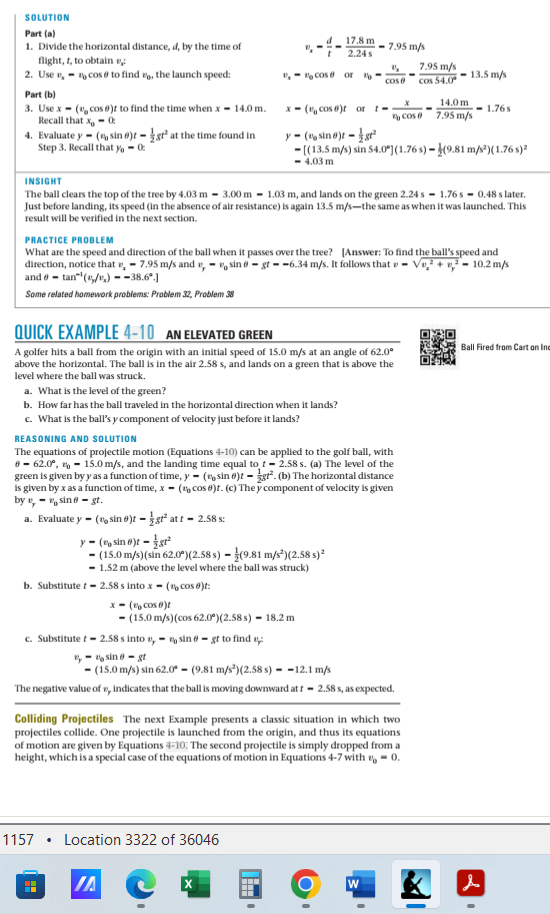
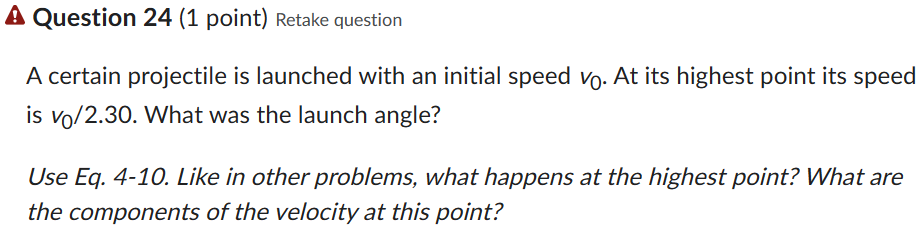
SOLUTION Part (a) 1. Divide the horizontal distance, d, by the time of B - d 17.8 m - 7.95 m/s 2.24s flight, f, to obtain of 7.95 m/'s 2. Use e, = th cose to find co, the launch speed: COSE Cos 54,0 - 13.5 m/s Part (b) 3. Use x = (, cose)f to find the time when x = 14.0m. x - ( coso)f or = 140m - 1.765 Recall that x, = 0 Th Cos # 7.95 m/s 4. Evaluate y = (to sing)t - agri at the time found in y = (to sing)t - gt Step 3. Recall that yo = 0: = [(13.5 m/s) sin 54.0"](1.76s) -}(9.81 m/s)(1.76s)# - 4.03 m INSIGHT The ball clears the top of the tree by 4.03 m = 3.00m = 1.03 m, and lands on the green 2.24s - 1.76s - 0.48 s later. Just before landing, its speed (in the absence of air resistance) is again 13.5 m/s-the same as when it was launched. This result will be verified in the next section. PRACTICE PROBLEM What are the speed and direction of the ball when it passes over the tree? [Answer: To find the ball's speed and direction, notice that e, - 7.95 m/s and e, - e, sine - gt - -6.34 m/s. It follows that e - Vo,: + 8,= = 10.2m/'s and o - tan" (8/6,) - -38.6'] Some related homework problems: Problem 32, Problem 38 QUICK EXAMPLE 4-10 AN ELEVATED GREEN A golfer hits a ball from the origin with an initial speed of 15.0 m/s at an angle of 62.0" Ball Fired from Cart on In above the horizontal. The ball is in the air 2.58 s, and lands on a green that is above the level where the ball was struck. a. What is the level of the green? b. How far has the ball traveled in the horizontal direction when it lands? c. What is the ball's y component of velocity just before it lands? REASONING AND SOLUTION The equations of projectile motion (Equations 4-10) can be applied to the golf ball, with 8 - 62.0%, ro - 15.0m/s, and the landing time equal to t - 2.58s. (a) The level of the green is given by y as a function of time, y - (e,sine)t - get . (b) The horizontal distance is given by x as a function of time, x - (, cose)t. (c) They component of velocity is given by e, - cosine - gt. a. Evaluate y - (up sine)t - 7gt att - 2.58 s: y = (to sine)t - 9812 - (15.0 m/s) (sin 62.0)(2.58s) - -(9.81 m/s )(2.58 s)2 - 1.52 m (above the level where the ball was struck) b. Substitute t - 2.58s into x = (to cose)t: x - (6, cos ejt - (15.0 m/s) (cos 62.0-)(2.58s) = 18.2 m C. Substitute * = 2.58s into a, - 6 sine - gt to find up " - to sing - gt - (15.0 m/s) sin 62.0" - (9.81 m/s')(2.58s) - -12.1 m/'s The negative value of e, indicates that the ball is moving downward at f = 2.58 s, as expected. Colliding Projectiles The next Example presents a classic situation in which two projectiles collide. One projectile is launched from the origin, and thus its equations of motion are given by Equations 4-10. The second projectile is simply dropped from a height, which is a special case of the equations of motion in Equations 4-7 with " = 0. 1157 . Location 3322 of 36046 W &A Question 24 (1 point) Retake question A certain projectile is launched with an initial speed v0. At its highest point its speed is v0i2.30. What was the launch angle? Use Eq. 4-10. Like in other probiems, what happens at the highest point? What are the components of the velocity at this point
Step by Step Solution
There are 3 Steps involved in it

Get step-by-step solutions from verified subject matter experts
 Study Help