







Question: solve 1. UML/ER Diagram Exercises A wedding planner that started her business a year ago is finding it difficult to keep track of everything on
solve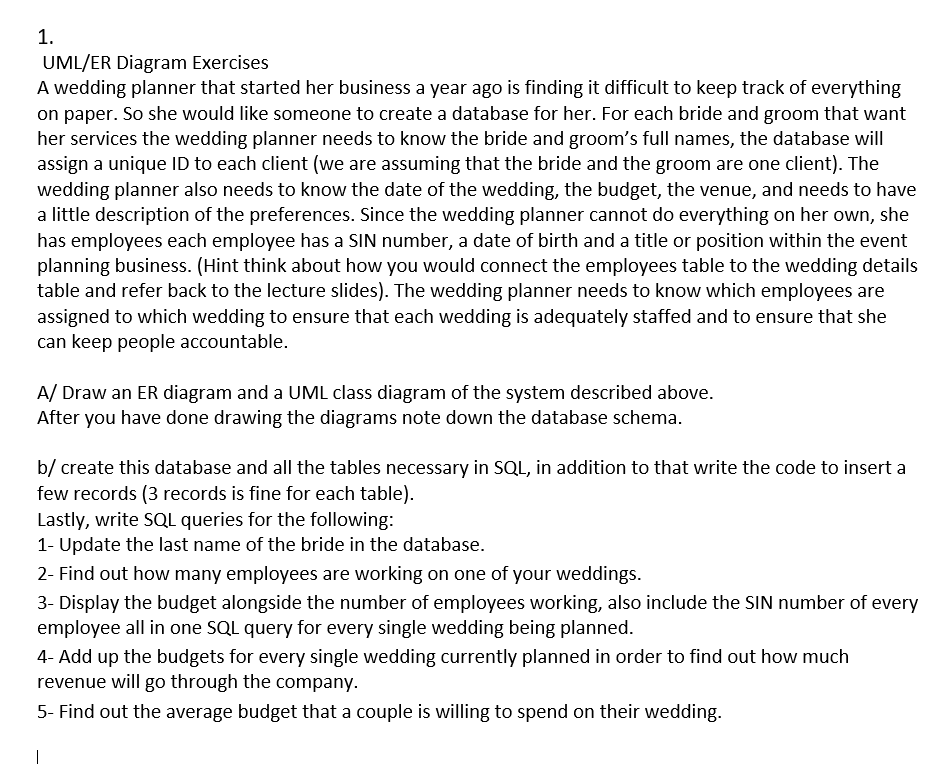
1. UML/ER Diagram Exercises A wedding planner that started her business a year ago is finding it difficult to keep track of everything on paper. So she would like someone to create a database for her. For each bride and groom that want her services the wedding planner needs to know the bride and groom's full names, the database will assign a unique ID to each client (we are assuming that the bride and the groom are one client). The wedding planner also needs to know the date of the wedding, the budget, the venue, and needs to have a little description of the preferences. Since the wedding planner cannot do everything on her own, she has employees each employee has a SIN number, a date of birth and a title or position within the event planning business. (Hint think about how you would connect the employees table to the wedding details table and refer back to the lecture slides). The wedding planner needs to know which employees are assigned to which wedding to ensure that each wedding is adequately staffed and to ensure that she can keep people accountable ere assuming A/ Draw an ER diagram and a UML class diagram of the system described above. After you have done drawing the diagrams note down the database schema. b/ create this database and all the tables necessary in SQL, in addition to that write the code to insert a few records (3 records is fine for each table) Lastly, write SQL queries for the following: 1- Update the last name of the bride in the database 2- Find out how many employees are working on one of your weddings 3- Display the budget alongside the number of employees working, also include the SIN number of every employee all in one SQL query for every single wedding being planned 4- Add up the budgets for every single wedding currently planned in order to find out how much revenue ill go through the company. 5- Find out the average budget that a couple is willing to spend on their wedding 1. UML/ER Diagram Exercises A wedding planner that started her business a year ago is finding it difficult to keep track of everything on paper. So she would like someone to create a database for her. For each bride and groom that want her services the wedding planner needs to know the bride and groom's full names, the database will assign a unique ID to each client (we are assuming that the bride and the groom are one client). The wedding planner also needs to know the date of the wedding, the budget, the venue, and needs to have a little description of the preferences. Since the wedding planner cannot do everything on her own, she has employees each employee has a SIN number, a date of birth and a title or position within the event planning business. (Hint think about how you would connect the employees table to the wedding details table and refer back to the lecture slides). The wedding planner needs to know which employees are assigned to which wedding to ensure that each wedding is adequately staffed and to ensure that she can keep people accountable ere assuming A/ Draw an ER diagram and a UML class diagram of the system described above. After you have done drawing the diagrams note down the database schema. b/ create this database and all the tables necessary in SQL, in addition to that write the code to insert a few records (3 records is fine for each table) Lastly, write SQL queries for the following: 1- Update the last name of the bride in the database 2- Find out how many employees are working on one of your weddings 3- Display the budget alongside the number of employees working, also include the SIN number of every employee all in one SQL query for every single wedding being planned 4- Add up the budgets for every single wedding currently planned in order to find out how much revenue ill go through the company. 5- Find out the average budget that a couple is willing to spend on their wedding
Step by Step Solution
There are 3 Steps involved in it

Get step-by-step solutions from verified subject matter experts
 Study Help