







Question: solve 1-d please. Below is the data of spring.csv 1 3 3.15 2 4 6.28 3 5 9.88 4 6 7.3 5 7 10.38 6
solve 1-d please. Below is the data of spring.csv
| 1 | 3 | 3.15 |
| 2 | 4 | 6.28 |
| 3 | 5 | 9.88 |
| 4 | 6 | 7.3 |
| 5 | 7 | 10.38 |
| 6 | 8 | 12.2 |
| 7 | 9 | 14.56 |
| 8 | 10 | 14.64 |
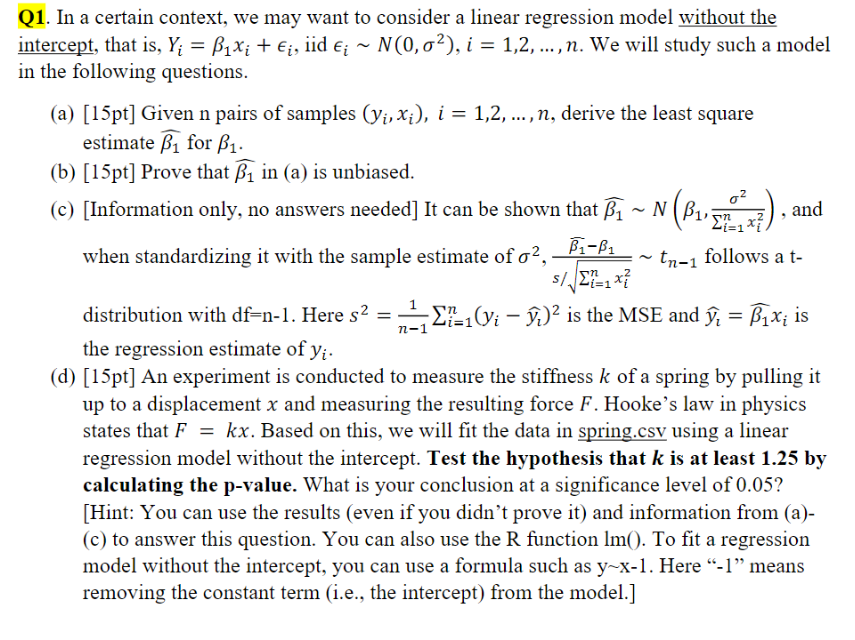
In a certain context, we may want to consider a linear regression model without the rcept, that is, Yi=1xi+i, iid iN(0,2),i=1,2,,n. We will study such a mod following questions. (a) [15pt] Given n pairs of samples (yi,xi),i=1,2,,n, derive the least square estimate 1 for 1. (b) [15pt] Prove that 1 in (a) is unbiased. (c) [Information only, no answers needed] It can be shown that 1N(1,i=1nxi22), an when standardizing it with the sample estimate of 2,s/i=1nxi211tn1 follows a tdistribution with df=n1. Here s2=n11i=1n(yiyt)2 is the MSE and yt=1xi is the regression estimate of yi. (d) [15pt] An experiment is conducted to measure the stiffness k of a spring by pulling i up to a displacement x and measuring the resulting force F. Hooke's law in physics states that F=kx. Based on this, we will fit the data in spring.csv using a linear regression model without the intercept. Test the hypothesis that k is at least 1.25b calculating the p-value. What is your conclusion at a significance level of 0.05 ? [Hint: You can use the results (even if you didn't prove it) and information from (a)(c) to answer this question. You can also use the R function lm(). To fit a regression model without the intercept, you can use a formula such as yx1. Here "-1" means removing the constant term (i.e., the intercept) from the model.] In a certain context, we may want to consider a linear regression model without the rcept, that is, Yi=1xi+i, iid iN(0,2),i=1,2,,n. We will study such a mod following questions. (a) [15pt] Given n pairs of samples (yi,xi),i=1,2,,n, derive the least square estimate 1 for 1. (b) [15pt] Prove that 1 in (a) is unbiased. (c) [Information only, no answers needed] It can be shown that 1N(1,i=1nxi22), an when standardizing it with the sample estimate of 2,s/i=1nxi211tn1 follows a tdistribution with df=n1. Here s2=n11i=1n(yiyt)2 is the MSE and yt=1xi is the regression estimate of yi. (d) [15pt] An experiment is conducted to measure the stiffness k of a spring by pulling i up to a displacement x and measuring the resulting force F. Hooke's law in physics states that F=kx. Based on this, we will fit the data in spring.csv using a linear regression model without the intercept. Test the hypothesis that k is at least 1.25b calculating the p-value. What is your conclusion at a significance level of 0.05 ? [Hint: You can use the results (even if you didn't prove it) and information from (a)(c) to answer this question. You can also use the R function lm(). To fit a regression model without the intercept, you can use a formula such as yx1. Here "-1" means removing the constant term (i.e., the intercept) from the model.]
Step by Step Solution
There are 3 Steps involved in it

Get step-by-step solutions from verified subject matter experts
 Study Help