







Question: Solve 2 & 3 The Array Collection problem accepts a positive integer k and collection of n sorted arrays containing integers between 1 and k.
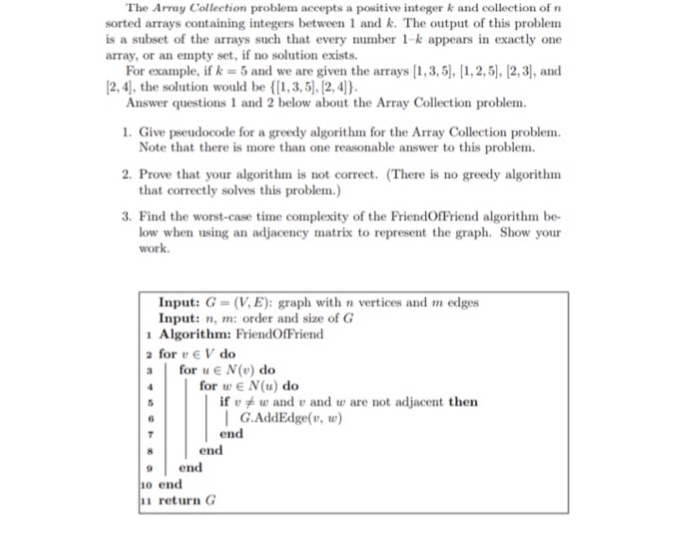
The Array Collection problem accepts a positive integer k and collection of n sorted arrays containing integers between 1 and k. The output of this problem is a subset of the arrays such that every number 1-k appears in exactly one array, or an empty set, if no solution exists 2,4], the solution would be ([1,3,5,2,4]) For example, if k 5 and we are given the arrays [1,3,5], [1.25], [2,3], and Answer questions 1 and 2 below about the Array Collection problem. 1. Give pseudocode for a greedy algorithm for the Array Collection problem. 2. Prove that your algorithm is not correct. (There is no greedy algorithm . Find the worst-case time complexity of the FriendOfFriend algorithm be- Note that there is more than one reasonable answer to this problem. that correctly solves this problem.) low when using an adjacency matrix to represent the graph. Show your wor Input: G = (V,E): graph with n vertices and m edges Input:n, m: order and size of G Algorithm: FriendOfFriened for EV do afor E N() do for w e N(u) do if v w and e and w are not adjacent then G.AddEdge(e,w) end end end o end 1 return G
Step by Step Solution
There are 3 Steps involved in it

Get step-by-step solutions from verified subject matter experts
 Study Help