



Question: solve a,b,c,d n (2) It is of computational (notably cryptographic) importance to compute integers raised to very, very large powers modulo n for some suitably
solve a,b,c,d
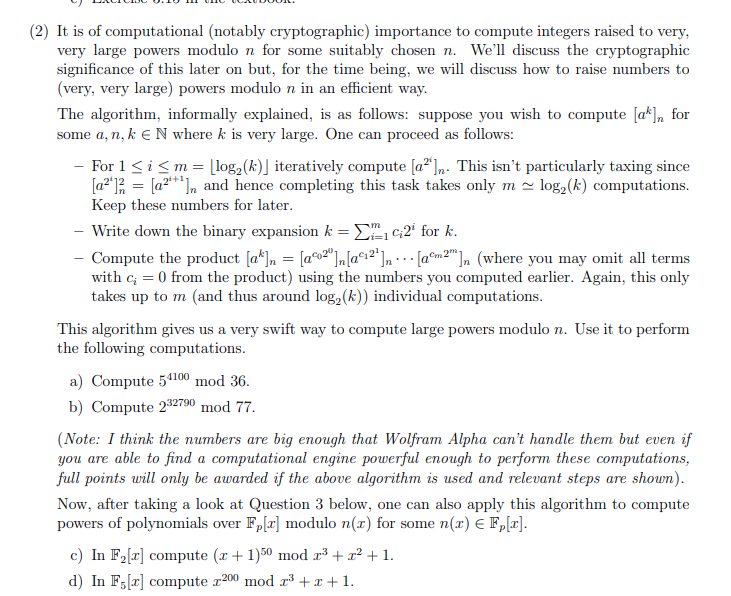
n (2) It is of computational (notably cryptographic) importance to compute integers raised to very, very large powers modulo n for some suitably chosen n. We'll discuss the cryptographic significance of this later on but, for the time being, we will discuss how to raise numbers to (very, very large) powers modulo n in an efficient way. The algorithm, informally explained, is as follows: suppose you wish to compute [a"], for some a, n,k e N where k is very large. One can proceed as follows: For 1 sism= Llog,(k)] iteratively compute [a?]. This isn't particularly taxing since [a?*]= [a2'*'), and hence completing this task takes only m = log,(k) computations. Keep these numbers for later. Write down the binary expansion k = L-1 C29 for k. - Compute the product [aa]n = [qc52"],[ac-2"], -- [qCm2"], (where you may omit all terms with c; = 0 from the product) using the numbers you computed earlier. Again, this only takes up to m (and thus around log2 (k)) individual computations. This algorithm gives us a very swift way to compute large powers modulo n. Use it to perform the following computations. a) Compute 54100 mod 36. b) Compute 232790 mod 77. (Note: I think the numbers are big enough that Wolfram Alpha can't handle them but even if you are able to find a computational engine powerful enough to perform these computations, full points will only be awarded if the above algorithm is used and relevant steps are shown). Now, after taking a look at Question 3 below, one can also apply this algorithm to compute powers of polynomials over Fp[x] modulo n(I) for some n(x) F[]. c) In F2[x] compute (x + 1)50 mod x3 + x2 +1. d) In F5[] compute -200 mod ++1
Step by Step Solution
There are 3 Steps involved in it

Get step-by-step solutions from verified subject matter experts