







Question: Solve all parts a,b,c & d Step by Step Consider a transposition cipher which encrypts a block of 40 bits by transposing the bit positions
Solve all parts a,b,c & d Step by Step
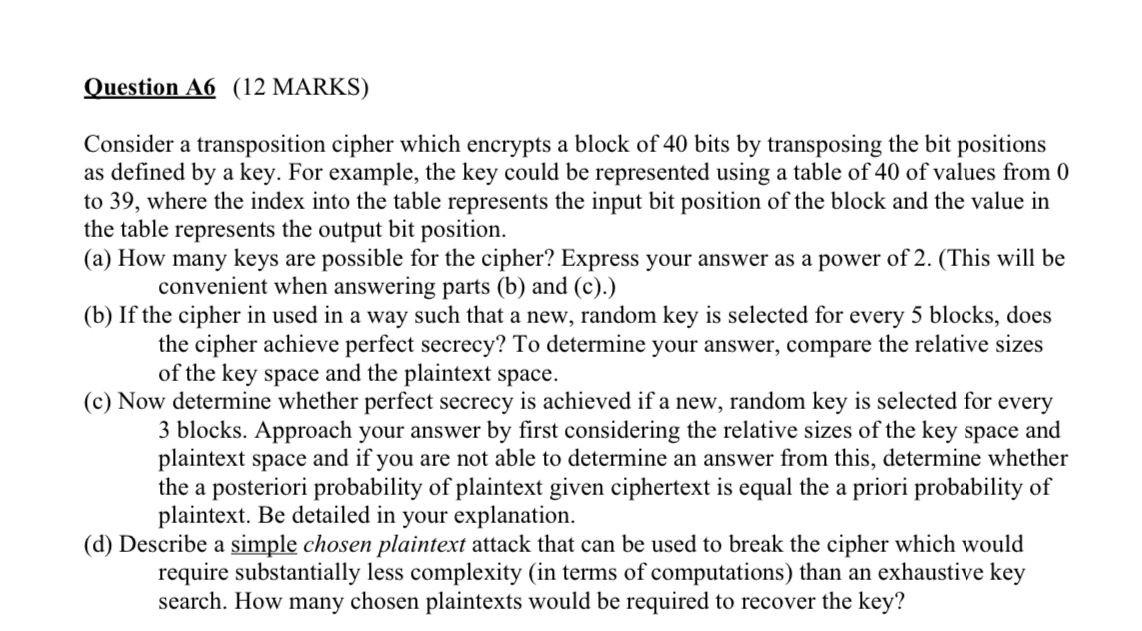
Consider a transposition cipher which encrypts a block of 40 bits by transposing the bit positions as defined by a key. For example, the key could be represented using a table of 40 of values from 0 to 39 , where the index into the table represents the input bit position of the block and the value in the table represents the output bit position. (a) How many keys are possible for the cipher? Express your answer as a power of 2. (This will be convenient when answering parts (b) and (c).) (b) If the cipher in used in a way such that a new, random key is selected for every 5 blocks, does the cipher achieve perfect secrecy? To determine your answer, compare the relative sizes of the key space and the plaintext space. (c) Now determine whether perfect secrecy is achieved if a new, random key is selected for every 3 blocks. Approach your answer by first considering the relative sizes of the key space and plaintext space and if you are not able to determine an answer from this, determine whether the a posteriori probability of plaintext given ciphertext is equal the a priori probability of plaintext. Be detailed in your explanation. (d) Describe a simple chosen plaintext attack that can be used to break the cipher which would require substantially less complexity (in terms of computations) than an exhaustive key search. How many chosen plaintexts would be required to recover the key
Step by Step Solution
There are 3 Steps involved in it

Get step-by-step solutions from verified subject matter experts
 Study Help