Question: Solve and compute Use Additional Information from 10-K to Explain Llnkages Among Financial Statements Community Health Systems operates general acute care hospitais in communities across
Solve and compute
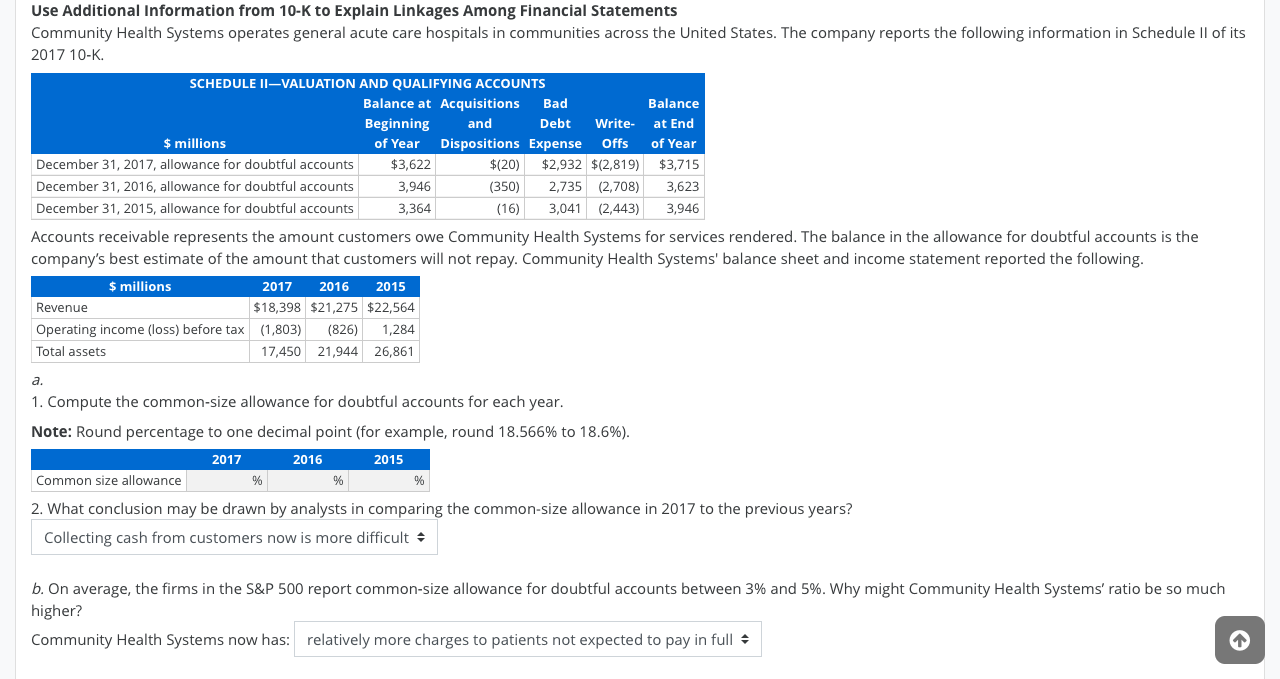
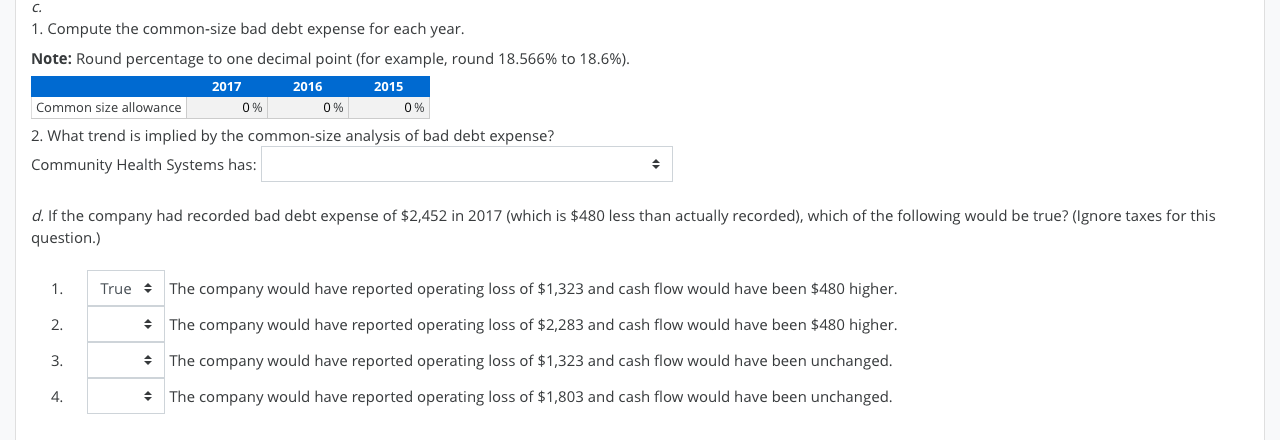
Use Additional Information from 10-K to Explain Llnkages Among Financial Statements Community Health Systems operates general acute care hospitais in communities across the United States. The company reports the following information in Schedule ii of its 2017 10-K. SCHEDULE IliVALUATION AND QUALIFYING ACCOUNTS Balance at Acquisitions Bad Baiance Beginning and Debt Writer at End 5 millions of Year Dispositions Expense Offs of Year December 31, 2017, allowance for doubtful accounts $3,622 ${20} $2,932 $12,319) $3,715 December 31, 2016, allowance for doubtful accounts 3,946 [350) 2,735 (2,703) 3,68 December 31, 2015, allowance for doubtful accounts 3,364 {16) 3,041 [2.443) 3,946 Accounts receivable represents the amount customers owe Community Health Systems for services rendered. The balance in the allowance for doubtful accounts is the company's best estimate of the amount that customers will not repay. Community Health Systems' balance sheet and income statement reported the following. Smllllons 201?I 2016 2015 Revenue $18,393 $21,275 $22,564 Operating income {loss} before tax [1,303] {326} 1,234 Total assets 17,450 21 ,944 25,351 a. 1. Compute the common-size allowance for doubtful accounts for each year. Note: Round percentage to one decimai point (for example, round 185.66% to 18.6%). 20]? 2016 2015 Common size allowance % 1M: 1M: 2. What conclusion may be drawn by analysts in comparing the common-size ailowance in 2017 to the previous years? Collecting cash from customers now is more difficult c b. On average, the rms in the S&P 500 report common-size allowance for doubtful accounts between 3% and 5%. Why might Community Health Systems' ratio be so much higher? Community Health Systems now has: relatively more charges to patients not expected to pay in full 3 a C. 1. Compute the common-size bad debt expense for each year. Note: Round percentage to one decimal point (for example, round 18.566% to 18.6%). 2017 2016 2015 Common size allowance 0% 0 % 0 % 2. What trend is implied by the common-size analysis of bad debt expense? Community Health Systems has: d. If the company had recorded bad debt expense of $2,452 in 2017 (which is $480 less than actually recorded), which of the following would be true? (Ignore taxes for this question.) 1. True * The company would have reported operating loss of $1,323 and cash flow would have been $480 higher. 2. The company would have reported operating loss of $2,283 and cash flow would have been $480 higher. 3 The company would have reported operating loss of $1,323 and cash flow would have been unchanged. 4. + The company would have reported operating loss of $1,803 and cash flow would have been unchanged









 Study Help