







Question: Solve both A and B and provide numbers pulled from NAAQS please (35 pts) As discussed in class, every time we breathe we inhale particles
Solve both A and B and provide numbers pulled from NAAQS please
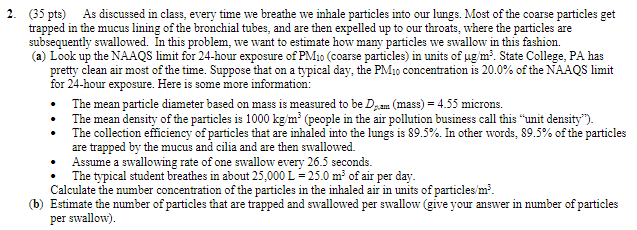
(35 pts) As discussed in class, every time we breathe we inhale particles into our lungs. Most of the coarse particles get trapped in the mucus lining of the bronchial tubes, and are then expelled up to our throats, where the particles are subsequently swallowed. In this problem, we want to estimate how many particles we swallow in this fashion. (a) Look up the NAAQS limit for 24-hour exposure of PM PM10 (coarse particles) in units of g/m3. State College, PA has pretty clean air most of the time. Suppose that on a typical day, the PMio concentration is 20.0% of the NAAQS limit for 24-hour exposure. Here is some more information: - The mean particle diameter based on mass is measured to be Dpam (mass) =4.55 microns. - The mean density of the particles is 1000kg/m3 (people in the air pollution business call this "unit density"). - The collection efficiency of particles that are inhaled into the lungs is 89.5%. In other words, 89.5% of the particles are trapped by the mucus and cilia and are then swallowed. - Assume a swallowing rate of one swallow every 26.5 seconds. - The typical student breathes in about 25,000L=25.0m3 of air per day. Calculate the number concentration of the particles in the inhaled air in units of particles /m3. (b) Estimate the number of particles that are trapped and swallowed per swallow (give your answer in number of particles per swallow). (35 pts) As discussed in class, every time we breathe we inhale particles into our lungs. Most of the coarse particles get trapped in the mucus lining of the bronchial tubes, and are then expelled up to our throats, where the particles are subsequently swallowed. In this problem, we want to estimate how many particles we swallow in this fashion. (a) Look up the NAAQS limit for 24-hour exposure of PM PM10 (coarse particles) in units of g/m3. State College, PA has pretty clean air most of the time. Suppose that on a typical day, the PMio concentration is 20.0% of the NAAQS limit for 24-hour exposure. Here is some more information: - The mean particle diameter based on mass is measured to be Dpam (mass) =4.55 microns. - The mean density of the particles is 1000kg/m3 (people in the air pollution business call this "unit density"). - The collection efficiency of particles that are inhaled into the lungs is 89.5%. In other words, 89.5% of the particles are trapped by the mucus and cilia and are then swallowed. - Assume a swallowing rate of one swallow every 26.5 seconds. - The typical student breathes in about 25,000L=25.0m3 of air per day. Calculate the number concentration of the particles in the inhaled air in units of particles /m3. (b) Estimate the number of particles that are trapped and swallowed per swallow (give your answer in number of particles per swallow)
Step by Step Solution
There are 3 Steps involved in it

Get step-by-step solutions from verified subject matter experts
 Study Help