Question: Solve completely (i) (@) State three features which are desirable when a graduation is performed. (b) Explain why they are desirable. [3] The actuary to

Solve completely
Solve completely (i) (@) State three featuresSolve completely (i) (@) State three features
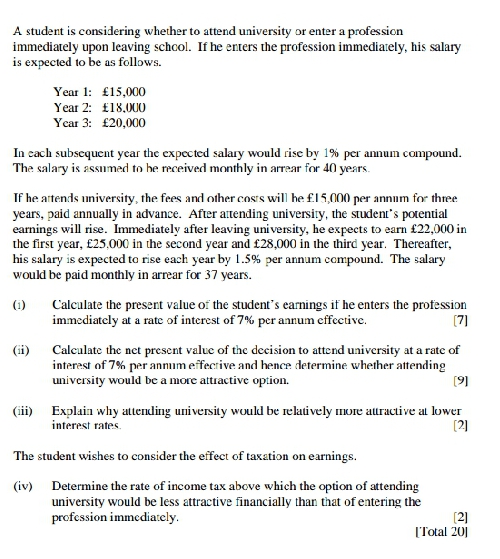
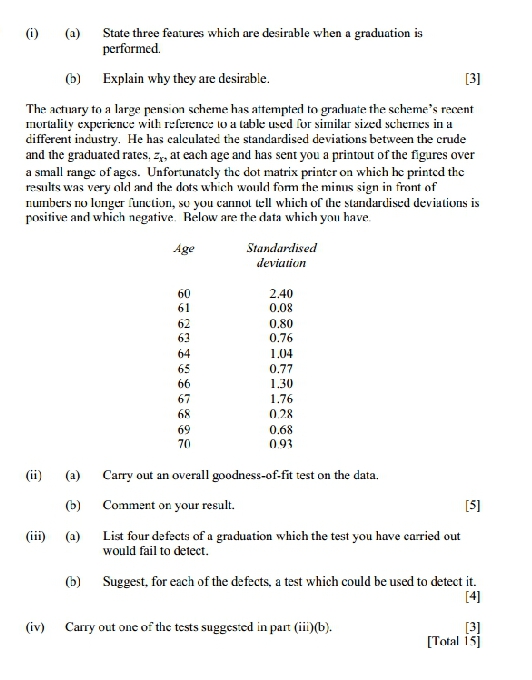
(i) (@) State three features which are desirable when a graduation is performed. (b) Explain why they are desirable. [3] The actuary to a large pension scheme has attempted to graduate the scheme's recent mortality experience with reference to a table used for similar sized schemes in a different industry. He has calculated the standardised deviations between the crude and the graduated rates, zy, at each age and has sent you a printout of the figures over a small range of ages. Unfortunately the dot matrix printer on which he printed the results was very old and the dots which would form the mimis sign in front of numbers no longer function, so you cannot tell which of the standardised deviations is positive and which negative. Relow are the data which you have. Age Standardised deviation 60 2.40 61 0.08 62 0.80 63 0.76 64 1.04 65 0.77 66 1.30 67 1.76 68 0.28 69 0.68 70 0.93 (ii) ) Carry out an overall goodness-of-fit test on the data. (b) Comment on your result. [5] (Lib (@) List four defects of a graduation which the test you have carried out would fail to detect. (b) Suggest, for each of the defects, a test which could be used to detect it. [4] (iv) Carry out one of the tests suggested in part (iii)(b). [3] [Total 15]A student is considering whether to attend university or enter a profession immediately upon leaving school. If he enters the profession immediately, his salary is expected to be as follows. Year 1: $15,000 Year 2: $18.000 Year 3: $20,000 In each subsequent year the expected salary would rise by 1% per annum compound. The salary is assumed to he received monthly in arrear for 40 years. If he attends university, the fees and other costs will be f1 5,0100 per annum for three years, paid annually in advance. After attending university, the student's potential earnings will rise. Immediately after leaving university, he expects to earn $22,000 in the first year, $25.000 in the second year and $28,000 in the third year. Thereafter, his salary is expected to rise each year by 1.5% per annum compound. The salary would be paid monthly in arrear for 37 years. (1) Calculate the present value of the student's earnings if he enters the profession immediately at a rate of interest of 7% per annum effective. [7] (ii) Calculate the net present value of the decision to attend university at a rate of interest of 7% per annum effective and hence determine whether attending university would be a more attractive option. [9] (iii) Explain why attending university would be relatively more attractive at lower interest rates. [2] The student wishes to consider the effect of taxation on earnings. (iv) Determine the rate of income tax above which the option of attending university would be less attractive financially than that of entering the profession immediately. [21 ['Total 201

Step by Step Solution

There are 3 Steps involved in it

1 Expert Approved Answer
Step: 1 Unlock blur-text-image

Question Has Been Solved by an Expert!

Get step-by-step solutions from verified subject matter experts

Step: 2 Unlock
Step: 3 Unlock

Students Have Also Explored These Related Accounting Questions!