







Question: Solve for A, B, C Do not write a code! 2) The golden ratio search is a divide-and-conger technique for searching a key in a
Solve for A, B, C
Do not write a code!
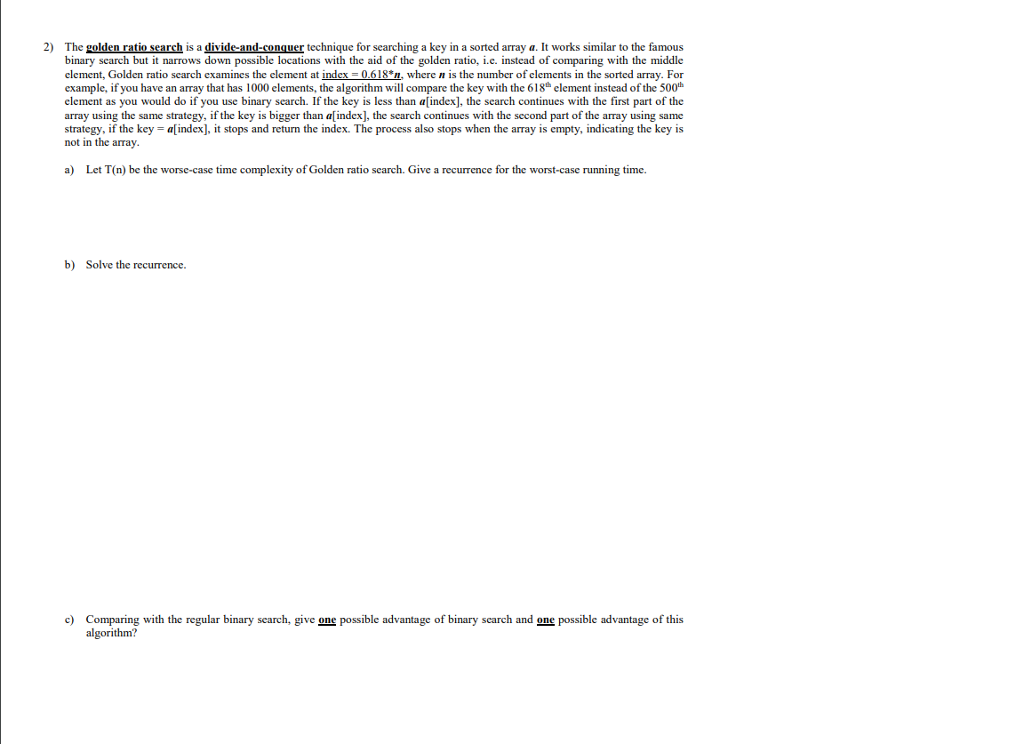
2) The golden ratio search is a divide-and-conger technique for searching a key in a sorted array a. It works similar to the famous binary scarch but it narrows down possible locations with the aid of the golden ratio, i.e. instead of comparing with the middle element, Golden ratio search examines the element at index 0.618 n, where n is the number of clements in the sorted array. For example, if you have an array that has 1000 elements, the algorithm will compare the key with the 618 element instead of the 500 element as you would do if you use binary search. If the key is less than [index], the searc array using the same strategy, if the key is bigger than a[index], the search continues with the second part of the array using same strategy, if the key aindex], it stops and return the index. The process also stops when the array is empty, indicating the key is not in the array . h continues with the first part of the a) Let T(n) be the worse-case time complexity of Golden ratio search. Give a recurrence for the worst-case running time. b) Solve the recurrence c Comparing with the regular binary search, give one possible advantage of binary scarch and one possible advantage of this algorithm? 2) The golden ratio search is a divide-and-conger technique for searching a key in a sorted array a. It works similar to the famous binary scarch but it narrows down possible locations with the aid of the golden ratio, i.e. instead of comparing with the middle element, Golden ratio search examines the element at index 0.618 n, where n is the number of clements in the sorted array. For example, if you have an array that has 1000 elements, the algorithm will compare the key with the 618 element instead of the 500 element as you would do if you use binary search. If the key is less than [index], the searc array using the same strategy, if the key is bigger than a[index], the search continues with the second part of the array using same strategy, if the key aindex], it stops and return the index. The process also stops when the array is empty, indicating the key is not in the array . h continues with the first part of the a) Let T(n) be the worse-case time complexity of Golden ratio search. Give a recurrence for the worst-case running time. b) Solve the recurrence c Comparing with the regular binary search, give one possible advantage of binary scarch and one possible advantage of this algorithm
Step by Step Solution
There are 3 Steps involved in it

Get step-by-step solutions from verified subject matter experts
 Study Help