







Question: Solve for empty cells and explian. What Are We Really Worth? When Wayne concocted his cleaning compound some 20 years ago, all that his wife,
Solve for empty cells and explian.
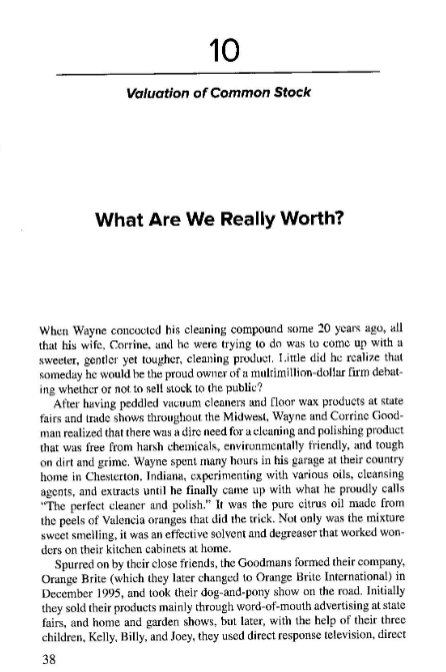
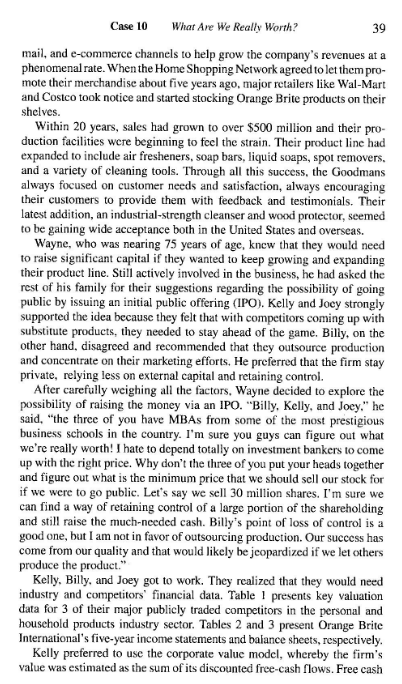
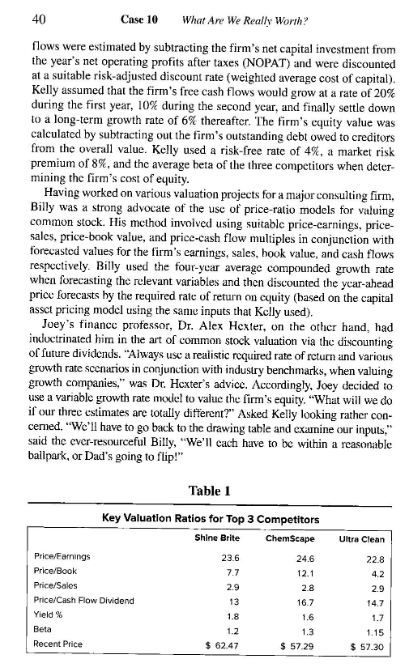
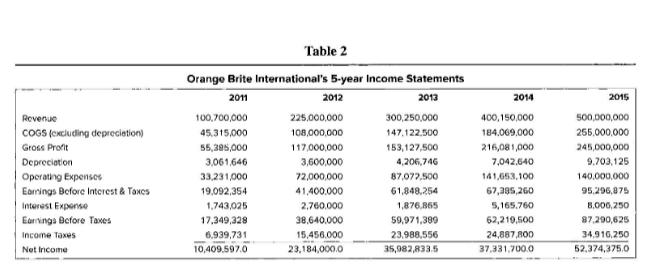
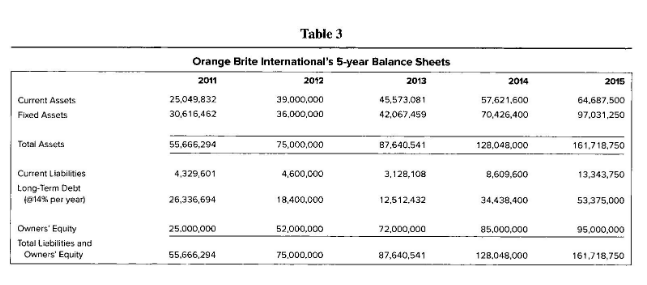
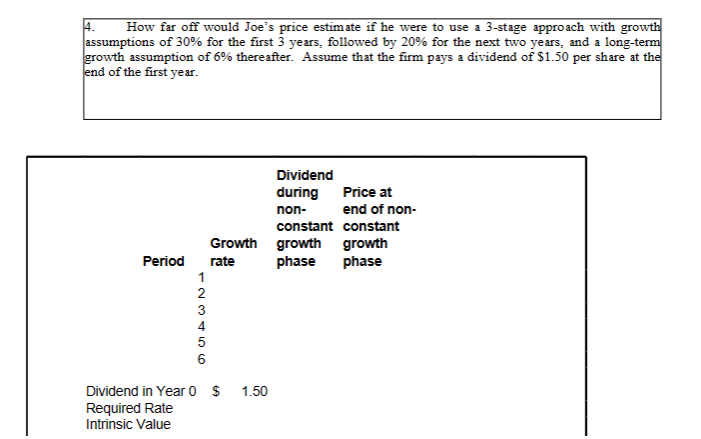
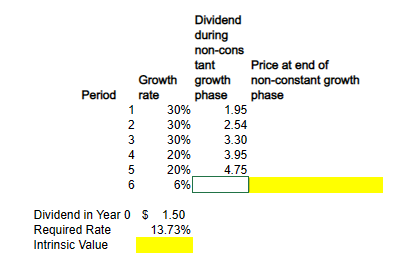
What Are We Really Worth? When Wayne concocted his cleaning compound some 20 years ago, all that his wife, Corrine, and he were trying to do was to come ap with a sweeter, gentler yet tougher, cleaning produet. t.ittle did he realize that someday he would be the proud owner of a multimillion-dollar firm dehating whethcr ot not to sell stock to the public? After having peddled vacuum cleaners and floor wax products at state fairs and trade shows throughout the Midwest, Wayne and Corrine Goodman realized that there was a dire need for a cleaning and polishing product that was free from harsh chemicals, environmentally friendly, and tough on dirt and grime. Wayne spent many hours in his garage at their country home in Chesterton, Indiana, experimenting with various oils, cleansing agents, and extracts until he finally came up with what he proudly calls "The perfect cleaner and polish." It was the pure citrus oil made from the peels of Valencia oranges that did the trick. Not only was the mixture sweet smeiling, it was an effective solvent and degreaser that worked wonders on their kitchen cabinets at home. Spurred on by their close friends, the Goodmans formed their company, Orange Brite (which they later changed to Orange Brite International) in December 1995, and took their dog-and-pony show on the road. Initially they sold their products mainly through word-of-mouth advertising at state fairs, and home and garden shows, bot later, with the help of their three children, Kelly, Billy, and Joey, they used direct response television, direct 38 Case 10 What Are We Really Worth? 39 mail, and e-commerce channels to help grow the company's revenues at a phenomenal rate. When the Home Shopping Network agreed to let them promote their merchandise about five years ago, major retailers like Wal-Mart and Costco took notice and started stocking Orange Brite products on their shelves. Within 20 years, sales had grown to over $500 million and their production facilities were beginning to feel the strain. Their product line had expanded to include air fresheners, soap bars, liquid soaps, spot removers. and a variety of cleaning tools. Through all this success, the Goodmans always focused on customer needs and satisfaction, always encouraging their customers to provide them with feedback and testimonials. Their latest addition, an industrial-strength cleanser and wood protector, seemed to be gaining wide acceptance both in the United States and overseas. Wayne, who was nearing 75 years of age, knew that they would need to raise significant capital if they wanted to keep growing and expanding their product line. Still actively involved in the business, he had asked the rest of his family for their suggestions regarding the possibility of going public by issuing an initial public offering (IPO). Kelly and Jocy strongly supported the idea because they felt that with competitors coming up with substitute products, they needed to stay ahead of the game. Billy, on the other hand, disagreed and recommended that they outsource production and concentrate on their marketing efforts. He preferred that the firm stay private, relying less on external capital and retaining control. After carefully wcighing all the factors, Wayne decided to explore the possibility of raising the money via an IPO. "Billy, Kelly, and Jocy," he said, "the three of you have MBAs from some of the most prestigious business schools in the country. I'm sure you guys can figure out what we're really worth! I hate to depend totally on investment bankers to come up with the right price. Why don't the three of you put your heads together and figure out what is the minimum price that we should sell our stock for if we were to go public. Let's say we sell 30 million shares. I'm sure we can find a way of retaining control of a large portion of the shareholding and still raise the much-needed cash. Billy's point of loss of control is a good one, but I am not in favor of outsourcing production. Our success has come from our quality and that would likely be jeopardized if we let others produce the product." Kelly, Billy, and Joey got to work. They realized that they would need industry and competitor' financial data. Table 1 presents key valuation data for 3 of their major publicly traded competitors in the personal and household products industry sector. Tables 2 and 3 present Orange Brite International's five-year income statements and balance sheets, respectively. Kelly preferred to use the corporate value model, whereby the firm's value was estimated as the sum of its discounted free-cash flows. Free cash flows were estimated by subtracting the firm's net capital investment from the year's net operating profits after taxes (NOPAT) and were discounted at a suitable risk-adjusted discount rate (weighted average cost of capital). Kelly assumed that the firm's free cash flows would grow at a rate of 20% during the first year, 10% during the second year, and finally settle down to a long-term growth rate of 6% thereafter. The firm's equity value was calculated by subtracting out the firm's outstanding debt owed to creditors from the overall value. Kelly used a risk-free rate of 4%, a market risk premium of 8%, and the average beta of the three competitors when determining the firm's cost of equity. Having worked on various valuation projects for a major consulting firm, Billy was a strong advocate of the use of price-ratio models for valuing common stock. His method involved using suitable price-carnings, pricesales, price-book value, and price-cash flow multiples in conjunction with forecasted values for the firm's earnings, sales, book value, and cash flows respectively. Billy used the four-year average compounded gruwth rate when forecasting the relevant variables and then discounted the ycar-ahead price forecasts by the required rate of return on cquity (based on the capital assct pricing model using the same inputs that Kclly used). Joey's finance professor, Dr. Alex Hexter, on the other hand, had inductrinated him in the art of common stock valuation via the discounting of future dividends. "Always usc a realistic required rate of return and various growth rate scenarios in conjunction with industry benchmarks, when valuing growth companies," was Dt. Hexter's advice. Accordingly, Joey decided to use a variable growth rate model to value the firm's equity. "What will we do if our threc estimates are totally different?" Asked Kelly looking rather concemed. "We'll have to go back to the drawing table and examine our inputs," said the ever-resourceful Billy, "We'll each have to be within a reasonable ballpark, or Dad's going to flip!" Table 2 Table 3 Orange Brite International's 5-year Balance Sheets 4. How far off would Joe's price estimate if he were to use a 3-stage approach with growth assumptions of 30% for the first 3 years, followed by 20% for the next two years, and a long-term growth assumption of 6% thereafter. Assume that the firm pays a dividend of $1.50 per share at the end of the first year. Dividend during non-cons tant Price at end of Growth growth non-constant growth Period rate phase phase \begin{tabular}{lll} 1 & 30% & 1.95 \\ 2 & 30% & 2.54 \\ 3 & 30% & 3.30 \\ 4 & 20% & 3.95 \\ 5 & 20% & 4.75 \\ 6 & 6% & \\ \hline \end{tabular} Dividend in Year 0$1.50 Required Rate 13.73% Intrinsic Value
Step by Step Solution
There are 3 Steps involved in it

Get step-by-step solutions from verified subject matter experts
 Study Help