







Question: Solve for the missing value using the Fisher Effect formula (handout) h 3.65% 1 4.20% 7.20% For instance, in the first row you are given
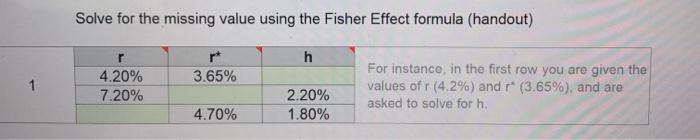
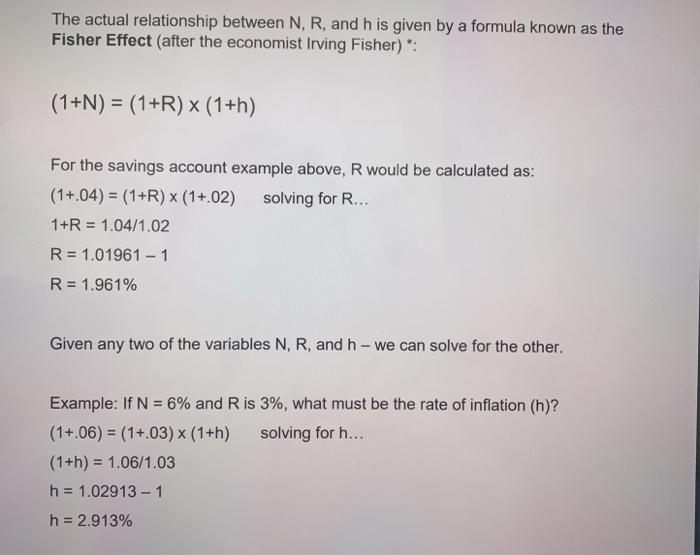
Solve for the missing value using the Fisher Effect formula (handout) h 3.65% 1 4.20% 7.20% For instance, in the first row you are given the values of r (4.2%) and r* (3.65%), and are asked to solve for h. 2.20% 1.80% 4.70% The actual relationship between N, R, and h is given by a formula known as the Fisher Effect (after the economist Irving Fisher) *: (1+N) = (1+R) X (1+h) For the savings account example above, R would be calculated as: (1+.04) = (1+R) X (1+.02) solving for R... 1+R = 1.04/1.02 R = 1.01961 - 1 R = 1.961% Given any two of the variables N, R, and h - we can solve for the other. Example: If N = 6% and R is 3%, what must be the rate of inflation (h)? (14.06) = (1.03) X (1+h) solving for h... (1+h) = 1.06/1.03 h = 1.02913 - 1 h = 2.913%
Step by Step Solution
There are 3 Steps involved in it

Get step-by-step solutions from verified subject matter experts
 Study Help