







Question: Solve for the unknown quantity in Parts (a) through (d) that makes the equivalent value of cash outflows equal to the equivalent value of the
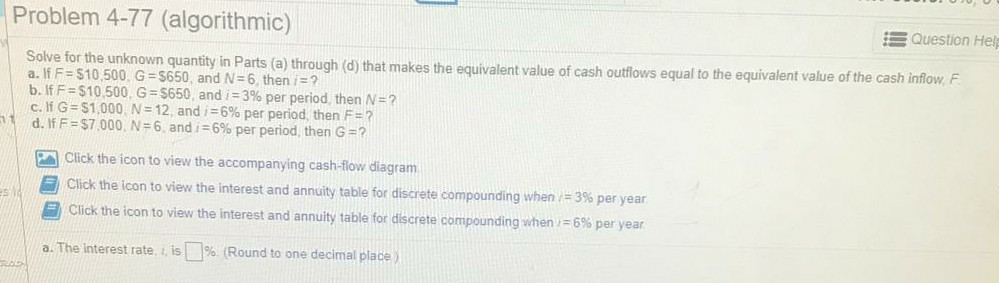
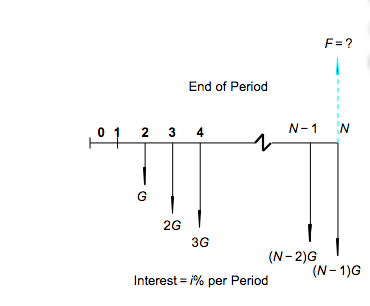
Solve for the unknown quantity in Parts (a) through (d) that makes the equivalent value of cash outflows equal to the equivalent value of the cash inflow, F. a. If F=$10,500, G=$650, and N=6, then iequals? b. If F=$10,500, G=$650, and i=3% per period, then N=? c. If G=$1000, N=12, and i=6% per period, then F=? d. If F=$7,000, N=6, and i=6% per period, then G=?
Problem 4-77 (algorithmic) Question Het Solve for the unknown quantity in Parts (a) through (d) that makes the equivalent value of cash outfows equal to th a. If F $10500, G $650, and N-6, then i ? b. If F-S10.500, GS650, and i 3% per period, then N c. If G# S1.000, N: 12, and i-6% per period, then F.? d. If F 57,000, N-6, and i-6% per period, then G Click the icon to view the accompanying cash-low diagram Click the icon to view the interest and annuity table for discrete compounding when 3% per year Click the icon to view the interest and annuity table for discrete compounding when :-6% per year a. The interest rate. , is 96 (Round to one decimal place ) F=? End of Period N-1 N 2G 3G (N-2)G (N-1)G Interest-No per Period
Step by Step Solution
There are 3 Steps involved in it

Get step-by-step solutions from verified subject matter experts
 Study Help