







Question: solve in 60 mins I will thumb up Part 1 (50% Range Finder 1a) In the Semester 1 Week 11 lab (or possibly later) you
solve in 60 mins I will thumb up 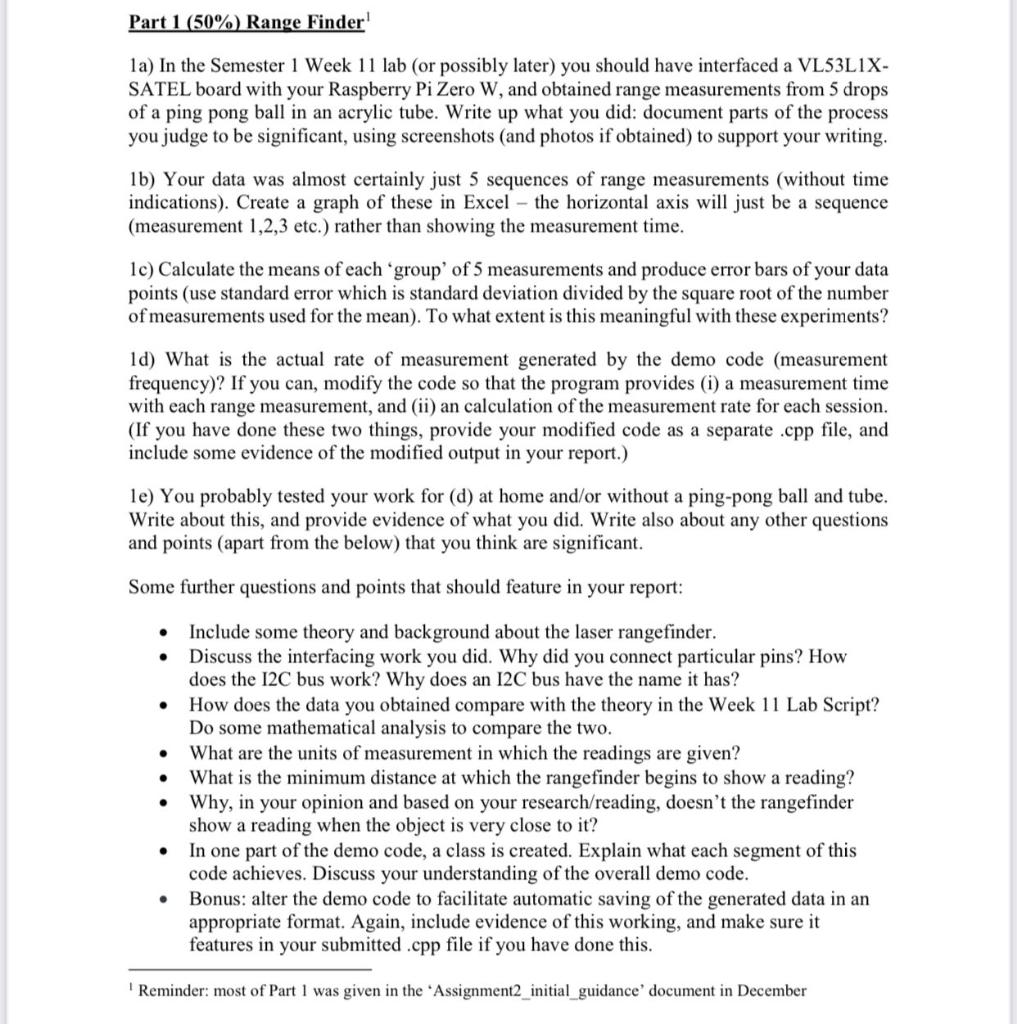
Part 1 (50% Range Finder 1a) In the Semester 1 Week 11 lab (or possibly later) you should have interfaced a VL53L1X- SATEL board with your Raspberry Pi Zero W, and obtained range measurements from 5 drops of a ping pong ball in an acrylic tube. Write up what you did: document parts of the process you judge to be significant, using screenshots (and photos if obtained) to support your writing. 1b) Your data was almost certainly just 5 sequences of range measurements (without time indications). Create a graph of these in Excel - the horizontal axis will just be a sequence (measurement 1,2,3 etc.) rather than showing the measurement time. 1c) Calculate the means of each group of 5 measurements and produce error bars of your data points (use standard error which is standard deviation divided by the square root of the number of measurements used for the mean). To what extent is this meaningful with these experiments? 1d) What is the actual rate of measurement generated by the demo code (measurement frequency)? If you can, modify the code so that the program provides (i) a measurement time with each range measurement, and (ii) an calculation of the measurement rate for each session. (If you have done these two things, provide your modified code as a separate .cpp file, and include some evidence of the modified output in your report.) le) You probably tested your work for (d) at home and/or without a ping-pong ball and tube. Write about this, and provide evidence of what you did. Write also about any other questions and points (apart from the below) that you think are significant. Some further questions and points that should feature in your report: . . Include some theory and background about the laser rangefinder. Discuss the interfacing work you did. Why did you connect particular pins? How does the 12C bus work? Why does an 12C bus have the name it has? How does the data you obtained compare with the theory in the Week 11 Lab Script? Do some mathematical analysis to compare the two. What are the units of measurement in which the readings are given? What is the minimum distance at which the rangefinder begins to show a reading? Why, in your opinion and based on your research/reading, doesn't the rangefinder show a reading when the object is very close to it? In one part of the demo code, a class is created. Explain what each segment of this code achieves. Discuss your understanding of the overall demo code. Bonus: alter the demo code to facilitate automatic saving of the generated data in an appropriate format. Again, include evidence of this working, and make sure it features in your submitted .cpp file if you have done this. . Reminder: most of Part I was given in the 'Assignment2_initial guidance document in December
Step by Step Solution
There are 3 Steps involved in it

Get step-by-step solutions from verified subject matter experts
 Study Help