







Question: Solve in C++ Lab 8 Develop a program to implement the bubble sort algorithm. Specifically, you need to do the following 1. Create a 30
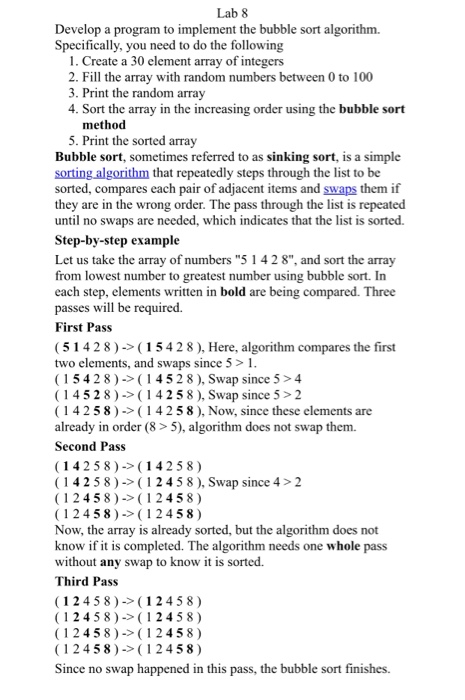
Lab 8 Develop a program to implement the bubble sort algorithm. Specifically, you need to do the following 1. Create a 30 element array of integers 2. Fill the array with random numbers between 0 to 100 3. Print the random array 4. Sort the array in the increasing order using the bubble sort method 5. Print the sorted array Bubble sort, sometimes referred to as sinking sort, is a simple sorting algorithm that repeatedly steps through the list to be sorted, compares each pair of adjacent items and swaps them if they are in the wrong order. The pass through the list is repeated until no swaps are needed, which indicates that the list is sorted. Step-by-step example Let us take the array of numbers "5 1428", and sort the array from lowest number to greatest number using bubble sort. In each step, elements written in bold are being compared. Three passes will be required. First Pass (51428)-(1542 8 ), Here, algorithm compares the first two elements, and swaps since 5>1 (15428)(145 2 8), Swap since 5> 4 14528)->(142 5 8), Swap since 5> 2 14258) ->(142 5 8), Now, since these elements are already in order (8> 5), algorithm does not swap them. Second Pass 14258) -> (14258) (14258) -> (1245 8), Swap since 4> 2 (12458)-(12458) (12458) -(1 2458) Now, the array is already sorted, but the algorithm does not know if it is completed. The algorithm needs one whole pass without an Third Pass y swap to know it is sorted. 12458) -> (12458) 12458) ->(12458) (12458) -> (12458) (12458)-(12458) Since no swap happened in this pass, the bubble sort finishes
Step by Step Solution
There are 3 Steps involved in it

Get step-by-step solutions from verified subject matter experts
 Study Help