







Question: Practice-t C flepeint.ccfaculty.org/java143/CSC142Asse Suppose that you are provided with a pre-written class ClockTime as described below. (The headings are shown, but not the method
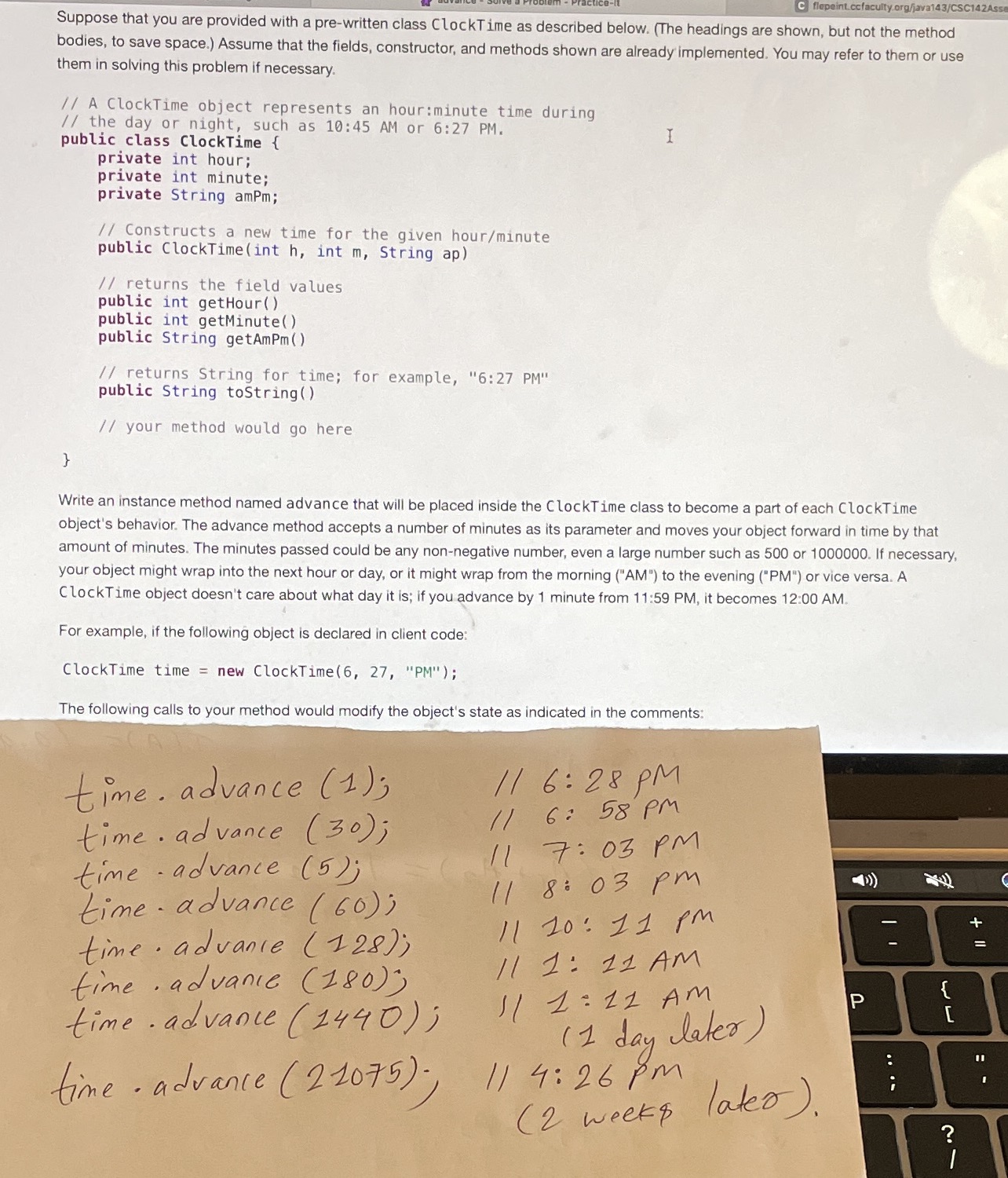
Practice-t C flepeint.ccfaculty.org/java143/CSC142Asse Suppose that you are provided with a pre-written class ClockTime as described below. (The headings are shown, but not the method bodies, to save space.) Assume that the fields, constructor, and methods shown are already implemented. You may refer to them or use them in solving this problem if necessary. // A ClockTime object represents an hour: minute time during // the day or night, such as 10:45 AM or 6:27 PM. public class ClockTime { private int hour; private int minute; private String amPm; // Constructs a new time for the given hour/minute public ClockTime (int h, int m, String ap) // returns the field values public int getHour() public int getMinute() public String getAmPm() // returns String for time; for example, "6:27 PM" public String toString() // your method would go here I } + 11 Write an instance method named advance that will be placed inside the ClockTime class to become a part of each ClockTime object's behavior. The advance method accepts a number of minutes as its parameter and moves your object forward in time by that amount of minutes. The minutes passed could be any non-negative number, even a large number such as 500 or 1000000. If necessary, your object might wrap into the next hour or day, or it might wrap from the morning ("AM") to the evening ("PM") or vice versa. A ClockTime object doesn't care about what day it is; if you advance by 1 minute from 11:59 PM, it becomes 12:00 AM. For example, if the following object is declared in client code: ClockTime time = new ClockTime (6, 27, "PM"); The following calls to your method would modify the object's state as indicated in the comments: time. advance (1); time. advance (30); time advance (5); time advance (60); time advance (128); time advanie (180); time advance (1440); time. advance (21075), 11 6:28 PM // 6: 58 PM 11 7:03 PM 11 8:03 pm PM 11 10 11 11 1 11 AM 1/1:12 AM (1 day later) 11 4:26 PM. (2 weeks later). P : { = - ? ?
Step by Step Solution
There are 3 Steps involved in it
Heres the solution for the advance method inside the ClockTime class java public class ClockTime pri... View full answer

Get step-by-step solutions from verified subject matter experts
 Study Help