







Question: solve IN EXCEL, show equations inputted please A large university with a total enrollment of about 50,000 students has offered Dr. Rocket Soda exclusivity agreement
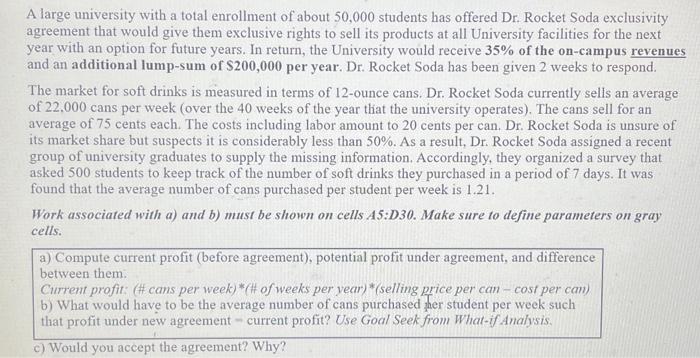
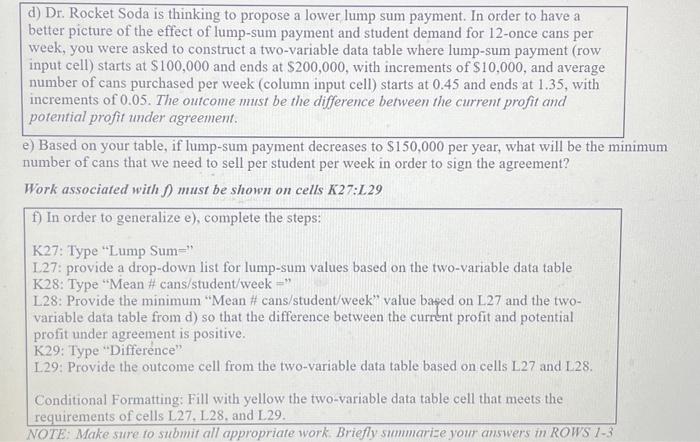
A large university with a total enrollment of about 50,000 students has offered Dr. Rocket Soda exclusivity agreement that would give them exclusive rights to sell its products at all University facilities for the next year with an option for future years. In return, the University would receive 35% of the on-campus revenues and an additional lump-sum of $200,000 per year. Dr. Rocket Soda has been given 2 weeks to respond. The market for soft drinks is measured in terms of 12-ounce cans. Dr. Rocket Soda currently sells an average of 22.000 cans per week (over the 40 weeks of the year that the university operates). The cans sell for an average of 75 cents each. The costs including labor amount to 20 cents per can. Dr. Rocket Soda is unsure of its market share but suspects it is considerably less than 50%. As a result, Dr. Rocket Soda assigned a recent group of university graduates to supply the missing information. Accordingly, they organized a survey that asked 500 students to keep track of the number of soft drinks they purchased in a period of 7 days. It was found that the average number of cans purchased per student per week is 1.21. Work associated with a) and b) must be shown on cells A5:D30. Make sure to define parameters on gray cells. a) Compute current profit (before agreement), potential profit under agreement, and difference between them: Current profit: (\# cans per week)*(\# of weeks per year)*(selling price per can - cost per can) b) What would have to be the average number of cans purchased her student per week such that profit under new agreement - current profit? Use Goal Seek from What-if Analysis. c) Would you accept the agreement? Why? d) Dr. Rocket Soda is thinking to propose a lower lump sum payment. In order to have a better picture of the effect of lump-sum payment and student demand for 12 -once cans per week, you were asked to construct a two-variable data table where lump-sum payment (row input cell) starts at $100,000 and ends at $200,000, with increments of $10,000, and average number of cans purchased per week (column input cell) starts at 0.45 and ends at 1.35 , with increments of 0.05 . The outcome must be the difference between the current profit and potential profit under agreement. e) Based on your table, if lump-sum payment decreases to $150,000 per year, what will be the mir number of cans that we need to sell per student per week in order to sign the agreement? Work associated with f) must be shown on cells K27:L29 f) In order to generalize e), complete the steps: K27: Type "Lump Sum=" L27: provide a drop-down list for lump-sum values based on the two-variable data table K28: Type "Mean \# cans/student/week =" L28: Provide the minimum "Mean \# cans/student/week" value baged on L.27 and the twovariable data table from d) so that the difference between the current profit and potential profit under agreement is positive. K29: Type "Difference" 1.29: Provide the outcome cell from the two-variable data table based on cells L27 and L.28. Conditional Formatting: Fill with yellow the two-variable data table cell that meets the requirements of cells L27, L28, and L29
Step by Step Solution
There are 3 Steps involved in it

Get step-by-step solutions from verified subject matter experts
 Study Help