







Question: Solve in MATLAB. Ignore Module 9, the information here should be enough to solve. We will write a function poissonm to construct sample paths of
Solve in MATLAB. Ignore "Module 9", the information here should be enough to solve.
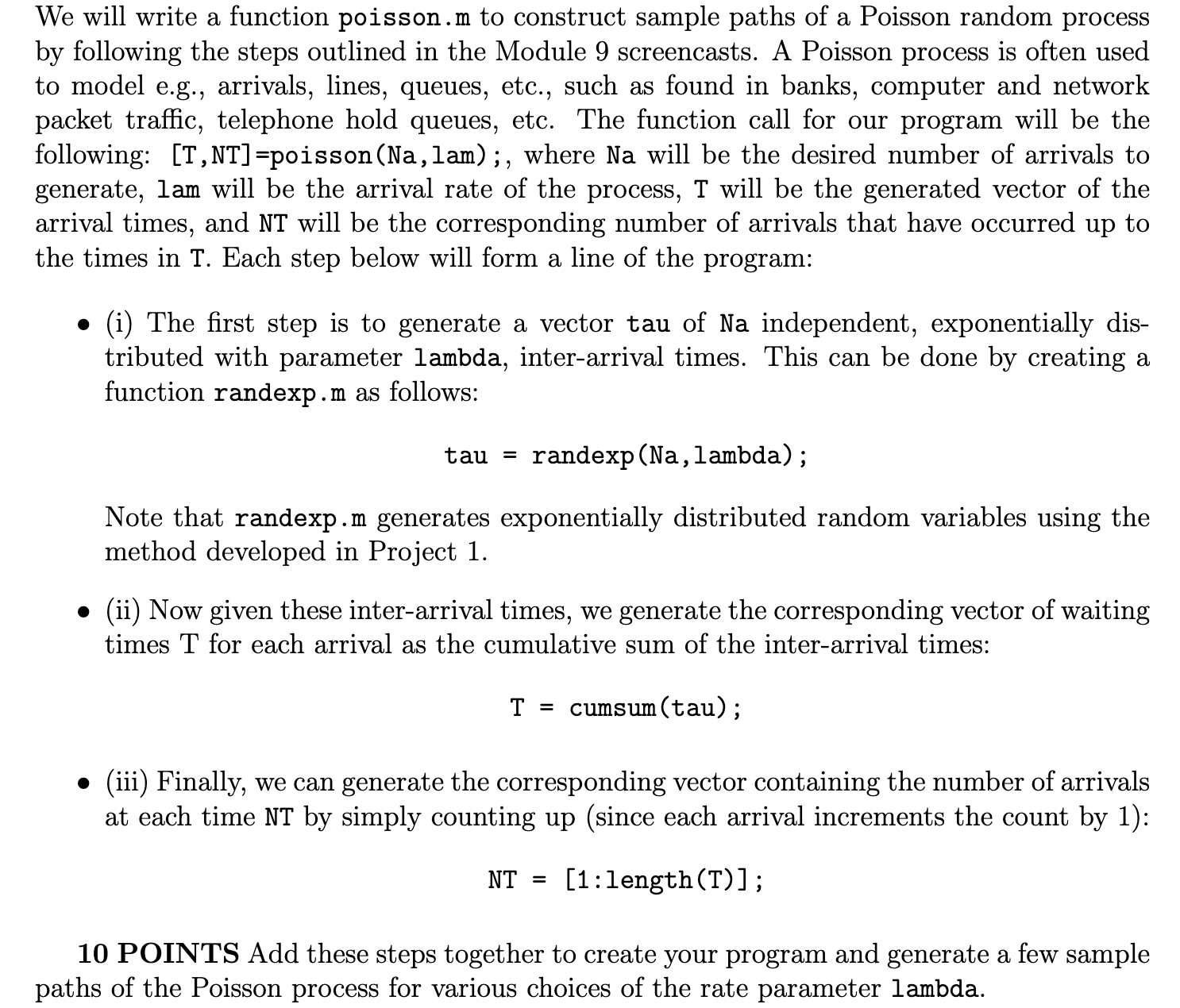
We will write a function poissonm to construct sample paths of a Poisson random process by following the steps outlined in the Module 9 screencasts. A Poisson process is often used to model e.g., arrivals, lines, queues, etc., such as found in banks, computer and network packet trafc, telephone hold queues, etc. The function call for our program will be the following: [T,NT] =poisson (Na,lam) ;, where Na will be the desired number of arrivals to generate, lam will be the arrival rate of the process, T will be the generated vector of the arrival times, and NT will be the corresponding number of arrivals that have occurred up to the times in T. Each step below will form a line of the program: 0 (i) The rst step is to generate a vector tau of Na independent, exponentially dis tributed with parameter lambda, interarrival times. This can be done by creating a function randexp .m as follows: tau randexp (Na, lambda) ; Note that randexp .m generates exponentially distributed random variables using the method developed in Project 1. 0 (ii) Now given these interarrival times, we generate the corresponding vector of waiting times T for each arrival as the cumulative sum of the inter-arrival times: T = cumsum(tau); 0 (iii) Finally, we can generate the corresponding vector containing the number of arrivals at each time NT by simply counting up (since each arrival increments the count by 1): NT = [1:lengthCT)]; 10 POINTS Add these steps together to create your program and generate a few sample paths of the Poisson process for various choices of the rate parameter lambda
Step by Step Solution
There are 3 Steps involved in it

Get step-by-step solutions from verified subject matter experts
 Study Help