







Question: solve it, using C++ language, and without using the built-in libraries Part 2: Lab Tasks (10 points) Note: Copy this section into a new word
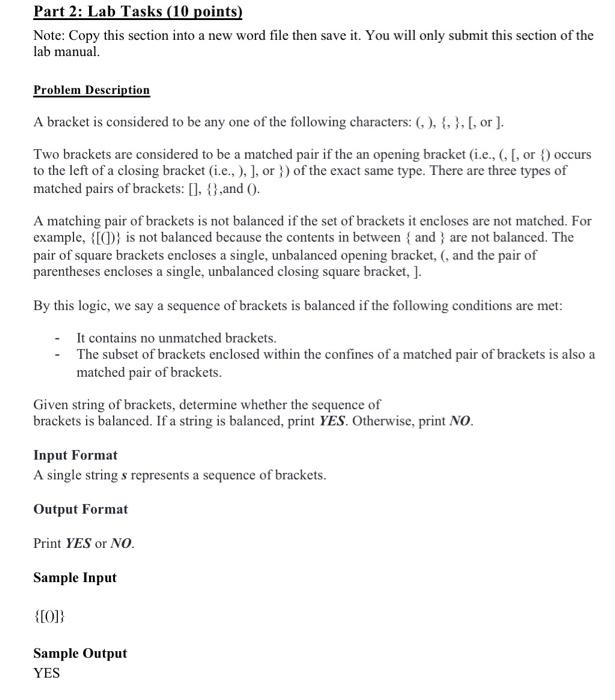
Part 2: Lab Tasks (10 points) Note: Copy this section into a new word file then save it. You will only submit this section of the lab manual. Problem Description A bracket is considered to be any one of the following characters: (,), {},,[, or ]. Two brackets are considered to be a matched pair if the an opening bracket (i.e., (, [, or } ) occurs to the left of a closing bracket (i.e., ), ], or \}) of the exact same type. There are three types of matched pairs of brackets: [], \{\} , and 0 . A matching pair of brackets is not balanced if the set of brackets it encloses are not matched. For example, {[(])} is not balanced because the contents in between { and } are not balanced. The pair of square brackets encloses a single, unbalanced opening bracket, (, and the pair of parentheses encloses a single, unbalanced closing square bracket, ]. By this logic, we say a sequence of brackets is balanced if the following conditions are met: - It contains no unmatched brackets. - The subset of brackets enclosed within the confines of a matched pair of brackets is also a matched pair of brackets. Given string of brackets, determine whether the sequence of brackets is balanced. If a string is balanced, print YES. Otherwise, print NO. Input Format A single string s represents a sequence of brackets. Output Format Print YES or NO. Sample Input {[0]} Sample Output YES
Step by Step Solution
There are 3 Steps involved in it

Get step-by-step solutions from verified subject matter experts
 Study Help