







Question: Solve it with using C++ answer simply Do not use comment time limit per test2 seconds memory limit per test256 megabytes inputstandard input outputstandard output
Solve it with using C++
answer simply
Do not use comment
time limit per test2 seconds memory limit per test256 megabytes inputstandard input outputstandard output Polycarp got an array of integers a[1n] as a gift. Now he wants to perform a certain number of operations (possibly zero) so that all elements of the array become the same (that is, to become a1=a2==an).
In one operation, he can take some indices in the array and increase the elements of the array at those indices by 1. For example, let a=[4,2,1,6,2]. He can perform the following operation: select indices 1, 2, and 4 and increase elements of the array in those indices by 1. As a result, in one operation, he can get a new state of the array a=[5,3,1,7,2].
What is the minimum number of operations it can take so that all elements of the array become equal to each other (that is, to become a1=a2==an)?
Input The first line of the input contains a single integer t (1t104) the number of test cases in the test.
The following are descriptions of the input test cases.
The first line of the description of each test case contains one integer n (1n50) the array a.
The second line of the description of each test case contains n integers a1,a2,,an (1ai109) elements of the array a.
Output For each test case, print one integer the minimum number of operations to make all elements of the array a equal.
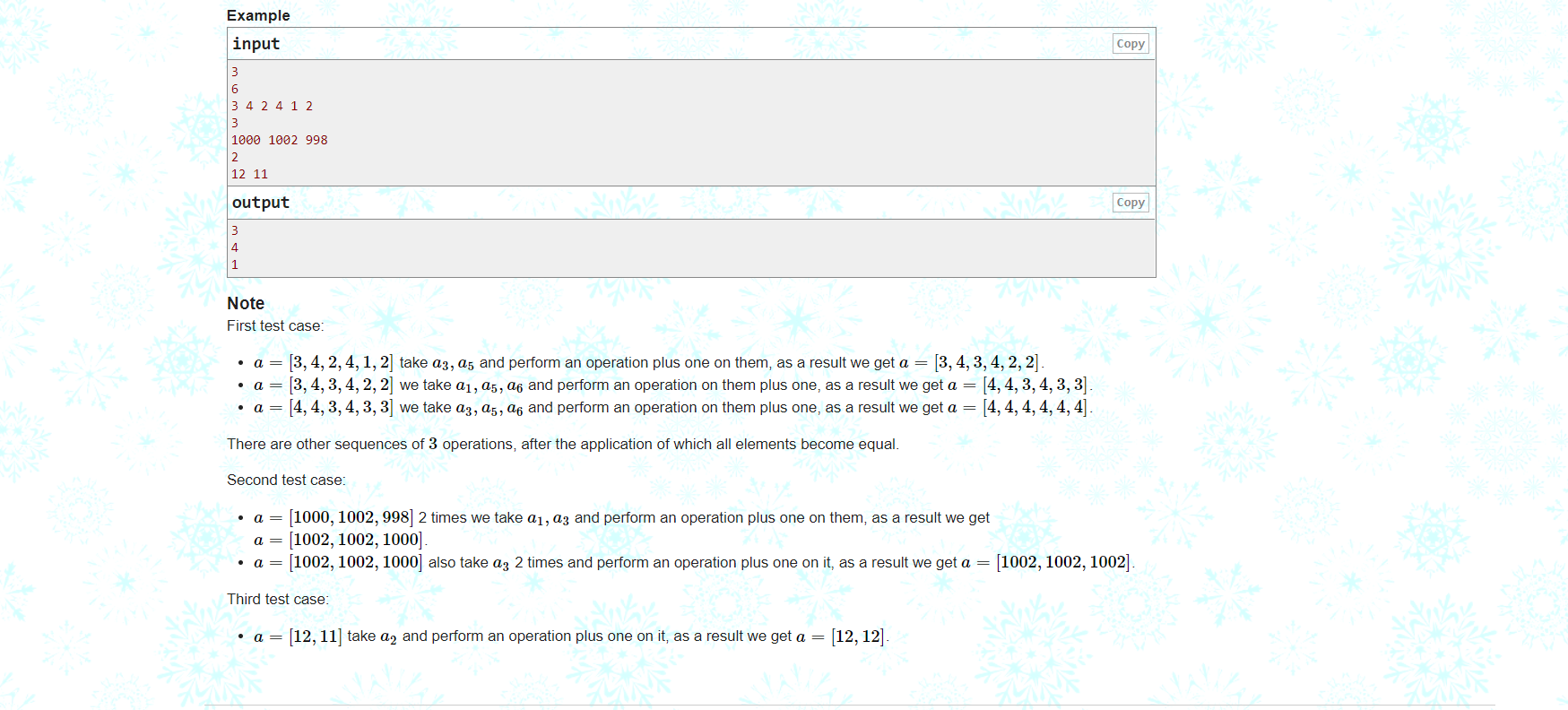
Example input Copy 6 34 24 1 2 3 1000 1002 998 2 12 11 output Copy 3 4 1 Note First test case: de oro . a = a = [3, 4, 2, 4, 1, 2] take a3, a5 and perform an operation plus one on them, as a result we get a = [3, 4, 3, 4, 2, 2] [3, 4, 3, 4, 2, 2] we take a1, a5, 26 and perform an operation on them plus one, as a result we get a = [4, 4, 3, 4, 3, 3]. [4,4,3,4,3, 3] we take az, a5, an and perform an operation on them plus one, as a result we get a = [4,4,4,4,4,4). a = There are other sequences of 3 operations, after the application of which all elements become equal. Second test case: a = a = [1000, 1002, 998] 2 times we take ai, az and perform an operation plus one on them, as a result we get (1002, 1002, 1000] [1002, 1002, 1000) also take az 2 times and perform an operation plus one on it, as a result we get a = [1002, 1002, 1002] . a = Third test case: a = [12, 11) take a, and perform an operation plus one on it, as a result we get a = (12, 12)
Step by Step Solution
There are 3 Steps involved in it

Get step-by-step solutions from verified subject matter experts
 Study Help