







Question: SOLVE ONLY 5 (a,b, &c). Show ALL work. No handwriting plz. 4 Sam's Cat Hotel operates 52 weeks per year, 7 days per week, and
 SOLVE ONLY 5 (a,b, &c). Show ALL work. No handwriting plz.
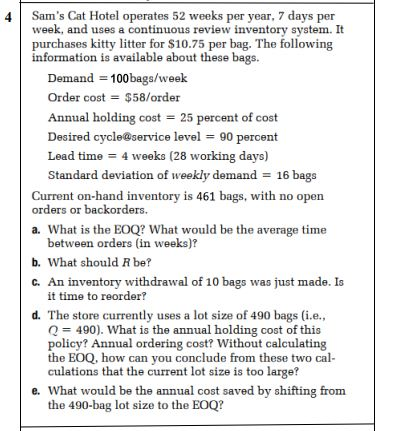
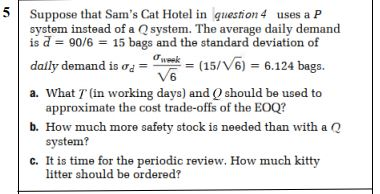
4 Sam's Cat Hotel operates 52 weeks per year, 7 days per week, and uses a continuous review inventory system. It purchases kitty litter for $10.75 per bag. The following information is available about these bags. Demand = 100 bags/week Order cost = $58/order Annual holding cost = 25 percent of cost Desired cycle@service level = 90 percent Lead time = 4 weeks (28 working days) Standard deviation of weekly demand = 16 bags Current on-hand inventory is 461 bags, with no open orders or backorders. a. What is the EOQ? What would be the average time between orders (in weeks)? b. What should R be? 6. An inventory withdrawal of 10 bags was just made. Is it time to reorder? d. The store currently uses a lot size of 490 bags (i.e., Q = 490). What is the annual holding cost of this policy? Annual ordering cost? Without calculating the EOQ, how can you conclude from these two cal- culations that the current lot size is too large? e. What would be the annual cost saved by shifting from the 490-bag lot size to the EOQ? V6 5 Suppose that Sam's Cat Hotel in question 4 uses a P system instead of a system. The average daily demand is d = 90/6 = 15 bags and the standard deviation of dally demand is on = Tek = (15/V6) = 6.124 bags. a. What 7 (in working days) and should be used to approximate the cost trade-offs of the EOQ? b. How much more safety stock is needed than with a system? C. It is time for the periodic review. How much kitty litter should be ordered! 4 Sam's Cat Hotel operates 52 weeks per year, 7 days per week, and uses a continuous review inventory system. It purchases kitty litter for $10.75 per bag. The following information is available about these bags. Demand = 100 bags/week Order cost = $58/order Annual holding cost = 25 percent of cost Desired cycle@service level = 90 percent Lead time = 4 weeks (28 working days) Standard deviation of weekly demand = 16 bags Current on-hand inventory is 461 bags, with no open orders or backorders. a. What is the EOQ? What would be the average time between orders (in weeks)? b. What should R be? 6. An inventory withdrawal of 10 bags was just made. Is it time to reorder? d. The store currently uses a lot size of 490 bags (i.e., Q = 490). What is the annual holding cost of this policy? Annual ordering cost? Without calculating the EOQ, how can you conclude from these two cal- culations that the current lot size is too large? e. What would be the annual cost saved by shifting from the 490-bag lot size to the EOQ? V6 5 Suppose that Sam's Cat Hotel in question 4 uses a P system instead of a system. The average daily demand is d = 90/6 = 15 bags and the standard deviation of dally demand is on = Tek = (15/V6) = 6.124 bags. a. What 7 (in working days) and should be used to approximate the cost trade-offs of the EOQ? b. How much more safety stock is needed than with a system? C. It is time for the periodic review. How much kitty litter should be ordered
Step by Step Solution
There are 3 Steps involved in it

Get step-by-step solutions from verified subject matter experts
 Study Help