







Question: Solve only from e.) to h.) and provide a clear and detailed answer 2. Ricardian Model (17.5%) Solve only from e.) to h.) Fantasia and
Solve only from e.) to h.) and provide a clear and detailed answer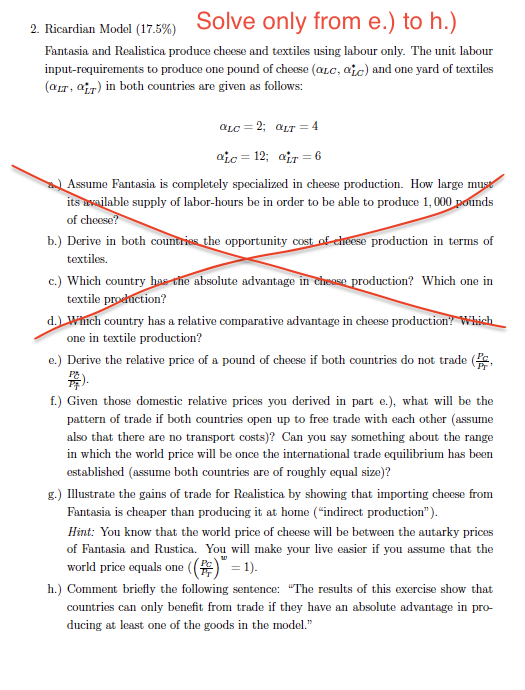
2. Ricardian Model (17.5%) Solve only from e.) to h.) Fantasia and Realistica produce cheese and textiles using labour only. The unit labour input-requirements to produce one pound of cheese (QLC, aic) and one yard of textiles (CLT, air) in both countries are given as follows: OLC = 2; OLT = 4 aic = 12; air = 6 Assume Fantasia is completely specialized in cheese production. How large must its zvojlable supply of labor-hours be in order to be able to produce 1,000 pounds of cheese? b.) Derive in both countries the opportunity cost of cheese production in terms of textiles. c.) Which country has the absolute advantage in cheese production? Which one in textile production? d.) Which country has a relative comparative advantage in cheese production? Which one in textile production? e.) Derive the relative price of a pound of cheese if both countries do not trade . f.) Given those domestic relative prices you derived in part e.), what will be the pattern of trade if both countries open up to free trade with each other assume also that there are no transport costs)? Can you say something about the range in which the world price will be once the international trade equilibrium has been established (assume both countries are of roughly equal size)? g.) Illustrate the gains of trade for Realistica by showing that importing cheese from Fantasia is cheaper than producing it at home (indirect production"). Hint: You know that the world price of cheese will be between the autarky prices of Fantasia and Rustica. You will make your live easier if you assume that the world price equals one () = 1). h.) Comment briefly the following sentence: "The results of this exercise show that countries can only benefit from trade if they have an absolute advantage in pro- ducing at least one of the goods in the model." 2. Ricardian Model (17.5%) Solve only from e.) to h.) Fantasia and Realistica produce cheese and textiles using labour only. The unit labour input-requirements to produce one pound of cheese (QLC, aic) and one yard of textiles (CLT, air) in both countries are given as follows: OLC = 2; OLT = 4 aic = 12; air = 6 Assume Fantasia is completely specialized in cheese production. How large must its zvojlable supply of labor-hours be in order to be able to produce 1,000 pounds of cheese? b.) Derive in both countries the opportunity cost of cheese production in terms of textiles. c.) Which country has the absolute advantage in cheese production? Which one in textile production? d.) Which country has a relative comparative advantage in cheese production? Which one in textile production? e.) Derive the relative price of a pound of cheese if both countries do not trade . f.) Given those domestic relative prices you derived in part e.), what will be the pattern of trade if both countries open up to free trade with each other assume also that there are no transport costs)? Can you say something about the range in which the world price will be once the international trade equilibrium has been established (assume both countries are of roughly equal size)? g.) Illustrate the gains of trade for Realistica by showing that importing cheese from Fantasia is cheaper than producing it at home (indirect production"). Hint: You know that the world price of cheese will be between the autarky prices of Fantasia and Rustica. You will make your live easier if you assume that the world price equals one () = 1). h.) Comment briefly the following sentence: "The results of this exercise show that countries can only benefit from trade if they have an absolute advantage in pro- ducing at least one of the goods in the model
Step by Step Solution
There are 3 Steps involved in it

Get step-by-step solutions from verified subject matter experts
 Study Help