







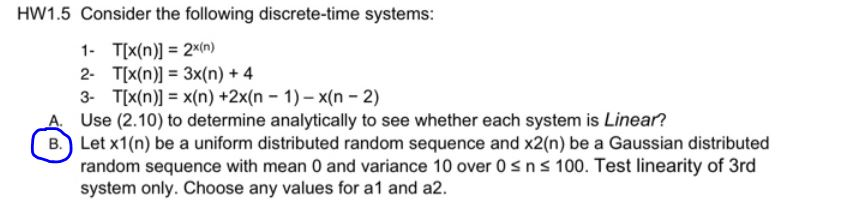
Question: Solve Part B. using matlab. HW1.5 Consider the following discrete-time systems: 1- T[x(n)] = 2x(n) 2- T[x(n)] = 3x(n) + 4 3- T[x(n)] = x(n)
Solve Part B. using matlab.
HW1.5 Consider the following discrete-time systems: 1- T[x(n)] = 2x(n) 2- T[x(n)] = 3x(n) + 4 3- T[x(n)] = x(n) +2x(n - 1) - x(n - 2) A. Use (2.10) to determine analytically to see whether each system is Linear? B. Let x1(n) be a uniform distributed random sequence and x2(n) be a Gaussian distributed random sequence with mean 0 and variance 10 over O ns 100. Test linearity of 3rd system only. Choose any values for a 1 and a2. HW1.5 Consider the following discrete-time systems: 1- T[x(n)] = 2x(n) 2- T[x(n)] = 3x(n) + 4 3- T[x(n)] = x(n) +2x(n - 1) - x(n - 2) A. Use (2.10) to determine analytically to see whether each system is Linear? B. Let x1(n) be a uniform distributed random sequence and x2(n) be a Gaussian distributed random sequence with mean 0 and variance 10 over O ns 100. Test linearity of 3rd system only. Choose any values for a 1 and a2
Step by Step Solution
There are 3 Steps involved in it

Get step-by-step solutions from verified subject matter experts
 Study Help